HBM Is Now the Constraint Defining AI Chips and the Servers Around Them
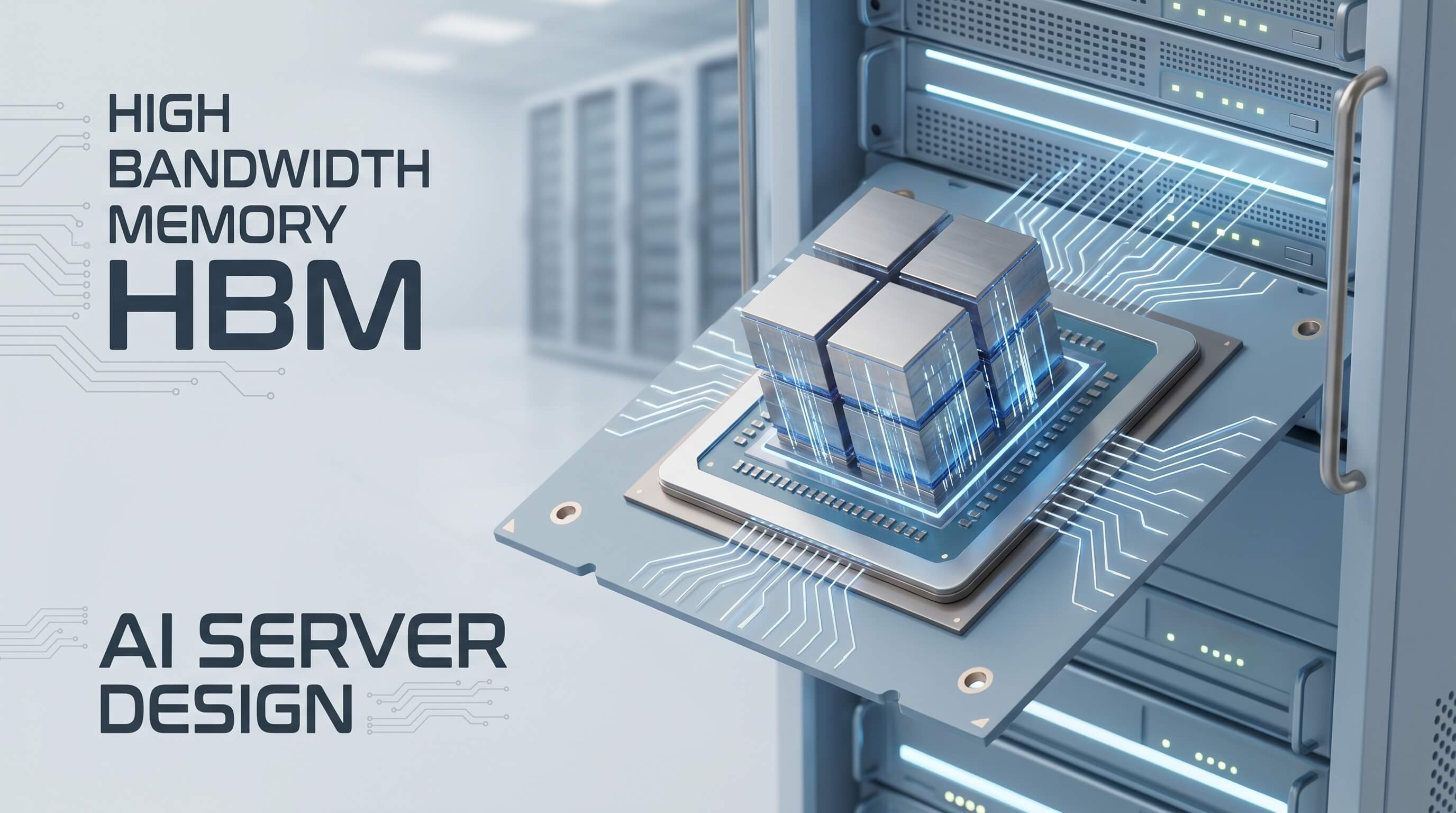
For years, AI hardware conversations were dominated by tensor cores, TOPS, and transistor counts. That framing is now incomplete. In modern training and inference systems, High Bandwidth Memory, not raw arithmetic throughput, is increasingly the binding constraint. Vendors can keep adding compute units, but if those units cannot be fed with enough data at low enough latency and within a reasonable power envelope, the extra silicon does not translate cleanly into useful performance.
This is why HBM has become the force shaping AI chip roadmaps and server design at the same time. It affects how large an accelerator package can be, how much memory can sit next to the die, which substrates and interposers are required, how many chips fit in a node, what the rack cooling strategy looks like, and even which suppliers can ship volume on schedule. The practical result is simple: in 2026, AI infrastructure planning is as much a memory and packaging problem as it is a compute problem.
Why HBM changed the balance
HBM solves a specific problem that ordinary server DRAM and even advanced GDDR cannot solve well enough for frontier AI workloads. Large models move enormous amounts of weights, activations, and KV cache data. That means many operations are memory-bandwidth-limited rather than pure compute-limited. HBM addresses this by stacking DRAM dies vertically and placing them close to the compute die through advanced packaging, typically on a silicon interposer or similar high-density bridge.
The payoff is dramatic bandwidth. A current AI accelerator can pair multiple HBM stacks with aggregate memory bandwidth measured in the multi-terabyte-per-second range. That is the right order of magnitude for feeding large matrix engines efficiently. Traditional DDR5 memory in a CPU server, even across many channels, operates far below that class of bandwidth. GDDR can help in some designs, but it comes with different tradeoffs in power, signaling, board complexity, and latency behavior. For the highest-end AI accelerators, HBM is no longer optional because it is the only memory technology that keeps the compute block busy enough.
Compute is scaling faster than memory economics
Chip vendors can keep increasing transistor budgets with larger dies, chiplets, and more aggressive packaging, but HBM does not scale as cheaply or as smoothly. Each generation of accelerator tends to demand more memory capacity and more bandwidth per package. That means more HBM stacks, faster HBM generations, wider interfaces, and more demanding package integration. At some point, the design challenge stops being “how many compute units can we add” and becomes “how much HBM can we source, package, cool, and power around those compute units.”
This is why accelerator launches now read like packaging announcements as much as silicon announcements. When a vendor moves from one HBM generation to the next, the benefit is not just a benchmark uplift. It can alter model fit, reduce communication overhead, improve batch efficiency, and change the economic viability of inference for larger contexts. Capacity matters alongside bandwidth. If bandwidth feeds the engine, capacity determines what fits on-package before the system spills to slower tiers or requires more model parallelism.
Packaging is no longer a back-end detail
HBM’s importance pushes advanced packaging into the critical path. Integrating several HBM stacks beside a large logic die is not a routine assembly step. It requires sophisticated interposers or bridges, tight yield management, thermal engineering, and access to specialized capacity at a small set of manufacturing partners. The package is now part of the product’s competitive moat and part of its production bottleneck.
This has two consequences. First, yields matter more because a defect can waste a very expensive multi-component package, not just a single die. Second, the supply chain narrows. A high-end AI accelerator depends not only on the chip designer and foundry, but also on HBM suppliers, OSAT and advanced packaging capacity, substrate availability, and validation throughput. Even if compute silicon is ready, missing packaging or HBM volume can delay deployment or cap shipments.
The supply chain bottleneck is strategic, not temporary noise
HBM supply is concentrated among a small number of memory vendors. That concentration gives memory roadmaps unusual leverage over the AI market. When HBM allocations are tight, accelerator launches, cloud expansion plans, and OEM server programs all feel it. Buyers often talk about “GPU availability,” but what they are really experiencing is a combined constraint across HBM, packaging, and final system integration.
This also changes competitive dynamics. A chip vendor with an excellent architecture can still lose ground if it cannot secure enough HBM at the right speed grade or cannot reserve enough advanced packaging slots. Conversely, a vendor with better supply coordination may outperform on revenue and deployment share even if architectural differences are narrower than headlines suggest. In other words, memory procurement and packaging partnerships now influence market winners almost as much as core design.
Rack-level design follows the memory package
Once HBM defines the accelerator package, it starts shaping the whole server. More memory bandwidth and capacity usually accompany higher package power. That pushes node power upward, which then affects motherboard layout, voltage regulation, airflow, liquid cooling adoption, and rack density. An eight-accelerator server is not just a compute container, it is a thermal and power delivery problem wrapped around memory-rich packages.
At rack scale, the implications are even sharper. Denser accelerator nodes can improve compute per rack, but they also increase cooling demands, power distribution complexity, and serviceability constraints. If HBM enables more capable accelerators, operators may choose fewer but stronger nodes, or they may redesign fabrics and topologies to keep those expensive memory-heavy accelerators utilized. The balance between accelerator memory capacity, host CPU role, NIC bandwidth, and east-west network design becomes tighter because idle HBM-equipped accelerators are financially painful.
Why this matters for inference buyers
Inference customers often assume HBM matters mostly for large training clusters. That is a mistake. Inference for larger models, longer contexts, retrieval-heavy pipelines, and multi-tenant serving can become strongly memory-sensitive. HBM capacity determines whether a model fits efficiently on fewer accelerators. HBM bandwidth affects token throughput and latency consistency, especially when serving many concurrent requests or large KV caches.
For buyers, this means the right question is not “Which chip has the most TOPS?” but “How much effective model-serving work can this memory system sustain?” A cheaper accelerator with less HBM may look attractive on paper and then lose badly once batching, context growth, quantization limits, and spillover penalties are included. The total cost picture depends on usable memory footprint, interconnect overhead, and rack efficiency, not headline compute alone.
What buyers should do next
Procurement teams should evaluate AI platforms with HBM-first thinking. Check memory capacity per accelerator, aggregate bandwidth, packaging generation, thermals, and actual availability from the vendor channel. Ask whether the platform’s roadmap depends on a future HBM generation that may be supply-constrained. Validate whether your workloads are compute-bound, bandwidth-bound, or capacity-bound before standardizing on a fleet architecture.
The industry will keep marketing bigger compute numbers, but the more important reality is already visible: HBM now governs what high-end AI hardware can achieve, what it costs, and how fast it can ship. That makes memory the architectural center of gravity. The chips, servers, and racks are increasingly designed around that fact, whether buyers notice it or not.