Game Preservation Is Becoming a Live-Service Design Problem
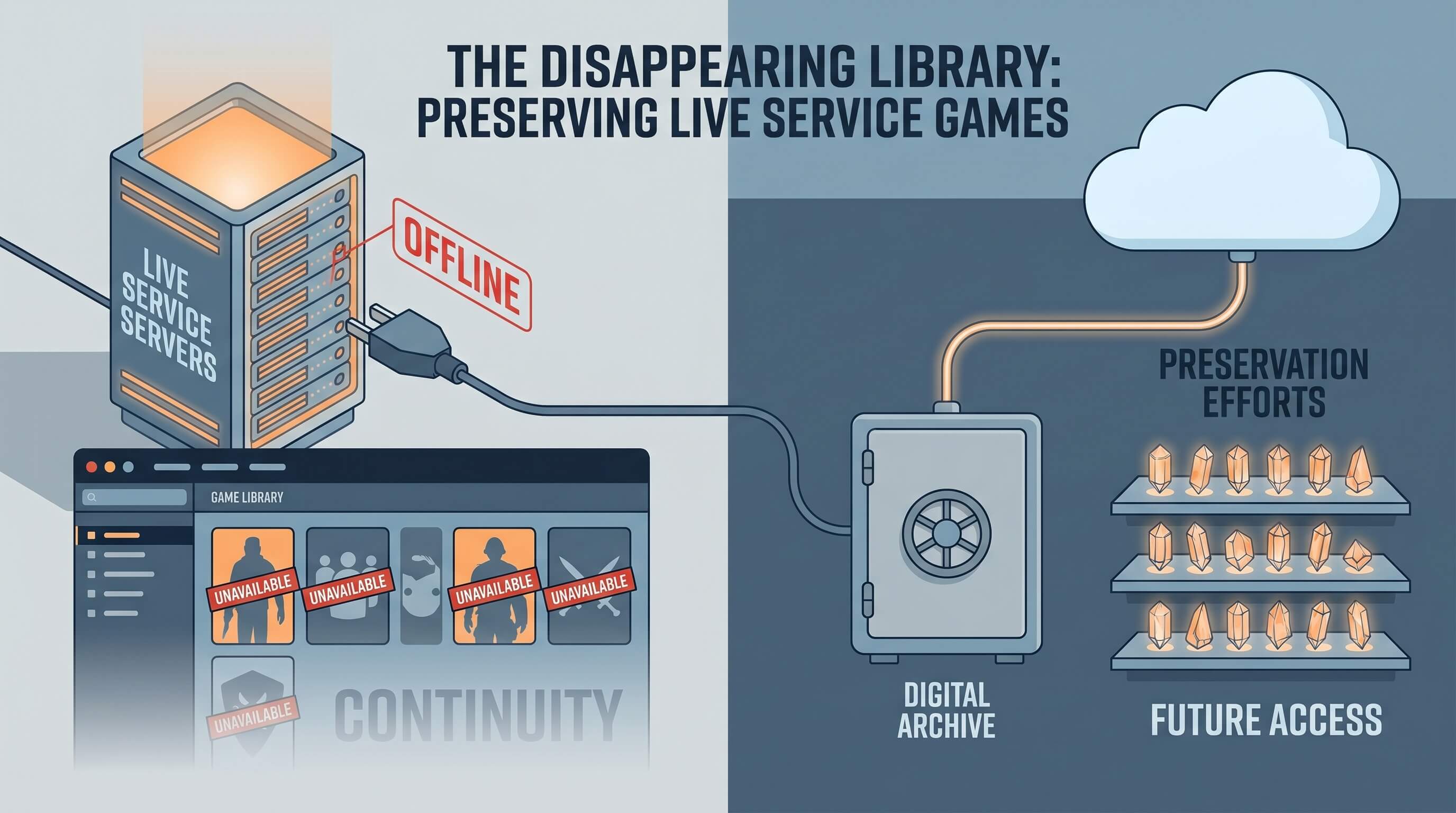
Game preservation used to sound like a retro problem. The typical image was a shelf of cartridges, aging optical discs, and volunteer archivists trying to keep old hardware alive. That picture still matters, but it no longer captures the center of the issue. In 2026, preservation is increasingly about games that are recent, profitable, and technically unavailable the moment a publisher turns off the service layer beneath them.
That is why preservation has become a live-service design problem rather than a museum-only concern. When progression, matchmaking, inventory, scripting, or even basic startup authentication depends on remote infrastructure, shutdown is not just an end-of-support event. It can become the instant conversion of a purchased or beloved game into a partial artifact. Players notice that gap, and it changes how they think about ownership, trust, and whether a studio deserves long-term loyalty.
Shutdowns changed the preservation argument
For years, live-service defenders could treat preservation complaints as niche or sentimental. The market assumption was that players cared primarily about whether a game was fun right now. That is still true, but repeated shutdowns have broadened the conversation. Players now have direct experience with games losing key modes, entire progression loops, or total accessibility because the online stack was never designed to survive a business decision.
The important shift is emotional as much as technical. A player may accept that a competitive service cannot run forever at full cost. What many do not accept is the idea that nothing usable should remain when commercial support ends. If a game included solo content, custom matches, creative tools, or private-server-friendly design paths, players increasingly expect some version of that value to persist.
This expectation is not irrational nostalgia. It comes from how games are marketed. Publishers sell cosmetics, battle passes, expansions, founders packs, and premium editions inside ecosystems that often feel less like temporary rentals and more like durable entertainment identities. When the system disappears completely, the mismatch between marketing language and practical ownership becomes impossible to ignore.
Preservation now starts at architecture
The core lesson for studios is that preservation cannot be bolted on at the end if the underlying design assumes permanent central control. If authentication, inventory, and world simulation are deeply entangled with back-end services, creating an offline or community-supported version later can become prohibitively expensive. By then the engineering team has moved on, the tools are internal-only, and the business case looks weak precisely because preservation was never scoped as a deliverable.
That is why the best preservation thinking now starts at architecture and product design. Which systems truly need central authority? Which ones could degrade gracefully? Can local play survive without the economy? Can solo progression be checkpointed without anti-cheat concerns? Could the final version of the game be patched to bypass an online dependency for non-competitive modes? These are design questions, not public-relations questions.
Offline modes are not a luxury feature
One of the clearest changes in player expectations is the status of offline modes. They used to be treated as an optional bonus in many connected games. Today they increasingly function as a trust signal. Even a limited offline mode tells players that the studio recognizes the difference between live operations and permanent access. It says the game was built with an exit path.
That does not mean every live-service title can or should promise a fully intact offline replica. Competitive economies, anti-cheat systems, and shared-world events complicate that idea. But studios can still make intentional choices. A preserved training mode, bot play, private lobbies, local save export, or an end-of-life community server toolkit can preserve more than people assume. The binary between full live service and total disappearance is often a design failure, not a law of nature.
Community trust is now part of the economics
Studios sometimes frame preservation as a cost center, but that view is getting narrower. Community trust has economic weight. Players remember which publishers strand purchases, erase progress, or remove access without a serious transition plan. That memory affects sequel adoption, premium spending, and the credibility of future service promises.
In other words, preservation is becoming part of live-service brand management. A thoughtful shutdown plan can soften backlash and protect reputation. A careless shutdown can teach customers that every future purchase from the same company should be discounted for platform risk. In an industry already struggling with retention and rising acquisition costs, that is not a small issue.
What studios can do differently now
Studios do not need a universal preservation template, but they do need explicit policy. First, they should classify modes by preservation feasibility during development, not at sunset. Second, they should separate business-critical service dependencies from gameplay dependencies whenever possible. Third, they should document what would be required to release a final offline build, local server option, or community maintenance package if the title is retired.
Legal and licensing review matters too. Music rights, engine middleware, anti-cheat agreements, and third-party hosting contracts can all block end-of-life access if they are ignored early. A preservation-minded team asks these questions before launch because late surprises usually arrive when budgets and staffing are lowest.
Communication also matters. Players respond better when studios are honest about what will and will not survive. A preservation policy does not have to promise immortality. It has to define the exit conditions clearly enough that customers can judge the tradeoff before they invest years of time and money.
The industry is moving toward a new standard
The broader trend is clear. As games become more service-shaped, preservation stops being a specialist demand and becomes a test of product stewardship. Players are not only buying entertainment moments. They are buying into ecosystems, social spaces, and long-tail habits. When those systems shut down, the absence of a preservation path feels less like ordinary obsolescence and more like preventable design negligence.
Studios that understand this early can design for graceful endings without undermining live-service ambition. That is the real opportunity. Preservation does not have to be anti-service. It can be the discipline that forces service games to think responsibly about what remains when the service ends. In the next phase of the market, that may become one of the clearest markers of whether a studio respects players as customers only for today, or as communities worth keeping faith with over time.