Game Engines Are Becoming the Top Training Ground for AI Agents
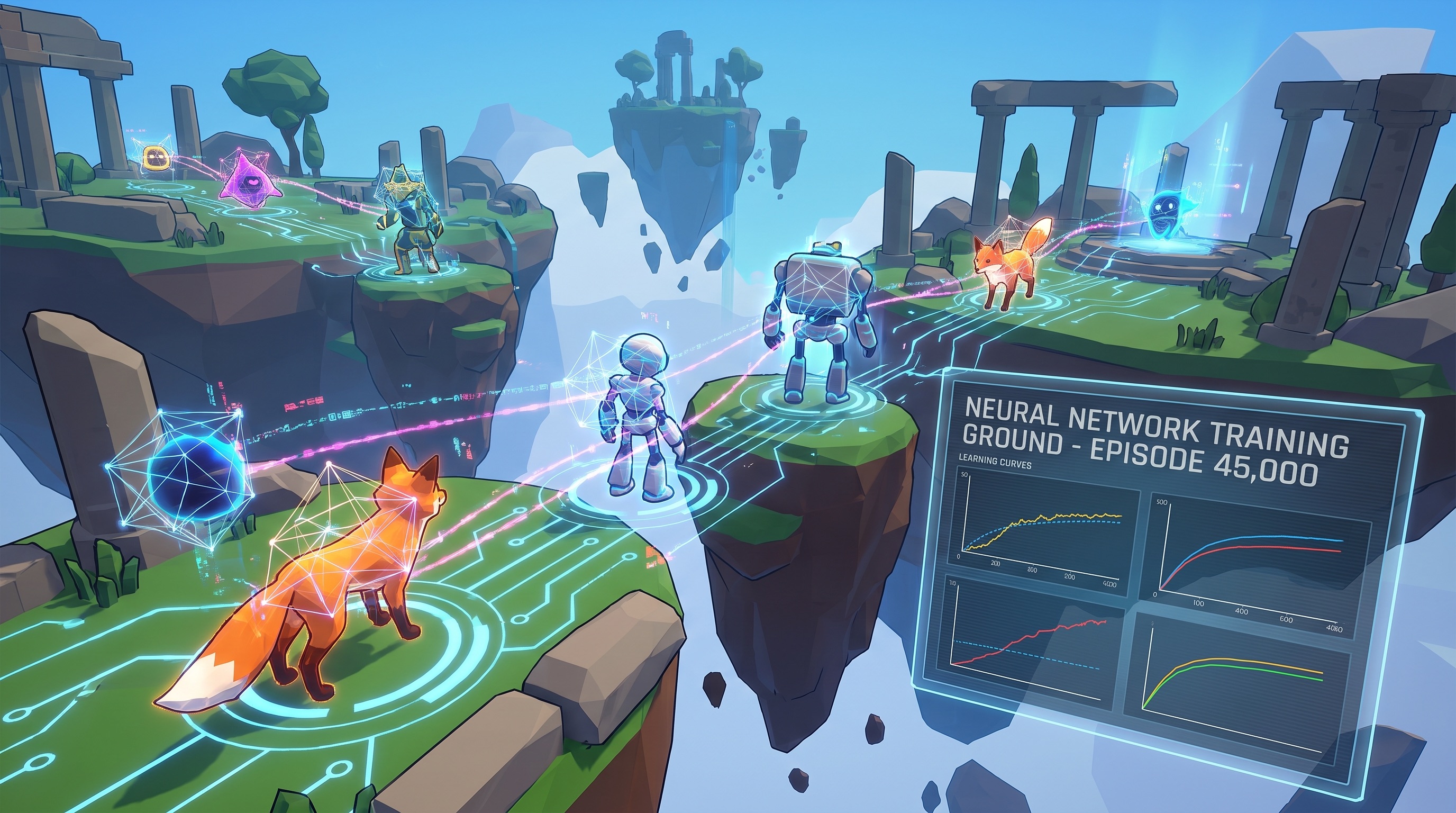
General Intuition's $320M Bet Explains a Shift That Has Been Building for Years
In June 2026, AI startup General Intuition raised $320 million from Khosla Ventures, General Catalyst, and Jeff Bezos. The premise: training AI agents on millions of hours of video gameplay produces agents that understand actions, consequences, and real-world decision-making better than agents trained on text alone.
That is not a novel idea — it is a well-funded culmination of research that has been accumulating since DeepMind's AlphaGo in 2016 and reinforcement learning breakthroughs that followed. What has changed is the scale, the tooling, and the explicit commercial ambition. Game engines are no longer an academic curiosity for AI research. They have become infrastructure.
Why Video Games Make Exceptional Training Environments
Training an AI agent to act in the world requires a simulation where the agent can try, fail, and try again — billions of times, without breaking anything real. Physical-world simulation is expensive and slow. A robot arm can make a few hundred attempts per day in the real world. In a physics simulation inside a game engine, that same arm can make millions of attempts overnight.
But there is more to it than raw speed. Game environments have properties that are uniquely valuable for agent training:
- Dense reward signals. Games are designed to give feedback constantly — points, health, proximity to objectives, mission completion. This is exactly what reinforcement learning algorithms need. Real-world tasks rarely provide clear reward signals this frequently.
- Procedural generation. Modern game engines can generate infinite variations of environments: different layouts, lighting conditions, obstacle configurations, and physics parameters. This variety is critical for producing agents that generalize beyond their training distribution rather than memorizing a fixed set of scenarios.
- Cheap failure. An agent that misjudges a jump in a game engine loses a few seconds of simulation time. An agent that misjudges a navigation decision on a factory floor costs real money and may cause real harm. Games make failure disposable, which accelerates learning by orders of magnitude.
- Ground truth data. Every event in a game engine is logged with perfect fidelity — position, velocity, action taken, reward received. The messy sensor noise and partial observability of the real world do not exist inside the simulation.
The Engines of Choice — and Why They Matter
The most widely used game engines for AI training are Unity and Unreal Engine, with OpenAI Gym and NVIDIA's Isaac Sim (built on Omniverse) serving specialized robotics and physics simulation use cases.
Unity ML-Agents Toolkit was one of the first frameworks to formalize game-engine-as-training-ground for AI. It provides a standard interface between a Unity scene and Python-based reinforcement learning algorithms, has been used in thousands of academic papers, and is the backbone of many commercial agent training pipelines.
Unreal Engine 5 has become increasingly important for photorealistic training environments where visual fidelity matters — autonomous vehicle simulation, drone navigation, and embodied AI research where the gap between simulation and reality (the "sim-to-real transfer problem") is a critical concern. More realistic visuals reduce that gap.
NVIDIA Isaac Sim, built on the Omniverse platform, targets robotics specifically. It provides physically accurate simulation of robot kinematics, sensors (LIDAR, cameras, IMUs), and complex environments. Boston Dynamics, Figure, and other humanoid robot companies use Isaac Sim or similar platforms to pre-train their robots' manipulation and navigation policies before deploying to hardware.
What Gameplay Data Teaches AI That Text Cannot
Large language models trained on internet text are extraordinarily capable at reasoning, writing, and knowledge retrieval. But text is a compressed, static representation of the world. It describes what happened; it does not show how to act.
General Intuition's thesis — and the broader research literature it draws on — is that gameplay data encodes something different: causal, sequential, embodied decision-making. A model that has watched (or played) a million hours of Minecraft has implicitly learned how three-dimensional spaces connect, how resources need to be gathered before tools can be built, how to navigate toward a goal across a complex terrain.
The DeepMind SIMA project, announced in early 2024 and expanded significantly in subsequent years, trained a generalist agent across nine commercial video games and found that agents trained on diverse game environments transferred strategies to novel games and even to real-world robotic tasks more effectively than agents trained on robotics simulation alone. The breadth of the game training distribution matters as much as the volume.
The Sim-to-Real Transfer Problem — and Progress on It
The persistent challenge with game-engine training is transferring policies to physical hardware. A robot trained in simulation to pick up objects will often fail on a real robot because the simulation's physics, friction, and visual rendering do not exactly match reality.
Several techniques have reduced this gap meaningfully:
- Domain randomization: Randomly varying physics parameters, lighting, and textures during training forces the agent to develop policies robust to those variations, rather than memorizing a specific simulated configuration.
- Photorealistic rendering: Unreal Engine 5's Lumen and Nanite systems produce visuals close enough to real camera footage that agents trained in UE5 environments show reduced sim-to-real gaps compared to older, lower-fidelity engines.
- Real-data fine-tuning: Training a policy in simulation, then fine-tuning it on a small amount of real-world data, has become the standard pipeline for commercial robotics deployments. The simulation provides the "curriculum"; real data corrects the residual domain gap.
Beyond Robotics: Game-Trained Agents in Software
Game engine training is not limited to physical robotics. The same approach is being applied to software agents — AI systems that navigate graphical user interfaces, operate web browsers, fill out forms, and interact with desktop applications.
Microsoft Research's Cradle project and Anthropic's computer-use agent work both draw on the insight that GUI navigation shares structural properties with video game navigation: both involve identifying actionable elements in a visual scene, selecting an action, observing the result, and adjusting strategy. Training on gameplay builds the underlying spatial and sequential reasoning capacity that transfers to both.
Actionable Takeaways
- If you are building AI agents that interact with physical environments or complex UIs, game engine simulation should be in your architecture. The tooling (Unity ML-Agents, Isaac Sim, Unreal Engine with Python bridges) is mature and well-documented.
- Diverse training environments matter more than volume alone. An agent trained across 20 different game environments will generalize better than an agent trained on 10× more data from a single environment.
- Sim-to-real transfer is a solvable engineering problem, not a fundamental barrier. Domain randomization plus a small real-world fine-tuning dataset is the current best practice for most robotics applications.
- Watch the General Intuition thesis play out. If gameplay-trained agents outperform text-trained agents on general task completion, the implications for agent architecture extend far beyond robotics — into any domain where sequential decision-making matters.