Game Engines Are Becoming the Default Tools for Virtual Production
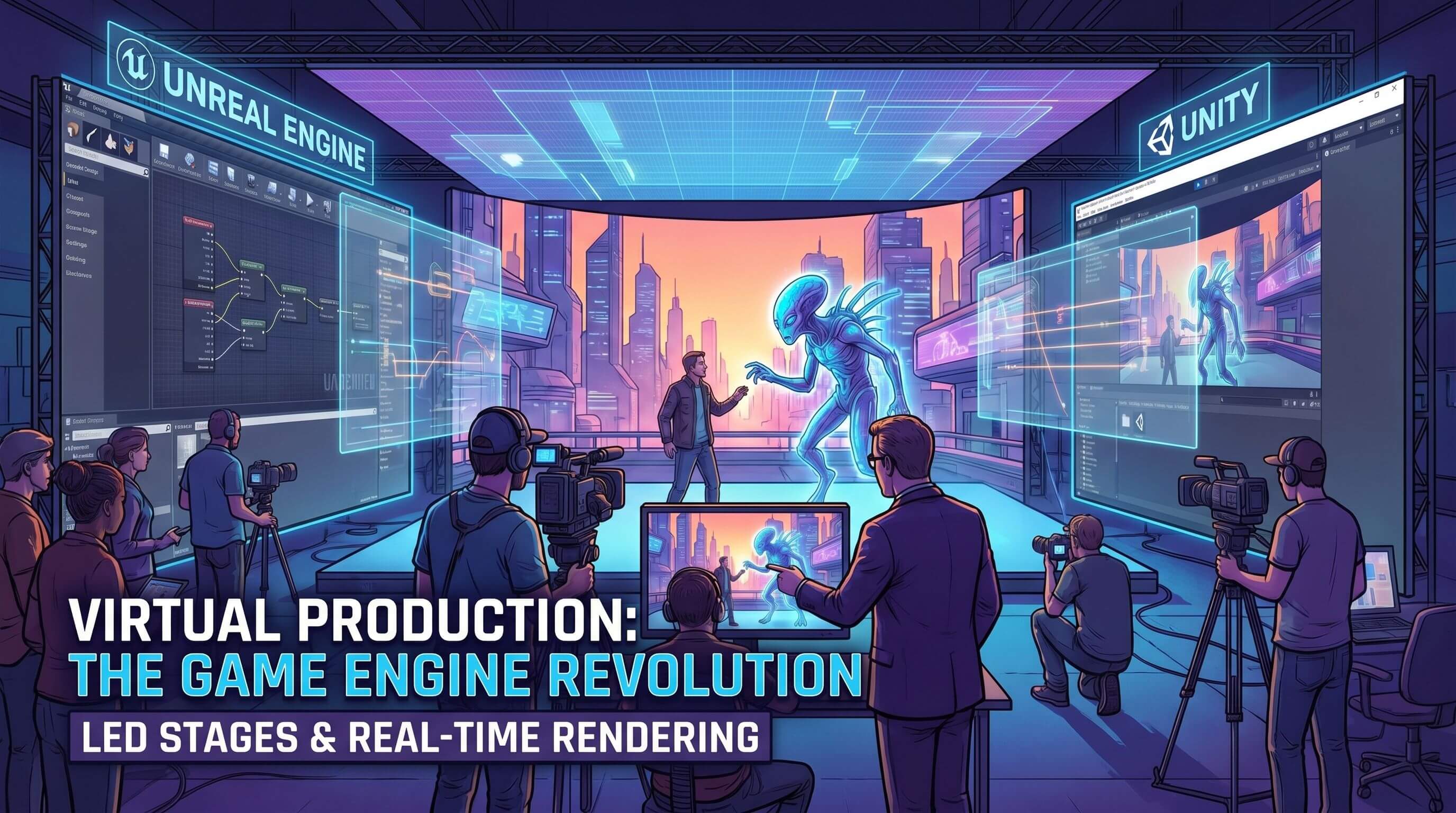
Virtual production used to sound like a specialized edge case, a flashy add-on for major studios with experimental budgets. That is no longer the right frame. Increasingly, game engines are becoming the default software layer for a wide range of production work, from previsualization and digital scouting to LED volume shoots, live compositing, and on-set iteration. What began as a borrowing of tools from games now looks more like a structural merger of workflows.
The thesis is straightforward: film and episodic production are moving closer to real-time pipelines because real-time tools solve practical coordination problems. Unreal, Unity, and adjacent ecosystems let teams see scenes earlier, revise faster, synchronize departments more tightly, and carry assets through more stages of production. The important story is not that cinema is turning into a video game. It is that the economics and tempo of production increasingly favor tools built for immediate feedback.
Why real-time wins inside production schedules
Traditional CG-heavy pipelines often separated departments by long handoff cycles. A director might wait for updated lighting, layout, or environment work; cinematography decisions could remain partly abstract until later renders arrived; production design choices might be locked before everyone had seen how assets behaved in context. Real-time engines compress those loops. They allow directors, VFX supervisors, and virtual art departments to test composition, lensing, blocking, and environmental changes in near real time.
That speed matters because production is full of expensive uncertainty. If a team can answer creative questions before a physical shoot, it reduces downstream waste. If it can answer them during a shoot, the value is even larger. LED volumes turned this from a theoretical advantage into a highly visible one. Suddenly a game-engine-driven environment was not just a planning tool. It became part of principal photography itself, influencing lighting, camera movement, and actor interaction on set.
Unreal has momentum, but the deeper story is pipeline logic
Unreal often gets the headline because it has become closely associated with high-end virtual production, especially in LED workflows and photoreal rendering. Unity remains influential in visualization, simulation, and cross-domain interactive work. But focusing only on an engine brand misses the bigger point. Production teams are standardizing around pipeline logic that originated in games: scene graphs designed for iteration, reusable assets, versioned environments, real-time shaders, and toolchains that support collaborative adjustment rather than late-stage reveal.
This changes expectations across departments. A previs team is no longer just storyboarding in motion. It may be building assets that later feed into techvis, virtual scouting, and final-stage environment work. Asset continuity becomes more valuable than one-off output. Decisions made early can travel farther. When that works, the engine is not a sidecar. It is the connective tissue of the production pipeline.
The talent market is being redrawn
One of the clearest consequences is in hiring. Studios and vendors increasingly want artists and technicians who are comfortable crossing the boundary between game and film workflows. Real-time lighting, technical art, Blueprint-style logic, environment optimization, shader literacy, and engine-level debugging are no longer niche skills in entertainment production. A virtual production stage may need people who understand camera tracking, performance constraints, color pipelines, asset streaming, and cinematography vocabulary at the same time.
That is reshaping career paths. Game developers can move into film-adjacent roles without abandoning their core tooling. Film artists are being pushed to learn interactive iteration, data hygiene, and engine-based scene management. Education providers are responding by blending curricula that used to sit in separate silos. The result is not perfect convergence, but a widening overlap in labor markets that would have looked unusual a decade ago.
Tooling is becoming more interoperable, not less
Another misconception is that game engines replace the rest of the production stack. In practice, they become central by integrating with many other tools. DCC packages, motion-capture systems, camera tracking, asset-management platforms, color pipelines, and compositing workflows all still matter. The difference is that the engine increasingly acts as a live coordination layer. It is the environment where many decisions become visible sooner and where cross-department feedback can happen with less delay.
This is why interoperability is becoming so important. Productions need assets to move from modeling to rigging to animation to rendering to on-set playback without constant destructive conversion. They need metadata continuity, version control, and predictable handoffs. Engine adoption therefore pushes teams to think more like software organizations. Pipeline robustness, not just artistic output, becomes a competitive advantage.
What this means for production economics
Real-time workflows do not automatically make filmmaking cheap. They often shift costs forward into asset preparation, technical planning, and pipeline engineering. A production that wants the benefits of virtual production has to invest earlier in standardized assets, calibrated environments, and team coordination. But that front-loading can reduce uncertainty later, which is often where productions bleed money through reshoots, last-minute fixes, and fragmented post schedules.
This is why game-engine adoption keeps spreading even beyond blockbuster spectacle. Commercial shoots, broadcast packages, branded content, live events, and smaller narrative productions all benefit from faster visualization and tighter iteration. The return is not only photoreal backgrounds. It is a production process that can answer more questions while the cost of changing course is still manageable.
The line between game development and film production keeps fading
The most durable effect may be cultural. Game development has long been organized around playable, inspectable worlds. Film production has traditionally revealed many of its final qualities later in the process. Virtual production narrows that gap by making more of the world visible and adjustable earlier. The mindset of building a scene that people can enter, test, and revise in real time is becoming normal in screen production.
That does not mean every film team will suddenly operate like a game studio, or that real-time engines will replace offline rendering everywhere. High-end final pixels will still use mixed approaches, and many productions will combine real-time and traditional methods. But the center of gravity is moving. More decisions are being made inside engines, more departments are orienting around shared real-time assets, and more talent is being hired for hybrid literacy.
In that sense, Unreal and Unity are not just useful tools borrowed from another industry. They are becoming default environments for coordinating creative intent, technical execution, and schedule risk. Virtual production is making the relationship between games and film less metaphorical and more operational. The studios that understand this early are not merely adopting new software. They are rebuilding their pipelines around the idea that seeing sooner, iterating faster, and sharing live context is now the baseline advantage.