Model Routing Is Becoming the Control Plane for Enterprise AI
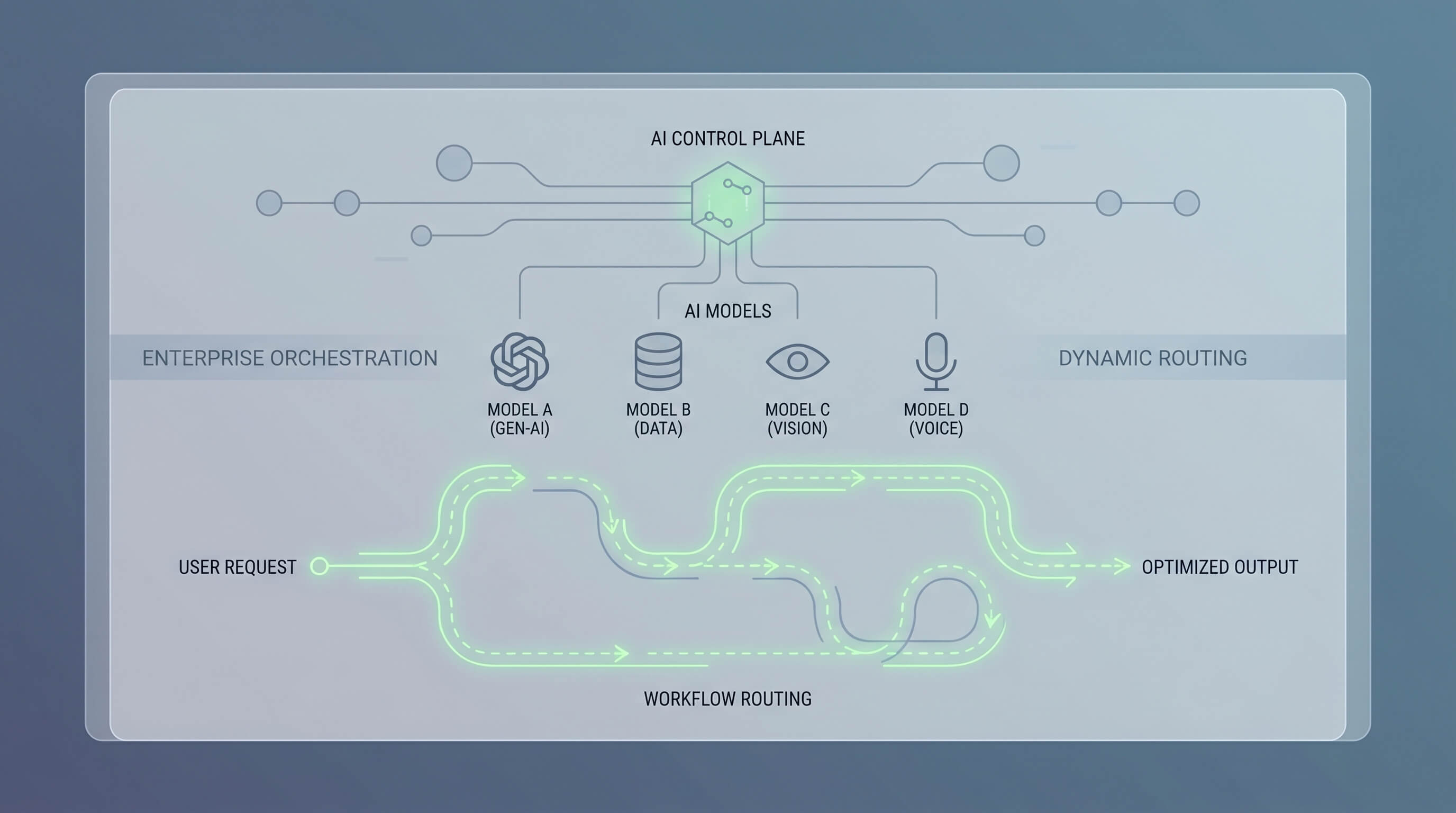
Enterprise AI is moving past the phase where success depends on picking a single flagship model and wiring it into a chatbot. As copilots and agents spread into support, operations, legal review, software delivery, and internal search, the real challenge becomes control. Which model should handle which task? When should a workflow escalate from a cheap model to a more capable one? What happens when data residency, latency, or auditability requirements conflict with pure benchmark performance? The organizations that scale AI well are increasingly answering those questions with a routing layer, not with a model loyalty strategy.
That routing layer is turning into the control plane for enterprise AI. It decides how requests are classified, how models are selected, when tools are invoked, how guardrails are enforced, and how quality is measured over time. In practice, this means the most durable enterprise AI architecture is not “one app, one model,” but “many tasks, one governed orchestration layer.” Copilots and agents may be the visible interface, but model routing is what makes them economically viable, operationally safe, and adaptable as the model landscape keeps changing.
Why a single-model strategy breaks down
In prototypes, a single strong model looks efficient. Teams move quickly, the demo works, and architecture stays simple. In production, that simplicity becomes expensive and brittle. Not every request needs the most advanced reasoning model. Not every workflow can tolerate the same latency. Not every data class can be sent to the same provider. And not every failure mode can be caught at the prompt layer.
An enterprise copilot handling thousands of daily interactions may face summarization, retrieval, classification, policy lookup, spreadsheet generation, and multi-step reasoning in the same hour. For some of those jobs, a fast low-cost model is enough. For others, especially ambiguous or high-risk tasks, the system may need a more capable model, a verification pass, or a human checkpoint. Without routing, the organization either overpays for routine work or underperforms on complex work. Often it does both.
Routing solves this by separating task intent from model identity. Instead of asking, “Which model runs our assistant?” enterprises can ask, “What is the cheapest, fastest, safest path to a good answer for this class of work?” That is a much more operational question, and much closer to how mature infrastructure teams think.
What model routing actually does
At its best, model routing is not just a switchboard. It is a policy engine backed by telemetry. It evaluates the request, the user, the context window, the tool requirements, the risk tier, and the service-level objective. Then it picks an execution path.
Common routing decisions include
Choosing between models based on cost, latency, domain fit, or compliance constraints.
Escalating hard queries when confidence scores are low or when earlier passes fail validation.
Sending structured extraction to a smaller model while reserving premium reasoning models for exception cases.
Applying region-specific routing for regulated data, such as keeping healthcare or financial workloads within approved providers and geographies.
Running secondary checks, such as hallucination detection, citation verification, or policy review, before a response reaches the user.
In other words, routing becomes the place where business rules and model behavior meet. That is why the control plane analogy matters. This layer does not just optimize inference. It governs AI operations.
Implementation patterns that work in the real world
The first useful pattern is tiered escalation. A support copilot might begin with a low-cost model for intent detection, knowledge retrieval, and draft response generation. If the request involves billing disputes, legal language, or frustrated customers threatening churn, the system escalates to a stronger model and attaches a policy validation step. This pattern reduces cost on the bulk of tickets while preserving quality where it matters most.
The second pattern is specialist routing. A software engineering assistant may use one model for code completion, another for repository-wide reasoning, and a third for security-focused analysis. The important shift is that the user experiences one assistant, while the platform decides which capability stack to invoke behind the scenes. This is often how enterprises hide model complexity from end users without giving up flexibility.
The third pattern is tool-first orchestration. In procurement, for example, an agent reviewing supplier contracts may call retrieval systems, policy databases, redlining tools, and approval workflows before it ever generates a natural-language answer. The router determines whether the task needs generation at all, or whether deterministic tools can answer most of it. That reduces hallucination risk and improves auditability.
A fourth pattern is judge-and-repair. In healthcare operations or insurance claims intake, one model extracts fields from unstructured documents, while another verifies schema consistency and flags anomalies. If extraction confidence falls below threshold, the workflow retries with a stronger model or routes to human review. This pattern treats models as components in a controlled pipeline rather than as one-shot oracles.
Concrete enterprise examples
A bank deploying an internal compliance copilot may route routine policy questions to a lower-cost model hosted within an approved environment, but escalate anti-money-laundering edge cases to a higher-reasoning model with mandatory citation checks and logging. The routing logic is driven less by model branding than by risk classification.
A global software company can route developer-assistant tasks by job type. Autocomplete and unit test drafting go to fast inference endpoints, while architecture review or migration planning uses a larger reasoning model with repository retrieval. Security scans may then be passed to a separate model tuned for vulnerability explanation. Users see one copilot, but the platform runs several specialized paths.
A healthcare administrator processing referral documents might use a compact model for OCR cleanup and metadata extraction, then a stronger model only when records are incomplete, contradictory, or likely to affect prior authorization decisions. This keeps throughput high while reserving expensive reasoning for exceptions.
An ecommerce marketplace may run customer service agents through a multilingual router that accounts for language, order value, fraud indicators, and refund policy sensitivity. A simple shipping question gets a cheap, fast answer. A suspected account takeover triggers a stricter workflow with verification and limited-generation policies.
What leaders should measure
Too many AI programs measure model quality only in benchmark-style terms. Routing shifts attention to system performance. Leaders should track cost per successful outcome, not cost per token alone. They should measure escalation rate, retry rate, human override frequency, latency by workflow tier, and policy violation rate. If a premium model produces only marginal gains on low-risk tasks, the router should learn from that. If a cheaper model causes downstream rework, that cost must be visible too.
This also means evaluation needs to happen at the workflow level. The right question is not whether one model outscored another on a public benchmark, but whether the overall orchestration improved business outcomes under enterprise constraints.
The strategic payoff
Enterprises that invest early in model routing gain something more valuable than short-term optimization. They gain optionality. Providers will change, models will improve, prices will drop, and governance requirements will tighten. A strong control plane lets organizations adapt without rebuilding every copilot and agent from scratch.
That is the deeper shift underway. The durable enterprise advantage in AI will not come from betting everything on one model vendor. It will come from building the orchestration layer that continuously matches the right model, tool, and policy to the job at hand. In the next phase of enterprise AI, routing is not plumbing. It is strategy made operational.