Edge Computing Is Now the Infrastructure Layer for Everything Physical
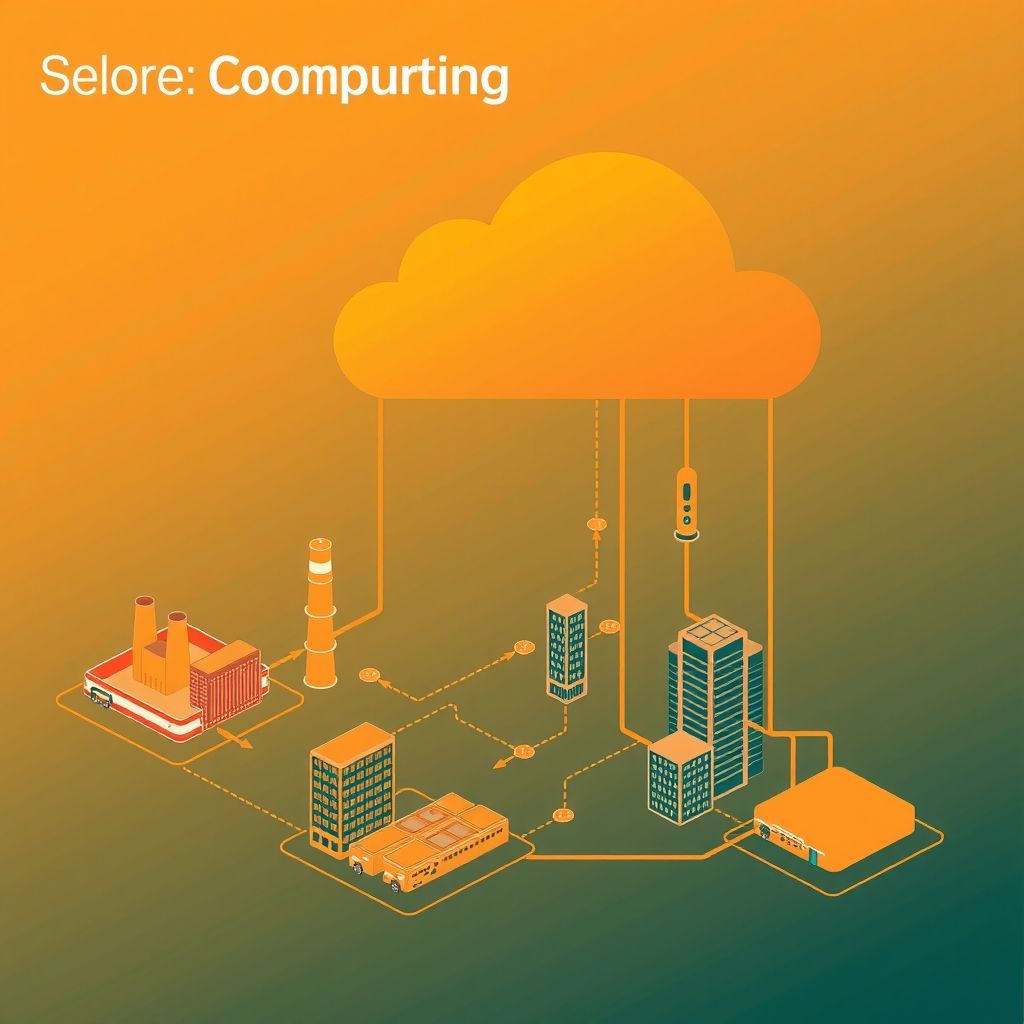
Cloud-First Is Over. Compute Is Moving Back to the Physical World.
For a decade, the default architecture was simple: send everything to the cloud, run logic there, return results. It worked because bandwidth was cheap, latency tolerances were loose, and centralized infrastructure was easier to manage. That equation has changed. A confluence of latency requirements, data sovereignty law, bandwidth economics, and a new generation of purpose-built edge hardware is forcing compute back toward the physical world. This is not a rollback to on-prem IT. It is a structural shift in where computation happens — and it is reshaping every industry that touches the physical world.
What "Edge" Actually Means in 2026
Edge computing is not a single location — it is a spectrum. Understanding the architecture requires being precise about where on that spectrum compute is placed:
- Device edge: Processing on the endpoint itself — a phone's neural engine, an industrial sensor with an embedded microcontroller, a camera running on-device object detection.
- On-premises edge server: A rack or appliance inside a factory, hospital, or retail store. Products like AWS Outposts, Dell EMC PowerEdge, and HPE Edgeline live here.
- Regional edge: Carrier-neutral data centers and CDN PoPs positioned 5–50ms from end users. Cloudflare's global network, AWS Wavelength nodes co-located inside telecom facilities, and Azure Edge Zones operate at this tier.
- Central cloud: Hyperscaler regions — us-east-1, eu-west-1 — where latency to a device in Stuttgart or São Paulo starts at 80ms and routinely exceeds 200ms under load.
A modern physical-world application routes workloads across all four tiers. Inference that needs <5ms runs on the device. Aggregation and anomaly detection run on the on-prem server. Analytics and model training go to regional or central cloud. The routing decision is the architecture.
The Latency Numbers That Actually Matter
The speed of light sets a floor: data traveling round-trip from a factory in Munich to an AWS Frankfurt region takes roughly 15–20ms under ideal conditions. To us-east-1 in Virginia, that becomes 180–220ms. Those numbers are not abstract:
- Autonomous vehicles processing LIDAR data and making steering corrections require decisions in under 2ms. A central cloud round-trip would mean the car has traveled several meters before a response arrives.
- Surgical robots used in minimally invasive procedures require haptic feedback latency below 10ms. At 200ms, the surgeon is essentially flying blind.
- Industrial automation on a stamping line running at 1,200 strokes per minute needs a control loop response in under 1ms. Edge PLCs and on-prem servers handle this; central cloud cannot.
- VR/AR headsets trigger motion sickness at rendering latencies above 20ms (the "motion-to-photon" threshold). On-device and regional edge inference keeps this manageable; central cloud does not.
For these applications, the cloud is not a viable architecture regardless of how fast the internet gets. The physics is the constraint.
The Bandwidth Economics of a Factory Floor
A modern factory with 500 IoT sensors — vibration monitors, thermal cameras, flow meters, quality vision systems — generates approximately 2TB of raw data per day. Sending that to a cloud region over a dedicated WAN link costs roughly $150–$300/month in data transfer fees alone, before compute. More critically, at peak production hours, the uplink bandwidth required exceeds what most industrial facilities have available.
The edge alternative: deploy an on-prem edge server running local ML inference. It processes sensor streams in real time, flags anomalies, and ships only a compressed event log — typically 5–15GB per day — to the cloud for longer-term analysis and model retraining. Bandwidth consumption drops 90–95%. Cloud compute costs drop proportionally. The on-prem server pays for itself inside six months in most mid-size manufacturing deployments.
Where This Is Already Running in 2026
Edge computing has moved well past pilot phase. Concrete production deployments include:
- AWS Outposts in hospital ICUs: Several major health systems in the US and EU have deployed AWS Outposts racks inside intensive care units. Real-time patient monitoring — ECG analysis, sepsis early-warning models, ventilator optimization — runs locally, with sub-10ms model inference, without patient data ever leaving the facility. Results are synced to central cloud for population analytics after de-identification.
- Cloudflare Workers at retail POS: Major retail chains run transaction processing, fraud scoring, and inventory adjustment logic inside Cloudflare Workers at the regional edge. When a central cloud region has an outage, the store keeps operating. Latency for checkout flows drops from 80ms to under 10ms.
- Siemens edge nodes in discrete manufacturing: Siemens Industrial Edge deploys standardized edge devices running containerized apps directly on the factory floor. Vision inspection, predictive maintenance on CNC machines, and real-time OEE (Overall Equipment Effectiveness) calculation all run without a cloud dependency in the control path.
AI at the Edge: Inference Without the API Call
The growth of AI workloads is the most significant driver of edge compute demand in 2026. Every application that runs a machine learning model faces the same tradeoff: send data to a cloud LLM API, or run inference locally.
The hardware to run serious models locally now exists. NVIDIA Jetson Orin modules deliver up to 275 TOPS (Tera Operations Per Second) in a 15W envelope — enough for real-time object detection, defect classification, and small language model inference. Qualcomm Cloud AI 100 cards bring 400+ TOPS to industrial edge servers. These are not hobbyist boards; they are production hardware deployed by automotive OEMs and medical device manufacturers.
The case for local inference is not only about latency. Privacy is often the primary requirement: a hospital running diagnostic AI on radiology images cannot send those images to a third-party API. An industrial plant running quality inspection cannot expose proprietary process parameters to a vendor's cloud. And offline operation matters — a manufacturing cell that stops when the internet goes down is unacceptable in environments where network reliability is not guaranteed.
Private 5G as Edge Infrastructure
Private 5G networks are collapsing the distinction between wireless connectivity and edge compute. BMW operates private 5G at its Dingolfing and Leipzig plants, with edge nodes co-located inside the network to process machine vision and automated guided vehicle (AGV) coordination at under 5ms. Tesla's Gigafactories run similar architectures. DHL and DB Schenker have deployed private 5G with edge compute at major logistics hubs for real-time parcel tracking, dock orchestration, and robot fleet management.
The key advantage: private 5G gives the facility control over the wireless medium, Quality of Service (QoS) guarantees, and physical data containment. Combined with an on-prem edge server, it creates a fully self-contained compute environment that happens to support thousands of connected devices with carrier-grade reliability — entirely independent of the public internet.
Data Sovereignty: The GDPR Argument for Edge
European manufacturers face a structural compliance problem when using US-headquartered cloud providers. Production data — machining parameters, yield rates, process recipes — often constitutes trade secrets and is subject to national industrial data protection frameworks. GDPR, combined with the EU Data Act and several national industrial data laws, creates significant legal exposure when production data transits to US cloud regions, even encrypted.
Edge computing resolves this at the infrastructure level. If data is processed and stored on-premises within the EU, cross-border transfer rules do not apply. Several German automotive suppliers have re-architected away from central cloud processing entirely for production-line data, keeping cloud connectivity only for non-sensitive workloads like sales analytics and HR systems.
Writing for the Edge: The Developer Shift
Building for edge runtimes is meaningfully different from building for centralized cloud. The primary platforms in 2026:
- Cloudflare Workers: JavaScript/TypeScript and WebAssembly runtime running in 300+ PoPs globally. Stateless by default; state via Durable Objects and KV. Cold start is zero (always-on isolate model). Ideal for request-time logic, A/B testing, auth, and API routing.
- AWS Greengrass: Deploys containerized Lambda functions and ML models to on-prem devices. Integrates with AWS IoT Core for device management and shadow state sync. Strong for brownfield IoT where AWS is already the cloud layer.
- Azure IoT Edge: Container-based runtime that runs Azure services and custom modules on edge devices. Native integration with Azure Machine Learning for model deployment at scale across device fleets.
Developers writing for edge must internalize constraints that do not exist in central cloud: memory limits are tight (Cloudflare Workers caps at 128MB), execution time is bounded, storage is expensive and limited, and network calls to central services add latency that defeats the purpose of edge placement. The mental model shifts from "infinite cloud resources, just pay more" to "constrained compute, do only what must be local."
Honest Limitations
Edge computing is not a free lunch. The operational complexity it adds is real:
- Firmware and software updates across hundreds or thousands of distributed edge devices require a robust device management platform. A failed update on a remote edge node can take a production line offline.
- Physical security is a genuine concern. A cloud server in a hyperscaler data center has multi-layer physical security. An edge node in a retail back room or an outdoor telecom cabinet does not. Tamper detection, encrypted storage, and hardware security modules are necessary, not optional.
- Observability is harder. Distributed edge infrastructure requires purpose-built monitoring. Applying cloud-native observability tools naively to edge fleets produces alert storms and missed failures.
- Vendor fragmentation remains a problem. AWS Greengrass, Azure IoT Edge, and Cloudflare Workers are not interoperable. Edge workloads written for one platform do not port cleanly to another.
When to Choose Edge vs. Cloud: A Decision Framework
The choice is not ideological — it is engineering. Apply this framework:
- Choose edge if latency requirements are below 20ms, if data sovereignty law prohibits cloud transfer, if bandwidth costs at scale are prohibitive, if offline operation is required, or if the data contains sensitive attributes that cannot leave the facility.
- Choose cloud if the workload is latency-tolerant (analytics, reporting, batch ML training), if global scale and elasticity are required, if the team lacks operational capacity for distributed edge management, or if the use case is not safety-critical.
- Use both in a tiered architecture for almost every physical-world application at scale. Edge handles the real-time control path; cloud handles aggregation, retraining, and business intelligence.
The infrastructure layer for everything physical is not the cloud and it is not edge exclusively — it is a deliberate allocation of compute across the spectrum, matched to the physics and economics of each workload. Organizations that architect for this tiered model now will have a structural advantage over those retrofitting edge onto a cloud-first design later.