Custom ARM server chips are eating into x86's cloud data center dominance
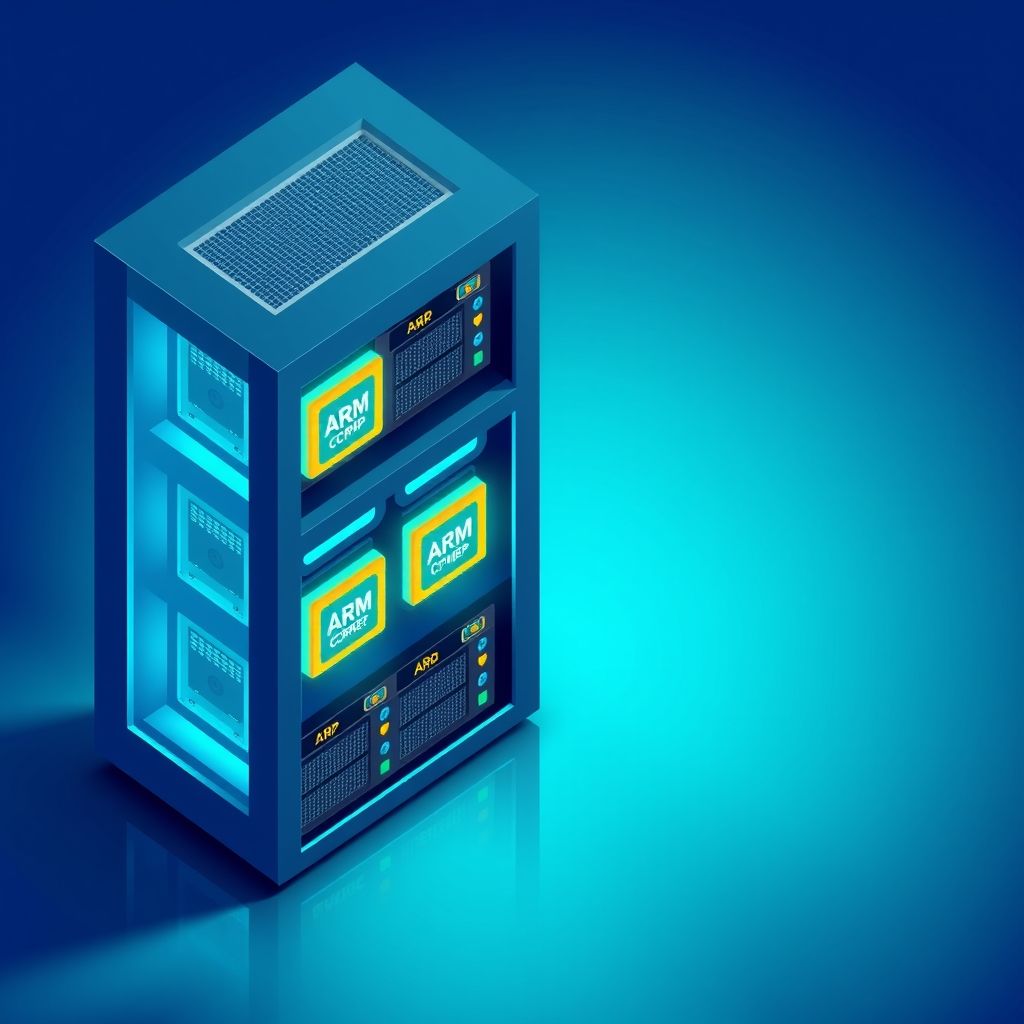
For two decades, "server" meant x86 — an Intel or AMD chip, running the same instruction set whether it sat in a bank's data center or a startup's rack at a colocation facility. That assumption is breaking down inside the three biggest cloud providers. AWS, Google Cloud, and Microsoft Azure have each spent the past several years designing their own Arm-based server CPUs, and by mid-2026 those chips account for a large enough share of new hyperscaler compute capacity that x86 is no longer the automatic default it used to be.
The numbers behind the shift
Arm's penetration of server CPU shipments climbed from roughly 5% in 2020 to somewhere in the 15-23% range in 2025, according to semiconductor analysts tracking the category. The more striking figure came out of sessions at Computex 2026: research presented there put Arm-based chips at close to half of hyperscaler compute capacity — not shipment count, but actual deployed capacity across AWS, Google, and Microsoft combined. The Arm-based server market itself has grown from roughly $5.8 billion in 2023 to an estimated $8.2 billion in 2026.
That growth hasn't come at the expense of AMD, interestingly. Server CPU shipment growth estimates for AMD were revised upward from 14% to 23% for 2026, and Intel's own projection moved from a 3% decline to 3% growth. The pie is growing fast enough that Arm's gains and AMD's gains are happening at the same time — it's legacy Intel x86 share, not the x86 architecture broadly, that's losing the most ground.
Three chips, three different bets
AWS pushed furthest first. Graviton5, generally available since June 10, 2026, packs 192 Arm Neoverse V3 cores across four chiplets built on TSMC's 3nm process, with 192MB of L3 cache, DDR5 memory, and PCIe Gen 6 — a five-fold cache increase over Graviton4 and a claimed 25% performance uplift. AWS built it explicitly around "agentic AI era" workloads: inference serving, retrieval pipelines, and the kind of bursty, memory-hungry request patterns that AI agents generate rather than classic batch computing.
Google Axion takes a different angle, positioned as the CPU half of a matched pair with Google's TPU v8 racks. Google claims Axion delivers 30% better performance than competing Arm cloud instances and 60% better energy efficiency than comparable x86 instances — efficiency being the operative word, since Axion's job is largely to feed data into and out of TPUs without becoming the power or thermal bottleneck in that pipeline.
Microsoft's Cobalt is the quietest of the three but arguably the most production-proven at this point: it's running live workloads across Azure regions today, with customers like Databricks running production data platforms on it rather than just pilot deployments. Unlike Graviton and Axion, which lean into AI-adjacent framing, Microsoft has marketed Cobalt more plainly as a general-purpose cost and efficiency play for ordinary Azure compute.
Why hyperscalers control their own silicon now
Designing a server CPU from scratch is not a decision cloud providers made lightly — it requires years of chip engineering investment most software companies never touch. The payoff is control over a variable that used to sit entirely with Intel and AMD's product roadmaps: performance-per-watt at data center scale. Power is now the binding constraint on how much compute a hyperscaler can physically deploy, given grid interconnection limits and the enormous power draw of AI training and inference clusters. A CPU designed in-house can be tuned specifically for the mix of workloads that provider actually runs, rather than the general-purpose profile a merchant chipmaker has to target to serve everyone.
That's also why Nvidia's Grace CPU — an Arm-based chip built to sit directly next to Nvidia's GPUs on the same board — matters here too, even though Nvidia isn't a cloud provider. It's the clearest evidence that Arm's advantage in this cycle isn't really about instruction set licensing costs; it's about which architecture lets a chip designer build the exact CPU-memory-interconnect combination their specific accelerator or workload needs, instead of buying whatever Intel or AMD shipped that year.
What this means for AMD, Intel, and independent Arm vendors
AMD's server growth acceleration suggests it's captured share from Intel rather than losing ground to Arm — EPYC remains the default merchant x86 choice for workloads that aren't run by a hyperscaler with its own silicon program. Intel's return to positive growth is a smaller win, but a real one after years of server share erosion. The company left out of the hyperscaler-captive-silicon trend is Ampere Computing, the independent Arm server chip designer whose AmpereOne processors compete directly with Graviton and Axion for the customers who don't want to build their own chip — cloud providers below the top three, and enterprises running Arm workloads in colocation rather than hyperscaler clouds.
What this means if you're choosing where to run workloads
For engineering teams evaluating cloud instance types, the practical question has shifted from "is Arm mature enough" to "which workloads should move first." Stateless, horizontally-scaled services — web tiers, API gateways, inference serving — tend to see the clearest price-performance gains on Graviton or Axion instances, often 20-40% lower cost for equivalent throughput, provided your build pipeline already produces Arm64 binaries or your language runtime abstracts the difference (Go, Java, most interpreted languages migrate with minimal changes; C/C++ codebases with architecture-specific intrinsics need real porting work). The chips that used to be a niche cost-optimization for a subset of workloads are now the default AWS, Google, and Microsoft want new capacity to run on — which means benchmarking your own workload on Arm instances is no longer optional due diligence, it's catching up with where the infrastructure already is.