Copper finally hit its limit inside AI data centers, and light is taking over
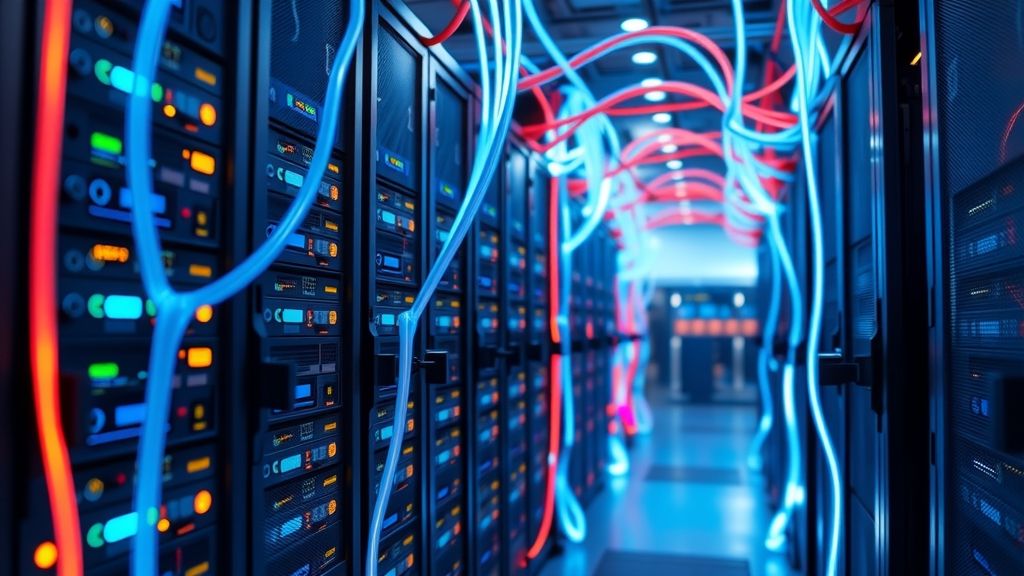
Copper wiring has run out of runway inside AI data centers. At the data rates modern GPU clusters now require, electrical signals degrade over distance fast enough that copper simply can't carry them the lengths a data center needs — not without burning enormous amounts of power to compensate. That physical wall is why 2026 is the year silicon photonics and co-packaged optics (CPO) stopped being a roadmap slide and started shipping in real hardware, with Nvidia and Broadcom leading a transition that will reshape how AI infrastructure gets built and priced.
Why copper broke first
The problem isn't bandwidth in the abstract — it's bandwidth per watt per meter. As GPU clusters scaled from thousands to hundreds of thousands of chips, the interconnect between them became the bottleneck, not the chips themselves. Copper's signal loss increases sharply as you push data rates higher over any meaningful distance, which means engineers either keep components unrealistically close together or spend an increasing share of the power budget just re-amplifying signals mid-cable. Neither option scales to million-GPU clusters, which multiple hyperscalers are now openly targeting for their next-generation AI factories.
Optical signals don't have this problem the same way. Light doesn't degrade over distance the way electrical current does, and it doesn't generate the same resistive heat. That's the core physics argument for photonics, and it's why the industry didn't wait for a cleaner alternative — it built one.
What's actually shipping right now
Nvidia's Spectrum-X Photonics line, built on TSMC's COUPE silicon photonics process, is the most concrete example. The flagship SN6800 switch delivers 409.6 Tb/s of bandwidth across 512 ports running at 800 Gb/s each. The headline number that matters for data center operators isn't bandwidth, though — it's power. Co-packaged optics on this platform cut networking power consumption by up to 3.5x compared to pluggable optical transceivers, while improving resiliency roughly 10x. Fiber connects directly to an optical engine sitting beside the switch ASIC, keeping electrical loss down to about 4 dB and pushing per-port power as low as 9 watts.
Broadcom is running a parallel effort using the same TSMC COUPE process, which signals something important: this isn't one vendor's bet, it's converging industry infrastructure. When two direct competitors adopt the same underlying photonics process from the same foundry, that's a sign the approach has cleared the experimental phase.
The power math is the real story
Hyperscaler AI infrastructure spending is tracking toward roughly $725 billion in 2026, and networking plus optical interconnect now represents an estimated $75–100 billion slice of that. That's not a rounding error — it's a budget line competing directly with GPU procurement. For an operator running a large training cluster, every watt saved on interconnect is a watt available for compute, and at data center scale, a 3.5x reduction in networking power translates into meaningfully lower total cost of ownership over a multi-year deployment.
This is also a cooling story. Data centers are increasingly constrained by how much heat they can remove, not just how much power they can deliver. Optical interconnects that generate less resistive heat ease pressure on cooling infrastructure that's already straining to keep pace with GPU thermal density.
Don't expect copper to disappear overnight
It's worth being precise here: 2026 is not the year copper vanishes from data centers. Industry engineers are pushing back on framing this as a wholesale replacement — adoption is happening unevenly across the data center hierarchy. Photonics and CPO are landing first at the switch-to-switch and top-of-rack layers, where distances are longest and bandwidth demands are highest. Shorter, chip-to-chip connections within a rack still favor copper or near-package optics for now, largely on cost and manufacturing maturity grounds.
The realistic timeline, per industry analysts tracking the space, has AI data center interconnects moving substantially optical within roughly five years — not instantly, but on a clear and fast trajectory. VCSEL-based near-package optics, terahertz radio-over-wire, and early microLED interconnects are all competing approaches that could win different layers of that stack.
What this means if you're buying AI compute
If you're evaluating cloud AI infrastructure or planning your own cluster buildout, interconnect architecture is now a line item worth interrogating, not an implementation detail to take on faith. Ask providers directly whether their networking layer uses co-packaged optics or legacy pluggable transceivers — the difference shows up in your power bill and in cluster reliability, since CPO's resiliency gains reduce the kind of intermittent link failures that silently degrade training throughput.
For hardware buyers specifically, expect the photonics premium to compress quickly as Nvidia and Broadcom both scale production on shared TSMC processes — competition between two major vendors on the same manufacturing base usually means faster cost declines than a single-vendor technology would see. Track deployment timelines for Nvidia's Rubin-generation clusters and Broadcom's photonics-enabled switches specifically, since those product cycles are where CPO adoption will become the default rather than the premium option.