Context Windows Grew 500x in Three Years — Here Is What Frontier AI Models Can Now Actually Do
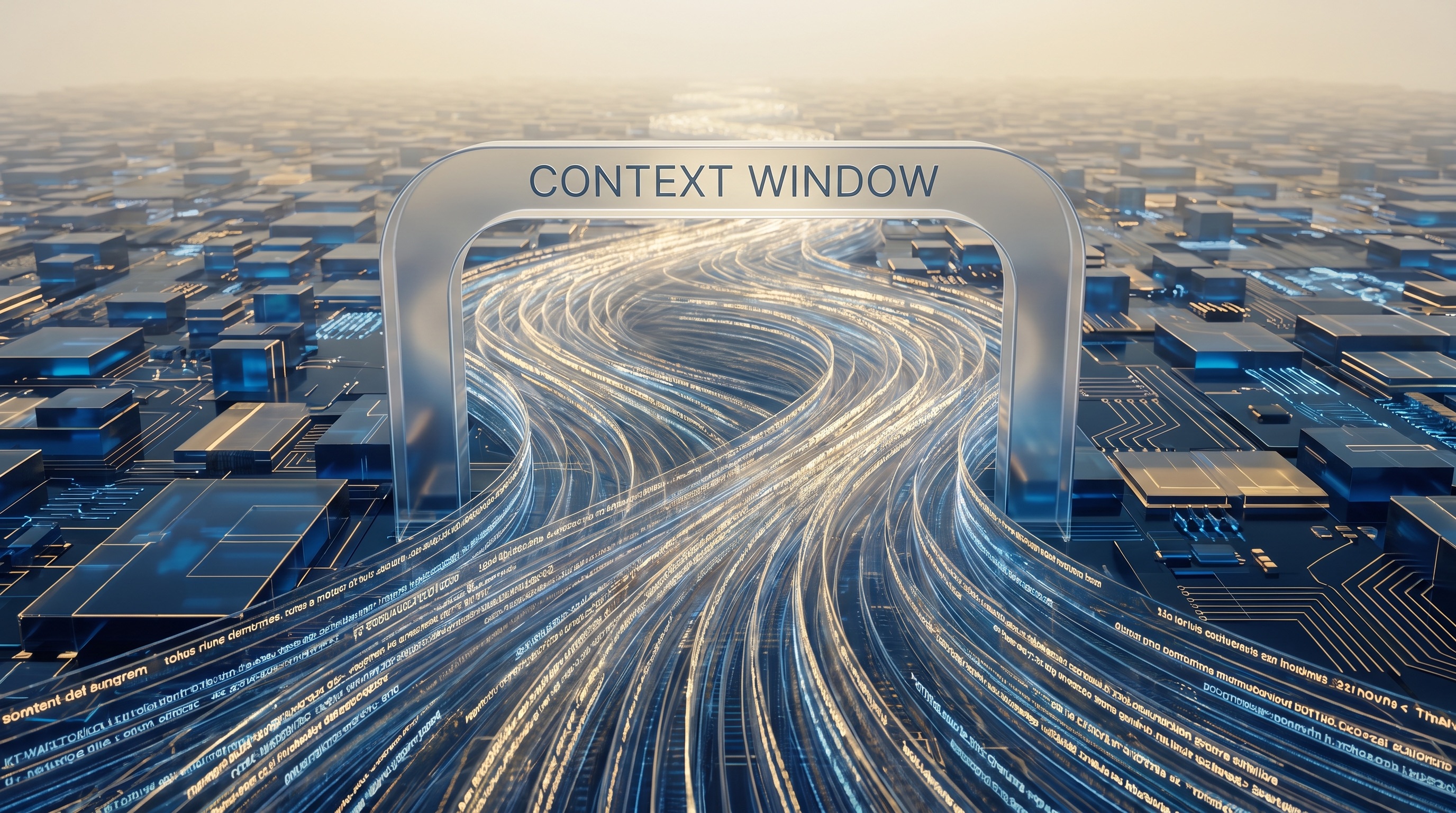
From 4,000 to 2,000,000 Tokens in Three Years
When GPT-3 launched in 2020, its context window topped out at 4,096 tokens — enough for a few pages of text. That forced a pattern developers still refer to as "chunking": slicing documents into fragments, processing each independently, and stitching results together. It worked, but it lost the thread. The model could not see how the end of a document connected to its beginning.
Three years later, that ceiling has been obliterated. Anthropic's Claude 4 family ships with 200,000-token context as a baseline. Google's Gemini 3.5 series pushes to 1,000,000 tokens. OpenAI's GPT-5.6 Sol, in limited preview as of June 2026, operates at 2,000,000 tokens — roughly 1,500 pages of dense text held in active memory simultaneously. That is not an incremental upgrade. It is a different category of capability.
Why Context Size Matters More Than Model Intelligence
Most coverage of AI model releases focuses on benchmark scores: does the new model score higher on MMLU, MATH, or HumanEval? Context window expansion rarely gets the same attention, but engineers who deploy these models at scale will tell you it changes more about day-to-day utility than raw intelligence gains.
The reason is simple: most real-world tasks are not about generating clever text from scratch. They are about processing existing material. A lawyer analyzing a 400-page contract. A developer debugging a 50,000-line codebase. A researcher synthesizing three months of clinical trial data. An analyst comparing quarterly earnings across twelve subsidiaries. Every one of these tasks involves holding a large body of existing text in memory while reasoning about it — and for most of AI's history, that was the bottleneck.
Longer context windows collapse that bottleneck. The model can now see the whole thing at once.
What This Actually Enables: Four Real Use Cases
1. Full-Codebase Analysis
With 200,000 tokens or more, a model can ingest a mid-size production codebase in a single pass. This is now commercially deployed at companies using tools like GitHub Copilot Enterprise, Cursor, and Claude Code. Instead of asking "what does this function do?", engineers are asking "where in this 80,000-line repo does the payment retry logic live, and does it interact with the rate limiter correctly?" — and getting accurate answers because the model has read all 80,000 lines.
The practical implication for teams: onboarding time for large codebases is collapsing. A developer new to a project can get substantive architectural questions answered in minutes rather than days.
2. Document-Length Legal and Financial Analysis
Law firms and financial institutions were early adopters of AI tools, but early deployments were hampered by context limits. Analyzing a merger agreement meant chunking it into sections, losing cross-references, and missing clauses that appeared on page 3 but were qualified by language on page 187.
Models with 1M+ token windows can hold the entire document. Early results from law firm pilots suggest contract review time dropping by 60–70% for first-pass analysis, with the model flagging cross-document inconsistencies that previously required a senior associate to catch manually.
3. Long Conversation Memory Without External Storage
The original RAG (Retrieval-Augmented Generation) architecture was, in part, a workaround for short context windows. If a model could only see a few thousand tokens, you had to retrieve the relevant fragments from a vector database and inject them into the prompt. That works, but it requires building and maintaining retrieval infrastructure, and it can miss information that is relevant but scores low on semantic similarity.
With multi-hundred-thousand-token windows, many RAG architectures are being replaced or simplified. You can now dump the entire knowledge base directly into the context for smaller corpora. For customer service bots handling product documentation under 500 pages, this is already common. The retrieval step disappears; the latency drops; the accuracy improves because the model sees everything instead of a curated slice.
4. Multi-Document Cross-Reference
Perhaps the most underappreciated capability: holding multiple large documents simultaneously and reasoning across them. A government procurement officer can feed 20 vendor proposals into a single session and ask the model to compare technical approaches, flag inconsistencies in pricing, and identify which proposals meet specific regulatory requirements — all in one pass. This was physically impossible two years ago without substantial engineering work.
The Engineering Challenges That Are Still Open
Large context windows are not free. Every token in context costs compute during inference, and the cost scales roughly quadratically with sequence length under standard attention mechanisms. Processing 2 million tokens is orders of magnitude more expensive than processing 8,000 — which is why frontier labs have invested heavily in sparse attention, ring attention, and other architectural innovations to make long-context inference economically viable.
There is also the "lost in the middle" problem, documented in research from Stanford and others: models consistently retrieve information near the beginning and end of long contexts more reliably than information buried in the middle. This is improving with each model generation, but it is not solved. Engineers deploying long-context applications need to be aware that critical information placed at position 700,000 of a 1,000,000-token prompt may be less reliably surfaced than information at position 1 or position 999,999.
Latency is another constraint. A 2,000,000-token context prompt takes seconds to process even on high-end hardware. For interactive use cases that require sub-second responses, this remains a practical ceiling. The use cases that benefit most from long context today are batch processing tasks where latency tolerance is higher: nightly document analysis, weekly report generation, asynchronous research workflows.
The Next Frontier: Dynamic Context Management
The next evolution is not just bigger windows — it is smarter management of what is inside them. Research groups at DeepMind, Meta, and several university labs are working on models that can dynamically compress, prune, and reorganize their context as it grows, retaining the most relevant information and discarding what is no longer needed without losing the thread of a long task.
OpenAI's agentic "ultra mode" in GPT-5.6, which orchestrates multiple subagents across a task, hints at the direction: rather than one model holding everything in a single context, future systems may coordinate across agents with specialized memory, passing summarized state between them. The 2M-token window of today may be a transitional form rather than the final architecture.
Actionable Takeaways
- Audit your chunking pipelines. If you built RAG or chunking infrastructure when context limits were under 32K, revisit those decisions. Many can be simplified or eliminated with modern context windows, reducing infrastructure cost and improving accuracy.
- Test long-context accuracy specifically. Do not assume that longer context means better answers. Run targeted evaluations placing critical information at different positions in your context to understand where your chosen model is reliable and where it is not.
- For batch document analysis, long context is likely now your best architecture. The latency penalty is acceptable for async workflows, and the accuracy gains from whole-document processing are substantial.
- Watch the cost curves. Long-context pricing is dropping quickly as labs optimize inference. A workflow that was prohibitively expensive at 200K tokens six months ago may now be viable at 1M tokens. Re-evaluate every quarter.