Context Engineering Is Becoming the Real Enterprise AI Skill
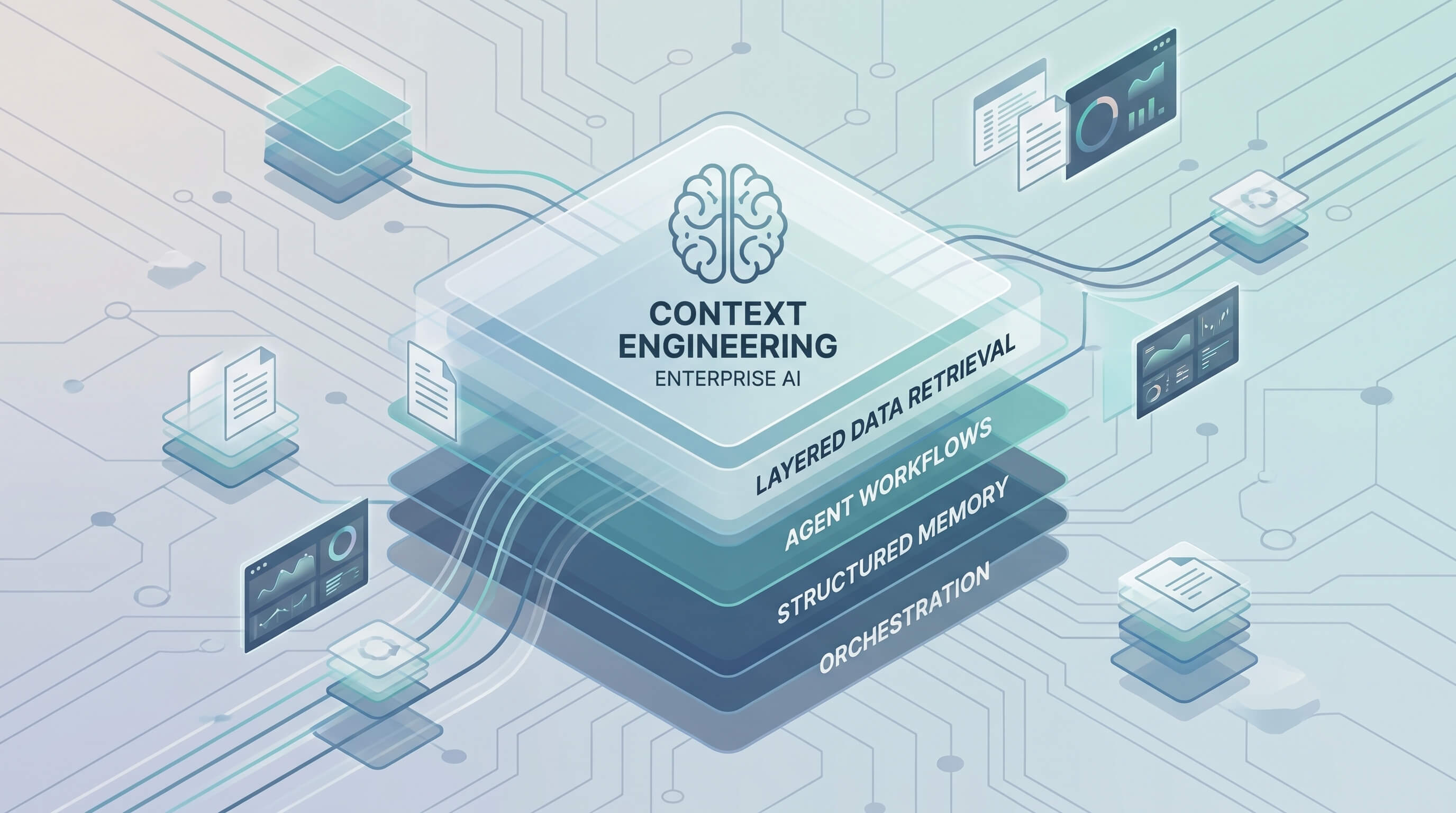
Enterprise AI is moving past the phase where success depends mostly on model choice. Most large teams can already access capable LLMs through commercial APIs, open weights, or managed platforms. The gap is shifting somewhere else. The teams getting reliable results are the ones that know how to assemble the right context for the model at the right moment.
That is why context engineering is becoming the real enterprise AI skill. It sits between data architecture, retrieval, workflow design, security, and product judgment. A prompt still matters, but a good prompt cannot rescue stale documents, missing permissions, noisy retrieval, or an agent that drags ten irrelevant tool results into its context window. In practice, enterprise AI quality is increasingly determined by context selection rather than prompt phrasing alone.
Prompt engineering solved the first wave, not the production problem
In the early generative AI cycle, prompt engineering became the visible skill because it produced immediate gains. A better system prompt could improve tone, structure, and task completion with almost no infrastructure work. That was useful, but it encouraged a misleading idea: that enterprise AI quality mostly comes from finding clever wording.
Production systems exposed the limit of that view. A finance assistant needs the latest policy memo, the correct chart of accounts, the user’s access scope, and a memory of the prior task. A support agent needs the current product version, the relevant knowledge base article, the customer’s plan tier, and the open ticket history. Once these systems operate in real environments, the central question stops being “what should the model say?” and becomes “what should the model know right now?”
What context engineering actually includes
Context engineering is the discipline of deciding which information enters the model’s working environment, in what structure, under which rules, and at what cost. That includes retrieval strategy, chunking, ranking, summarization, metadata filtering, tool output shaping, memory handling, and permission boundaries.
It also includes negative decisions. Good teams are not just good at adding context. They are good at excluding context that confuses the model, increases latency, leaks sensitive information, or causes the model to anchor on outdated material. Bigger context windows help, but they do not remove this problem. Many teams are discovering a form of context rot: once too much loosely related information is included, reasoning quality drops even if the model technically fits everything.
Why enterprises care now
Enterprises care because the failure modes are concrete. Poor context engineering shows up as hallucinated citations, wrong policy answers, duplicated tool calls, slow workflows, and unexpectedly high inference bills. Those are not academic problems. They affect support resolution, legal review, internal search, procurement workflows, and every other area where AI is supposed to reduce operational friction.
The economic angle matters too. Modern AI agents often retrieve documents, call tools, inspect intermediate results, and retry steps. Each stage adds tokens, latency, and cost. If a system carries too much irrelevant context into every step, the business pays twice: lower accuracy and higher spend. That is why context engineering now overlaps directly with LLMOps. It is as much an operations discipline as a modeling discipline.
Practical example: the same model, two very different outcomes
Imagine two companies deploying an internal procurement copilot on the same frontier model. Company A indexes every policy PDF, dumps the top ten matches into the prompt, and lets the model decide. Company B tags documents by region, contract size, policy date, approval authority, and business unit. It retrieves only in-scope documents, reranks them, summarizes repeated clauses, and injects the user’s role plus the current workflow state.
The model is identical, but the product outcome is not. Company A gets verbose answers, policy conflicts, and frequent escalations to human reviewers. Company B gets shorter answers, clearer citations, and more reliable routing to the next approval step. This is not primarily a model intelligence story. It is a context design story.
Agent workflows make context engineering even more important
Agentic systems raise the stakes because context is no longer a single prompt assembly problem. Every step in an agent workflow creates new context decisions. Should the agent carry the full transcript forward, or a compressed state summary? Should tool outputs be raw JSON, normalized fields, or a human-readable digest? Should memory persist across sessions, and if so, which facts deserve long-term storage?
These choices shape reliability more than most demos admit. A sales operations agent that remembers the wrong pricing exception becomes dangerous. A security triage agent that carries forward stale incident notes becomes noisy. A research assistant that over-trusts its first retrieved source becomes brittle. Context engineering is the control layer that keeps agents from becoming expensive improvisers.
What strong teams do differently
Strong teams treat context as a system, not a blob. They measure retrieval precision, not just answer quality. They test with adversarial and stale documents. They log which sources were used in successful versus failed runs. They separate permanent memory from task memory. They reserve large context loads for tasks that truly need them and keep routine flows lean.
They also assign ownership. In many organizations, no one owns context quality end to end. Data teams own the warehouse, app teams own the interface, security owns permissions, and AI teams own prompts. The result is fragmented responsibility. The emerging enterprise advantage goes to teams that appoint someone, or a cross-functional group, to own retrieval quality, grounding, memory policy, and context cost together.
How to build the skill inside an enterprise
Start with a narrow workflow
Pick one business process where answer quality can be checked against reality, such as support deflection, contract review triage, or internal policy search. Avoid starting with a general assistant for the whole company.
Instrument every context source
Track which documents, tool calls, summaries, and memory items were inserted into the model input. If a run fails, you need to know whether the problem was retrieval, ranking, permissions, or model reasoning.
Design for selective context
Do not send everything. Build filters for freshness, role, geography, product line, and workflow stage. Smaller, better context often beats larger context.
Make evaluation operational
Create tests for citation accuracy, stale-data resistance, latency, and token cost, not just final-answer fluency. A polished answer with the wrong grounding is a production failure.
The enterprise AI stack is shifting upward
The next durable enterprise AI advantage will not come from secret prompts. It will come from better context pipelines, stronger retrieval discipline, cleaner memory boundaries, and smarter orchestration across tools and models. That work is less glamorous than a viral demo, but it is what makes AI dependable inside real businesses.
That is why context engineering is becoming the real enterprise AI skill. It is the layer that turns powerful general models into useful organizational systems. Enterprises that learn it early will not just get better answers. They will build AI products that are cheaper to run, easier to trust, and much harder for competitors to copy.