Carrier Network APIs Are Turning Telecom Into a Developer Platform
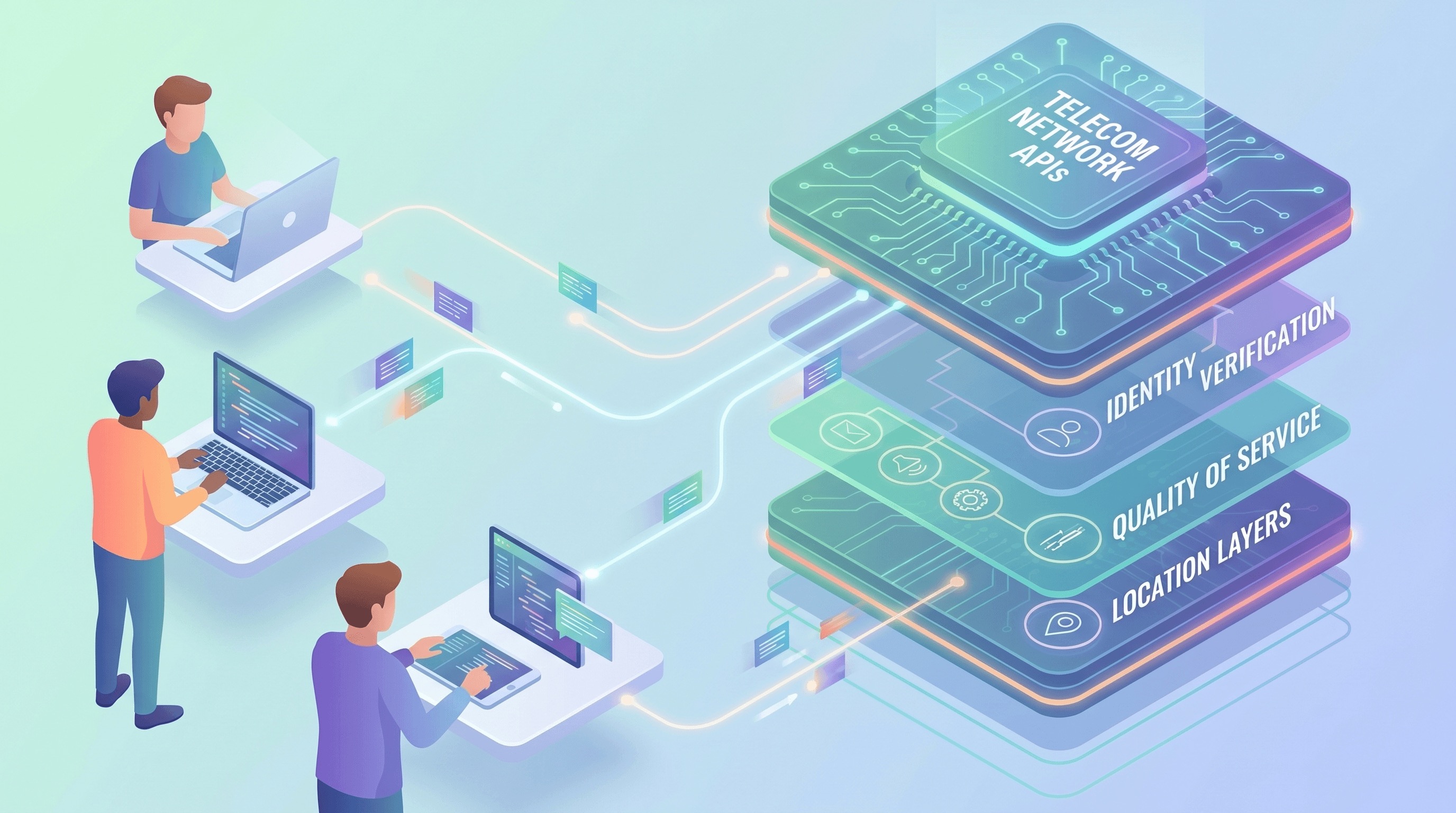
Telecom operators have spent most of the 5G era searching for a clean story about new revenue. Faster radios and broader coverage matter, but they do not automatically create a new software business. The more credible opportunity is now coming from a different direction: packaging network capabilities as APIs that developers and enterprises can consume without negotiating custom infrastructure deals every time.
That is why network APIs deserve attention beyond telecom trade circles. Initiatives such as GSMA Open Gateway and the CAMARA project are trying to turn mobile networks into a standardized application surface. By early 2026, the GSMA said 86 operator groups representing more than 300 networks and roughly 80 percent of global mobile connections had aligned around the framework, with more than 300 commercial launches of 20 CAMARA APIs across 65 markets. Those numbers matter because they suggest the industry is finally moving from PowerPoint ambition to repeatable deployment.
The important shift is not technical exposure, but productization
Telecom networks have always had capabilities that software companies wanted indirectly: subscriber verification, location context, service quality controls, and device intelligence. The problem was never that carriers lacked useful data or controls. The problem was that each network exposed those capabilities differently, if at all, and usually through slow commercial relationships that did not fit modern product development.
What Open Gateway and CAMARA are trying to solve is the packaging layer. The promise is not “here is raw network access.” It is “here is a predictable product with documentation, versioning, consent rules, and cross-operator behavior.” That sounds mundane, but it is the difference between a capability staying inside telecom and becoming part of the software economy.
Why fraud and identity APIs are leading the market
The first serious commercial wins are not the futuristic ones. They are the operational ones. Number verification, SIM-swap detection, one-time-password support, and verified caller services solve immediate pain for banks, retailers, marketplaces, and communications platforms. Those buyers already spend money fighting account takeover and transaction fraud. A network signal that improves confidence at the moment of authentication is easy to explain in budget terms.
This pattern is worth noticing because it says a lot about how new infrastructure gets adopted. The winning API is rarely the most glamorous one. It is the one that removes an existing cost center. Telecom operators have a better chance of selling network APIs when they frame them as measurable business controls rather than as abstract 5G innovation.
Quality on demand is where the platform story gets more interesting
Identity APIs are the easy entry point, but quality-on-demand APIs are where telecom starts to look more like a programmable computing layer. The idea is straightforward: an application can request a better network profile for a limited session or a specific workflow. That might matter for industrial control, premium video, cloud gaming, autonomous systems, financial transactions, or field-service applications that fail badly when connectivity becomes unpredictable.
For years, that kind of promise sat inside broad “network slicing” narratives that were too heavy for most developers to use. APIs make the concept narrower and therefore more usable. A software team does not want to redesign its stack around carrier architecture. It wants a controllable interface that says: when this workflow starts, request this network behavior, then release it. That is a much more plausible product.
The hard part is still distribution, not standards
Standardization is necessary, but it does not finish the job. Telecom operators are still learning a software lesson that cloud providers learned long ago: a technical interface is not automatically a product. Developers need onboarding, pricing clarity, test environments, observability, rate limits, support expectations, and confidence that an API will behave consistently across markets. Without that, “global” APIs become regional experiments.
This is why channel partners matter almost as much as operators. Hyperscalers, CPaaS companies, aggregators, and enterprise integration partners are the ones most likely to package network APIs into workflows customers already buy. In practice, many enterprises will consume carrier capabilities through another platform rather than through a direct operator contract. Telecom still supplies the capability, but the commercial surface may belong to someone else.
Telecom is becoming one layer in a larger software stack
That may sound like a loss of control for operators, but it is probably the realistic path to scale. Most developers do not want a new vendor category unless the capabilities are unique enough to justify it. They would rather pull network verification into an identity platform, or quality controls into a cloud orchestration layer, than build one more specialized relationship from scratch. The telecom industry is more likely to win if it accepts that its APIs will often be embedded inside broader products.
Seen that way, network APIs look less like a consumer revolution and more like infrastructure normalization. Telecom becomes another programmable layer next to payments, maps, messaging, and cloud compute. That is a healthier ambition than trying to make developers think like network engineers.
What enterprises should ask before buying in
Enterprises should be excited, but not naïve. The right questions are practical. How many markets are actually covered for the API you need? What are the fallback paths when a carrier signal is unavailable? How is user consent handled? Can you audit decisioning when a fraud or verification API blocks a transaction? Are latency and uptime commitments strong enough for production use, or are you still buying into a pilot ecosystem?
Those questions will decide whether network APIs become reliable inputs for mainstream applications or remain occasional enhancements. The difference is not in the telecom pitch. It is in operational maturity.
The real opportunity is modest and therefore believable
The strongest case for network APIs is not that they will suddenly transform every mobile app. It is that they expose a set of network-native functions that software teams can finally use without telecom-specific engineering. That is a narrower claim, but it is exactly why the market now feels more credible than earlier 5G monetization stories.
Telecom has spent a long time trying to convince the software world that the network is strategic. APIs are the first form factor that makes that argument usable. If operators can keep simplifying the commercial and technical experience, the network may finally become something developers treat not just as connectivity, but as a programmable product.
Actionable takeaways
If you run product or infrastructure teams, treat network APIs as targeted tools, not as a grand platform bet. Start with fraud reduction, identity verification, or narrowly defined quality-sensitive workflows. Measure outcome improvements, not just API adoption. If you are a telecom operator, the lesson is even sharper: sell fewer stories and better products. In this market, boring reliability will beat futuristic rhetoric.