BYD Outsells Tesla Globally. The Only Thing Keeping Chinese EVs Out of Western Markets Is Policy.
In 2024, BYD sold approximately 1.76 million pure battery electric vehicles globally, edging past Tesla's 1.79 million — a near-tie, with BYD ahead in some quarterly measurements. In 2025, BYD extended its lead, crossing 2 million BEV sales while also selling an even larger number of plug-in hybrids. By any reasonable measure, BYD is now the world's largest electric vehicle company by volume.
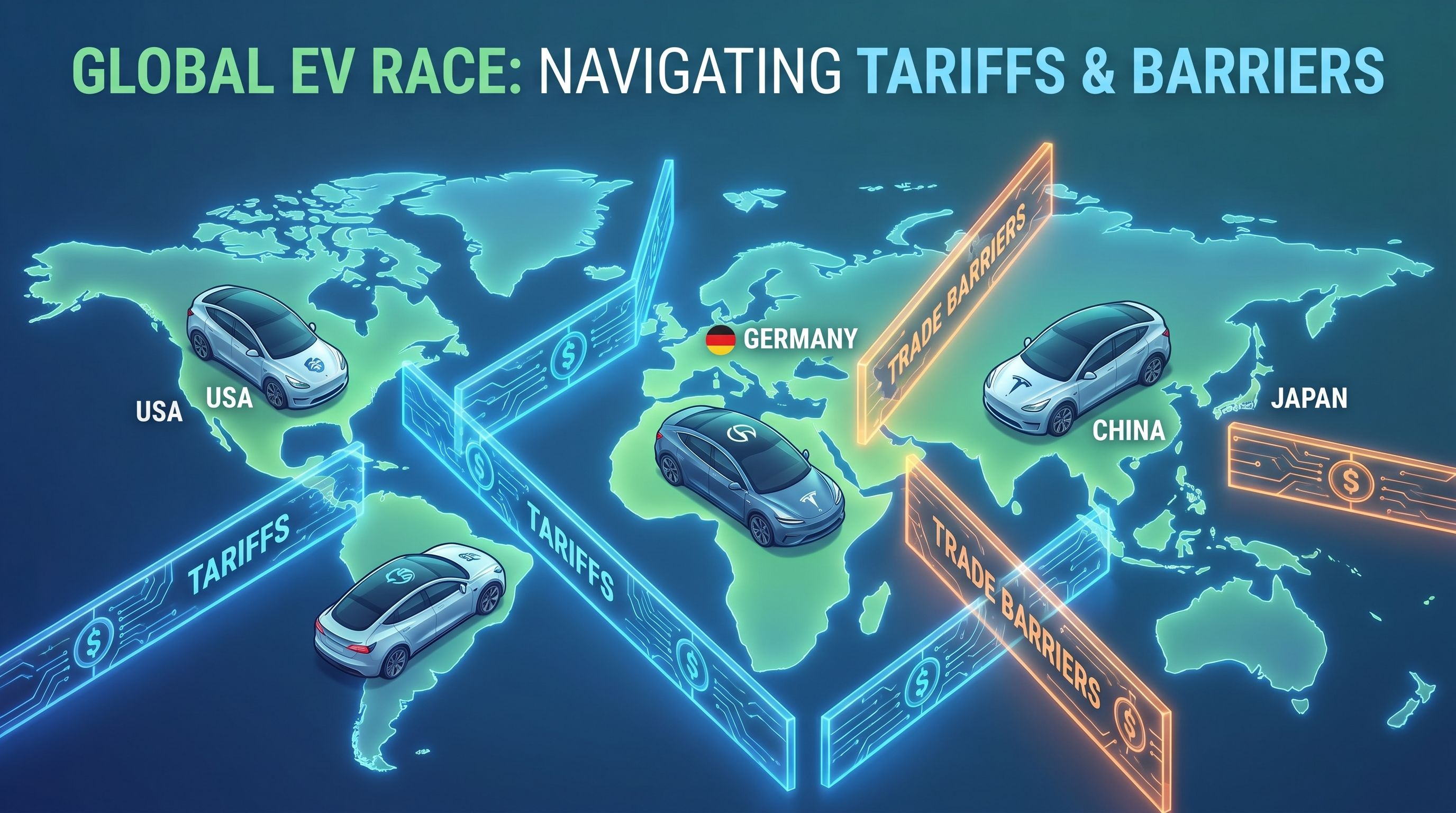
This would be a straightforward technology-adoption story if BYD's vehicles were being sold where most consumers can evaluate them. They're not. BYD has significant market presence in China (where it dominates), Southeast Asia, Australia, Latin America, and parts of Europe — but the US market is effectively closed to it by a 100% tariff on Chinese-made EVs. The EU, after its own investigation into Chinese EV subsidies, imposed additional duties in late 2024 that pushed Chinese EV tariffs in Europe to 45-67% depending on the manufacturer. The result is that the company selling the most electric vehicles on Earth is nearly invisible to American and most European buyers.
What BYD Is Actually Building
The product case for BYD deserves scrutiny independent of the political context. The company's Blade Battery — a lithium iron phosphate (LFP) cell design that integrates cells directly into the battery pack's structural frame, eliminating the module layer — delivers two things at once: higher energy density than previous LFP designs, and dramatically better thermal stability. LFP chemistry doesn't catch fire the way that NMC batteries can, and the Blade's structural integration means there are fewer components to fail. Multiple third-party tests have confirmed the Blade Battery's safety performance under nail penetration and extreme heat conditions that cause thermal runaway in other chemistries.
BYD's e-Platform 3.0 is an 800V architecture — the same high-voltage platform that allows Porsche's Taycan and Hyundai's Ioniq 6 to charge at speeds that have become a selling point in the premium segment. BYD uses this architecture across a wide range of vehicles, including models priced well below what 800V technology typically costs in Western-brand vehicles. The company also manufactures its own semiconductors through its subsidiary BYD Semiconductor, which gives it a cost and supply chain advantage that most legacy automakers don't have.
The BYD Seal, competing with the Tesla Model 3, starts at roughly $22,000 in China. The BYD Atto 3 and Dolphin compete in the compact SUV and hatchback segments at similar price points. These are not budget-quality vehicles with budget technology — they're midrange price points with technology specifications that match or exceed what European and American automakers charge significantly more for.
Where BYD Is Winning
In markets without prohibitive tariffs, BYD is moving aggressively. Australia saw BYD become a top-five selling EV brand within two years of entry. In Norway — one of the world's most EV-saturated markets — BYD models have strong sales figures. In Thailand, Indonesia, and Brazil, BYD is establishing local manufacturing to circumvent import duties and reduce cost. Its Sealion 6 PHEV has been particularly successful across Southeast Asian markets.
Europe presents a more complex picture. The additional EU tariffs make BYD vehicles less price-competitive, but at the adjusted prices some models remain cheaper than comparable European alternatives. BYD has been building relationships with European dealerships and opened a plant in Hungary (which benefits from EU market access) to produce vehicles that would avoid import tariffs. The factory, with production capacity for 150,000+ vehicles annually, is a bet that the tariff environment will eventually shift or that local production can make the economics work regardless.
Tesla's Actual Competitive Position
It would be a mistake to read this as a story of Tesla losing. Tesla's premium position — Model S, X, and Cybertruck at the high end, Model 3 and Y in the mainstream — maintains strong margins and brand equity. Tesla's software and Supercharger network remain genuine advantages that no Chinese EV brand has replicated in markets where they compete directly. Tesla's energy business is growing faster than its vehicle business by some measures. Autopilot and Full Self-Driving, whatever their limitations, are substantially more advanced than what BYD offers in driver assistance.
What's happened is that the lower and middle segments of the global EV market — the space Tesla historically occupied with Model 3 and Model Y before prices rose — have been filled by BYD and other Chinese manufacturers in markets where they can sell. The Cybertruck was never going to sell in Europe; but the Model 3 has faced genuine price pressure from the BYD Seal in markets where both compete.
The Tariff Calculation
The US 100% tariff and EU's 45-67% tariff are explicitly defensive measures. US tariffs were originally applied under Section 301 of the Trade Act, citing unfair trade practices, and were maintained and raised under successive administrations. The EU's additional duties followed an anti-subsidy investigation that found China's EV manufacturers receive state support that distorts competition.
Whatever the legal and economic justification, the practical effect is market segmentation by geography: Western consumers pay more for electric vehicles than they otherwise would, and the pricing pressure that BYD would otherwise exert on incumbent manufacturers is artificially reduced. Whether that's the right tradeoff — protecting domestic manufacturing vs. accelerating EV adoption through lower prices — is a genuine policy debate with legitimate arguments on both sides.
The longer-term question is whether tariffs can hold indefinitely against a manufacturer that has demonstrated genuine technical capability, is localizing production in non-tariffed markets, and continues to close whatever quality and software gaps once justified the product premium that Western brands commanded. The tariffs buy time. What automakers do with that time is what determines whether the protection was worth it.