Bitcoin Scaling Evolves with a Multi-Layer Architecture
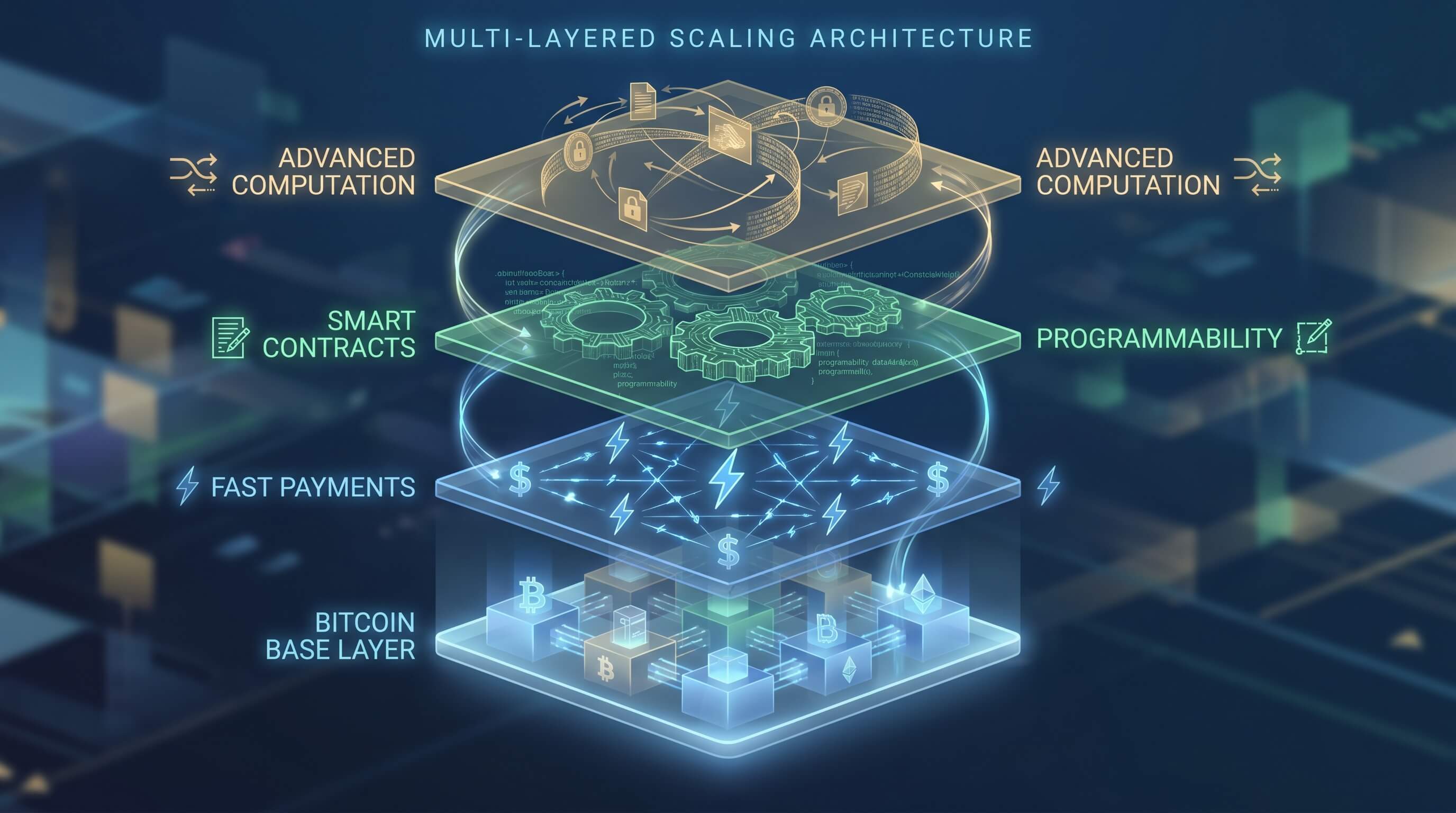
For years, discussions around Bitcoin's scalability have predominantly centered on the Lightning Network. While Lightning remains a critical innovation for rapid, low-cost payments, it represents just one facet of a much broader, evolving strategy to expand Bitcoin's capabilities. The reality is that Bitcoin is developing into a multi-layer stack, akin to the internet's own layered architecture, where different protocols and systems handle specialized functions. This layered approach allows Bitcoin to maintain its foundational security and decentralization while enabling a vast array of new applications, from programmable smart contracts to more efficient transaction processing, each optimized for specific use cases and trust assumptions.
This shift from a singular focus on Lightning to a comprehensive layered ecosystem is crucial for understanding Bitcoin's long-term potential. It acknowledges that no single solution can address all scaling challenges without compromising Bitcoin's core principles. Instead, a diverse set of Layer 2 (L2) and sidechain technologies are emerging, each contributing to a robust infrastructure. Developers and users must navigate these options, understanding their unique benefits and inherent tradeoffs, to effectively leverage Bitcoin's expanding utility beyond its role as digital gold.
The Foundational Role of the Lightning Network
The Lightning Network revolutionized Bitcoin payments by introducing a network of off-chain payment channels. These channels allow users to conduct an arbitrary number of transactions instantly and with minimal fees, settling only the net result on the main Bitcoin blockchain. This design significantly alleviates congestion on the base layer, making everyday micro-payments feasible without sacrificing the security of the underlying Bitcoin network. For instance, a coffee shop can accept Bitcoin payments via Lightning, with transactions confirming in milliseconds, a stark contrast to the block confirmation times of the main chain.
Despite its successes, including growing adoption and increasing capacity, Lightning has specific limitations. It is primarily designed for payments and doesn't inherently support complex programmable smart contracts or advanced decentralized finance (DeFi) applications. Furthermore, while trust-minimized, users need to manage channel liquidity and be online to receive payments, presenting operational complexities. Its focus is on high-frequency, low-value transactions, leaving other scaling needs unaddressed.
Sidechains: Expanding Programmability and Functionality
Sidechains represent another significant layer in Bitcoin's scaling stack, designed to introduce greater programmability and functionality that the main Bitcoin chain deliberately lacks. Unlike Lightning, which focuses on payment channels, sidechains operate as separate blockchains pegged to Bitcoin, allowing Bitcoin to be moved between the main chain and the sidechain. This enables the creation of more complex applications, including smart contracts, custom tokens, and even NFTs, without burdening the Bitcoin base layer.
Examples like Liquid Network and Stacks illustrate this approach. Liquid, developed by Blockstream, is a federated sidechain primarily aimed at institutional users, offering faster settlement and confidential transactions for Bitcoin-backed assets. It uses a federation of functionaries to secure pegged assets, which introduces a different trust model compared to Bitcoin's proof-of-work. Stacks, on the other hand, aims to bring smart contracts and decentralized applications directly to Bitcoin, using its own consensus mechanism (Proof of Transfer) that is anchored to Bitcoin's security. This allows developers to build DeFi protocols, DAOs, and other Web3 applications that settle their state changes on the Bitcoin blockchain, inheriting a degree of its security. The tradeoff here is the introduction of new trust assumptions and often a separate token for gas fees or staking, diverging from Bitcoin's native security model.
Emerging Architectures: BitVM, Rollups, and Covenants
Beyond established solutions, the Bitcoin scaling landscape is seeing innovative designs that push the boundaries of what's possible. These include proposals for BitVM-style computation, various rollup architectures, and the ongoing debate around Bitcoin covenants.
BitVM: Off-Chain Computation Without Base Layer Changes
BitVM (Bitcoin Virtual Machine) is a groundbreaking concept that demonstrates how complex computations can be verified on Bitcoin without altering its core protocol. Instead of running smart contracts directly on Bitcoin, BitVM allows for the execution of arbitrary programs off-chain, with the Bitcoin network only verifying a proof of correct execution if a dispute arises. This is achieved through a technique called "fraud proofs," where a challenger can prove that an off-chain computation was performed incorrectly, forcing the correct outcome to be enforced on the Bitcoin chain. This design pattern significantly expands Bitcoin's computational capabilities, enabling a vast array of applications, including more sophisticated Layer 2 solutions, without increasing the base layer's complexity or attack surface. BitVM2, a subsequent iteration, aims to improve efficiency and reduce the on-chain footprint for these fraud proofs, making such designs even more practical.
Rollups: Scaling with Stronger Bitcoin Guarantees
Inspired by Ethereum's scaling roadmap, the concept of rollups is also gaining traction within the Bitcoin ecosystem. Rollups bundle hundreds or thousands of off-chain transactions into a single batch, which is then submitted to the Bitcoin blockchain. This significantly increases transaction throughput. There are two main types: optimistic rollups and zero-knowledge (ZK) rollups. Optimistic rollups assume transactions are valid by default but allow a "challenge period" during which anyone can submit a fraud proof if they detect an invalid transaction. ZK-rollups, conversely, use cryptographic proofs (zero-knowledge proofs) to instantly verify the correctness of off-chain transactions, offering stronger immediate finality. While still largely in the conceptual or early development stages for Bitcoin, rollups promise to offer a higher degree of security inheritance from the Bitcoin base layer compared to many sidechains, as their security relies more directly on Bitcoin's consensus rules.
Covenants: A Debated Enabler for Advanced L2s and Vaults
Bitcoin covenants are a class of proposed Bitcoin script enhancements that would allow a user to constrain how bitcoins can be spent in the future. Essentially, a covenant dictates conditions that must be met for a transaction to be valid, even before the transaction is created. While not a scaling solution in themselves, covenants are considered a powerful enabler for more sophisticated Layer 2 designs, advanced security features like vaults, and even congestion control mechanisms. For example, a covenant could enforce that funds can only be spent to a specific set of addresses or after a certain time delay, or only if they adhere to a specific script template. This capability could unlock more robust and trust-minimized Layer 2 protocols by allowing them to enforce complex rules on the Bitcoin base layer, ensuring funds are always recoverable or spent according to predefined logic. Proposals like OP_VAULT (allowing self-custodied recovery mechanisms) and OP_CTV (CheckTemplateVerify, enabling transaction batching and congestion control) are actively debated. The debate surrounding covenants is intense because they represent a change to Bitcoin's consensus rules, requiring careful consideration of security implications, potential for centralization, and the overall philosophical direction of Bitcoin's evolution. They are not a settled upgrade but a significant area of research and discussion.
Navigating the Tradeoffs in Bitcoin's Layered Stack
Each layer in Bitcoin's scaling stack comes with a unique set of tradeoffs, and understanding these is paramount for both users and developers. There is no one-size-fits-all solution; choices depend on specific needs regarding security, decentralization, performance, and programmability.
- Security and Trust Assumptions: The Bitcoin base layer offers the highest security guarantees, protected by its immense proof-of-work. Lightning Network inherits much of this security but introduces operational requirements. Sidechains often rely on different trust models (e.g., federations for Liquid, separate consensus for Stacks), meaning their security is not identical to Bitcoin's. Rollups aim for stronger security inheritance, with ZK-rollups offering the strongest cryptographic guarantees tied to the base layer.
- Decentralization: While Bitcoin's base layer is highly decentralized, some Layer 2 solutions might introduce elements of centralization, such as a smaller set of validators or a federation of signers. The goal for all these layers is to minimize these centralizing forces while maximizing efficiency.
- Performance and Cost: Lightning offers near-instant, low-cost payments. Sidechains can offer higher transaction throughput and lower fees for their specific use cases. Rollups promise significant scaling by batching transactions. The base layer, by design, prioritizes security and decentralization over raw transaction speed.
- Programmability: The Bitcoin base layer has limited scripting capabilities. Sidechains like Stacks provide rich smart contract environments. Emerging designs like BitVM and rollups aim to bring complex programmability to Bitcoin in a trust-minimized way, without altering the base layer's simplicity.
Actionable Takeaways for Users and Builders
For individuals and businesses interacting with Bitcoin, understanding this layered architecture is key to making informed decisions:
- For Everyday Payments: The Lightning Network remains the optimal choice for fast, cheap, and frequent transactions like buying goods or services. Its maturity and growing ecosystem make it a practical solution for daily use.
- For Advanced Programmability and DeFi: If your goal is to build or interact with smart contracts, NFTs, or more complex decentralized applications, explore sidechains like Stacks. Be aware of their distinct security models and token economics. As BitVM-style solutions and Bitcoin rollups mature, they will offer more trust-minimized ways to engage with programmability directly anchored to Bitcoin's security.
- For Institutional Use Cases and Confidentiality: Solutions like the Liquid Network cater to specific institutional needs, offering faster settlement and privacy features for Bitcoin-backed assets.
- Stay Informed on Core Protocol Debates: For those interested in Bitcoin's fundamental evolution, follow the discussions around covenants. While not user-facing today, their eventual inclusion could dramatically reshape the capabilities of future Layer 2s and security models. Understanding these proposals helps anticipate future infrastructure.
- Evaluate Tradeoffs Carefully: Always assess the balance between security, decentralization, performance, and programmability for any given Layer 2 or sidechain. No single solution is perfect for all needs. Prioritize based on your specific application or risk tolerance.
Bitcoin's scaling story is no longer a monolithic narrative but a dynamic, multi-faceted exploration of how to extend its utility while preserving its core values. By embracing a layered approach, the ecosystem is building a robust and adaptable foundation for the future of decentralized finance and computation.