Bidirectional Charging Is Turning EVs into Energy Platforms
The EV as a Grid Asset, Not Just a Car
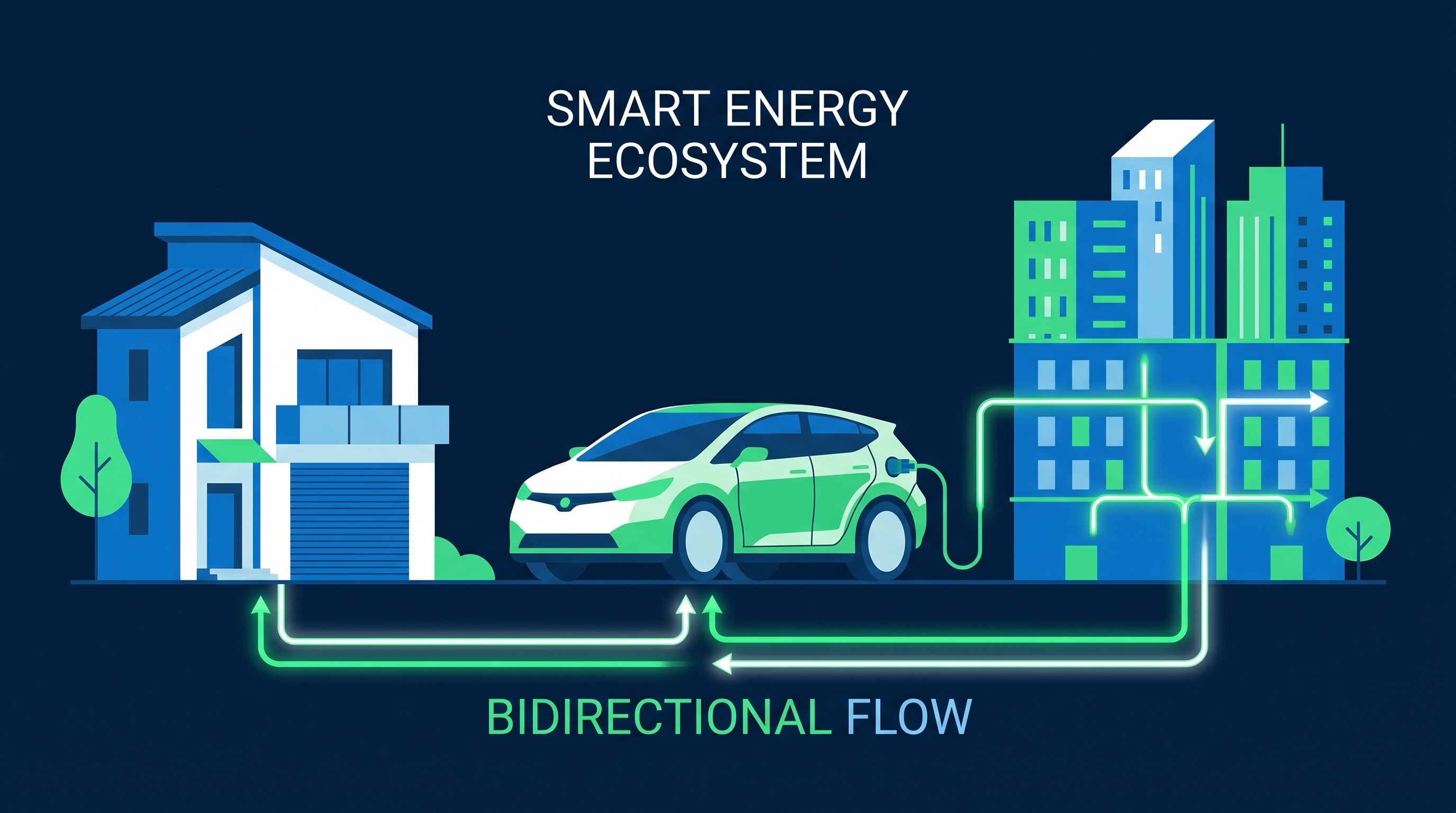
For years, the electric vehicle conversation has centered on range, charging speed, and performance. These metrics, while important, represent a limited view of an EV's potential. A fundamental shift is underway, moving beyond the vehicle as a simple consumer of electricity to the vehicle as an active, integrated component of our energy infrastructure. Bidirectional charging is the technology driving this transformation, turning your EV into a powerful, mobile battery that can power your home, support the grid, and generate revenue. This is no longer a futuristic concept confined to pilot programs; it is an emerging platform built on new standards, hardware, and utility integration that redefines the value of EV ownership.
This transition means the criteria for evaluating an EV and its ecosystem are changing. Battery capacity is no longer just about driving range—it's about how many hours you can power your home during an outage. The charging connector, whether NACS or CCS, is less about the physical shape and more about the underlying communication protocol, like ISO 15118, that enables advanced energy services. The true value proposition of the next generation of EVs will be measured by their ability to seamlessly integrate into a broader energy strategy, involving charging hardware, home energy systems, dynamic utility tariffs, and streamlined grid interconnection.
Understanding the Core Capabilities: V2H, V2G, and V2L
Bidirectional charging isn't a single feature but a collection of capabilities that allow energy to flow out of the vehicle's battery. Each serves a distinct purpose.
Vehicle-to-Home (V2H)
Vehicle-to-Home allows an EV to act as a home backup generator. During a power outage, the EV's battery can power essential circuits in your house. For example, a Ford F-150 Lightning with its 131 kWh battery can power a typical home for several days. This requires more than just the vehicle; it necessitates a bidirectional DC charger and a home integration system that can safely disconnect the home from the grid and manage the flow of power from the car. It eliminates the need for a noisy, fossil-fuel-powered generator and provides a silent, seamless source of backup power.
Vehicle-to-Grid (V2G)
Vehicle-to-Grid is the most ambitious application, allowing EV owners to sell energy back to the utility. This typically happens during peak demand hours when electricity is most expensive and the grid is most strained. A fleet of electric school buses, which are parked during peak afternoon hours, could provide gigawatts of stabilizing power to the grid. For individual owners, V2G programs can create a direct revenue stream, offsetting the cost of ownership. This requires sophisticated software on the utility side to manage these distributed energy resources and market mechanisms to compensate owners fairly.
Vehicle-to-Load (V2L)
The simplest and most common form, Vehicle-to-Load turns the EV into a large, mobile power bank with standard AC outlets. This feature, available on vehicles like the Hyundai Ioniq 5 and Kia EV6, allows you to power tools at a worksite, appliances while camping, or even another EV in an emergency. V2L doesn't require complex home integration or utility agreements, making it a highly practical and immediately useful feature.
The Ecosystem Bottlenecks to Mass Adoption
While the technology is proven, several systemic hurdles must be cleared before bidirectional charging becomes mainstream. The car itself is often the most ready component; the surrounding ecosystem is where the real work lies.
- Standards Alignment and Interoperability: The key to bidirectional functionality is not the plug shape (NACS or CCS) but the communication protocol. ISO 15118 is the international standard that enables the necessary data exchange between the car, charger, and grid. While widely adopted as the goal, its full implementation, particularly the V2G-enabling ISO 15118-20, is still being rolled out by automakers and hardware manufacturers. Inconsistent implementations can lead to compatibility issues, where a certified car and a certified charger fail to communicate properly.
- Utility Interconnection and Permitting: A homeowner can't simply connect a V2G system to the grid. Utilities have strict interconnection rules to ensure safety and grid stability. These processes are often bureaucratic, slow, and vary significantly between jurisdictions. Streamlining and standardizing permitting and interconnection agreements is critical to reducing "soft costs" and installation timelines for customers.
- Battery Warranty and Degradation Concerns: Automakers have been hesitant to provide clear warranty coverage for batteries used in V2G applications. While modern LFP and NMC battery chemistries are incredibly durable, frequent cycling for grid services could theoretically accelerate degradation. Manufacturers need to provide transparent warranty terms that don't penalize owners for participating in V2G programs, and intelligent charging management systems can minimize battery wear by optimizing charging and discharging cycles.
- The Installer Ecosystem: Installing a bidirectional charging system is more complex than a standard EV charger. It involves high-voltage DC electricity and integration with a home's main electrical panel and utility meter. There is currently a significant shortage of electricians and installers trained and certified to handle these advanced installations, creating a bottleneck in deployment.
- Utility Software and Market Integration: For V2G to work at scale, utilities need advanced software platforms, often called Distributed Energy Resource Management Systems (DERMS), to manage and aggregate power from thousands of individual EVs. They also need to create market structures and tariffs that accurately value the services (like frequency regulation and peak shaving) that EVs provide, ensuring fair compensation for owners.
Actionable Takeaways for the New Energy Era
The transition to EVs as energy platforms requires a shift in mindset for all stakeholders. The focus must expand from the vehicle in isolation to the complete energy ecosystem.
For Prospective EV Buyers
When you purchase your next EV, investigate its bidirectional capabilities as thoroughly as you do its range. Ask specific questions: Does it support V2H or V2G? Which communication standards (e.g., ISO 15118-20) does it use? What specific third-party chargers and home integration hardware are compatible? Finally, carefully review the battery warranty to understand any limitations related to V2H or V2G usage.
For Homeowners and Fleet Managers
Your local utility is now a key partner. Before investing in hardware, research their available programs. Do they offer time-of-use rates that make V2G profitable? Are there established pilot programs or interconnection agreements for bidirectional systems? For fleet managers, modeling the total cost of ownership should now include potential V2G revenue streams, which can dramatically alter the economic case for electrification.
For Utilities and Regulators
The priority must be to reduce friction. This means standardizing interconnection processes to make it as easy to connect a V2G system as it is to install solar panels. It means creating dynamic tariffs and market mechanisms that send clear price signals to EV owners, rewarding them for providing valuable grid services. Investing in modern grid management software is no longer optional; it is essential for harnessing the immense potential of millions of mobile batteries.