AlphaFold 3 Redefines Biology as a Software-First Discipline
The Paradigm Shift from Prediction to Interaction
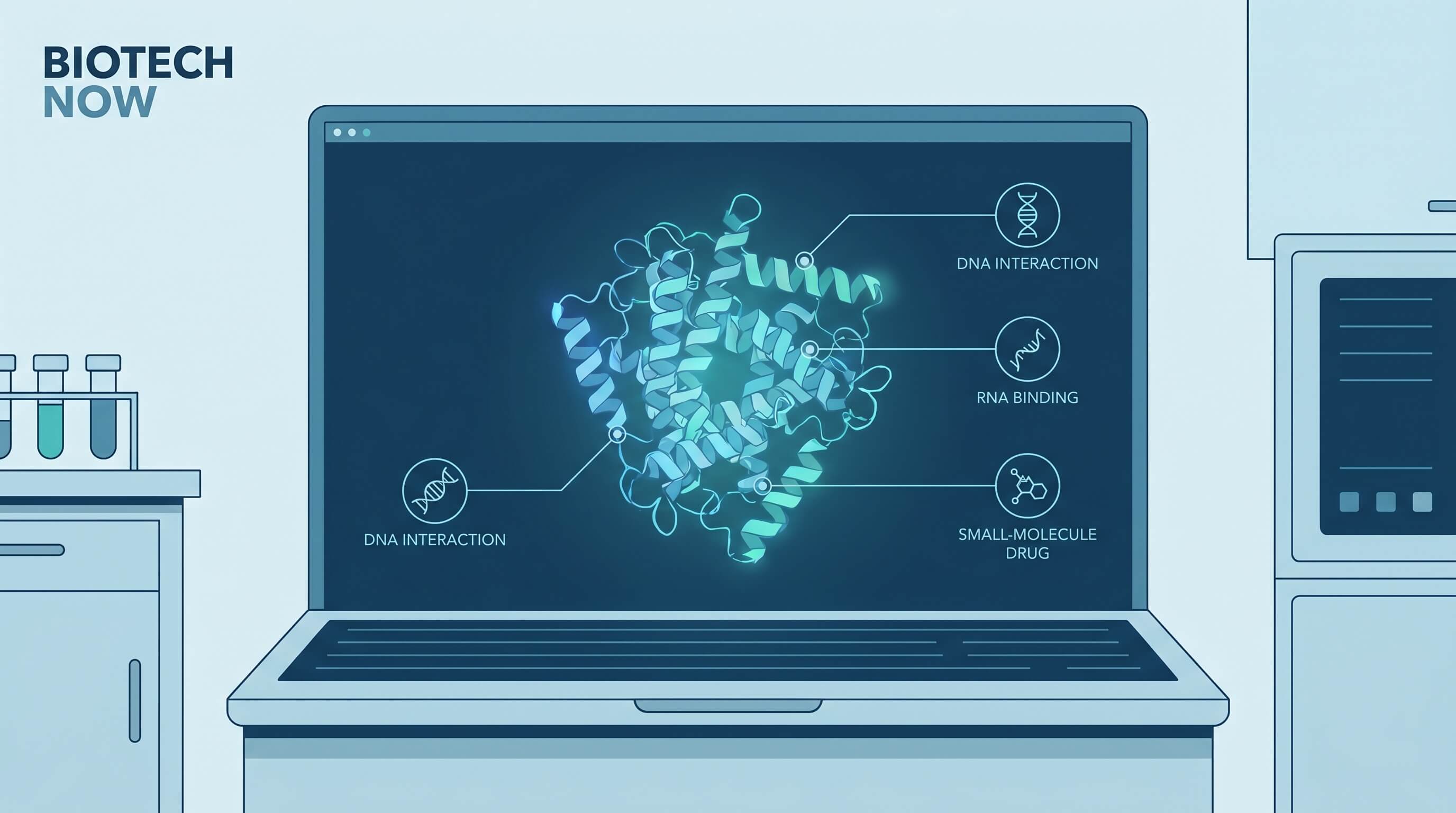
AlphaFold 3 represents a critical inflection point in biological research. While its predecessor, AlphaFold 2, solved the longstanding protein folding problem with astonishing accuracy, its focus was on individual protein structures. AlphaFold 3 expands this capability to model the interactions of nearly all of life's molecules: proteins, DNA, RNA, small molecule ligands, and ions. This is not an incremental improvement; it is a categorical leap that transforms structural biology from a discipline centered on static, individual structures into one focused on dynamic, interconnected molecular systems.
This shift firmly establishes a new paradigm: biology is becoming a software-first discipline. The primary workflow for many research questions will no longer begin with months or years of painstaking wet-lab experiments to determine a single structure. Instead, it will start at a computer, with researchers generating dozens of high-confidence structural hypotheses about complex molecular interactions in a matter of hours. This computational pre-screening step allows labs to design smarter, more targeted, and far more efficient experiments, fundamentally altering the economics and speed of discovery.
How a New Software Stack Changes the Lab
The introduction of the free AlphaFold Server is the mechanism for this transformation. By providing broad access to AlphaFold 3's power, it democratizes a capability previously limited to specialized computational biology labs. The impact on daily research workflows is profound.
From Target Discovery to Assay Prioritization
Consider a typical drug discovery pipeline. Identifying a new therapeutic target often involves understanding how it interacts with other proteins or nucleic acids. Previously, this was a high-risk, resource-intensive process. A team might spend a year trying to co-crystallize a protein complex just to get a first look at the binding interface.
With AlphaFold 3, the workflow is inverted. A team can now generate a structural model of the entire interaction complex as a first step. This model, while a prediction, provides immediate hypotheses about which residues are critical for binding. This information is invaluable for several downstream tasks:
- Target Validation: The model can predict how a mutation might disrupt an interaction, guiding the design of experiments to validate the target's biological function.
- Assay Design: Instead of blindly screening for inhibitors, researchers can use the predicted interface to design more specific and relevant binding assays, saving time and reagents.
- Medicinal Chemistry: For small molecule drug discovery, AlphaFold 3 can predict how a potential drug lead (a ligand) sits in the binding pocket of its target protein. This helps medicinal chemists prioritize which chemical scaffolds to synthesize and test, focusing efforts on compounds with a higher probability of success.
This computational front-loading doesn't eliminate the need for experimental validation through methods like X-ray crystallography, cryo-EM, or surface plasmon resonance (SPR). However, it dramatically narrows the search space, ensuring that expensive and time-consuming experimental work is spent on the most promising hypotheses.
The Critical Limits: Where AI Is a Guide, Not an Oracle
Despite its power, treating AlphaFold 3 as a source of absolute truth is a critical mistake. Its outputs are static, single-state predictions, and understanding its limitations is essential for its effective use.
1. Dynamics and Conformational Change
Proteins are not rigid structures; they are dynamic machines that flex, bend, and change shape to perform their functions. AlphaFold 3 provides a high-quality static snapshot, but it doesn't capture this motion. It cannot, by itself, model the process of a protein binding to a ligand or the allosteric changes that occur across a protein's structure as a result. For these questions, traditional methods like molecular dynamics (MD) simulations remain indispensable, often using an AlphaFold structure as a starting point.
2. Binding Affinity vs. Binding Pose
A crucial distinction for drug discovery is the difference between predicting a binding pose (how a molecule fits) and predicting binding affinity (how tightly it binds). AlphaFold 3 is remarkably good at predicting plausible binding poses. However, it does not provide a reliable, quantitative measure of binding affinity. A predicted interaction is a hypothesis that a bond is possible, not a measurement of its strength. Teams still need to perform experimental assays to quantify affinity and determine whether a compound is a potent drug candidate.
3. Environmental Context and Difficult Cases
The model can struggle with molecules whose conformation is heavily dependent on their environment, such as membrane proteins embedded in a lipid bilayer. While it has shown progress, these predictions require extra scrutiny. Furthermore, the accuracy of any prediction is tied to the quality and volume of data in the Protein Data Bank (PDB) used for its training. Novel protein folds or highly unusual molecular complexes may yield less reliable results. Always check the model's confidence scores (like pLDDT and PAE) and treat low-confidence regions with skepticism.
Actionable Guidance for Adopting AI Structural Tools
For a research team to successfully leverage AlphaFold 3, it must be integrated thoughtfully into an existing research culture. Simply making the tool available is not enough. Here is a practical framework for adoption:
1. Integrate, Do Not Replace
Position AlphaFold 3 as a hypothesis generation engine that feeds into your experimental pipeline. The goal is to accelerate discovery by making the experimental phase more focused. Create clear workflows where computational predictions are directly linked to a validation plan. The question should always be: "What is the fastest experiment we can run to test this model's prediction?"
2. Cultivate Interpretation Skills
The most valuable team members will be those who can bridge the gap between computational biology and the wet lab. This means training researchers to not only run the model but also to critically interpret its outputs. They must understand the confidence metrics, recognize potential artifacts, and know when a prediction is robust enough to act on versus when it is too speculative.
3. Focus on System-Level Questions
Leverage AlphaFold 3's unique strength: modeling interactions. Shift from asking "What does this protein look like?" to "How does this protein work with its partners?" Use it to explore protein-DNA interactions, map out protein complexes, and screen potential ligands against binding sites. This system-level view is where the tool offers the most transformative potential.
4. Build a Rapid Validation Loop
The speed of computational prediction must be matched by an agile experimental follow-up. A prediction that sits for months without being tested is a wasted opportunity. Establish a streamlined process for taking a high-confidence *in silico* model and quickly moving to a validation experiment, whether it's a simple mutagenesis study, a binding assay, or a preliminary cryo-EM screen. The synergy between rapid prediction and rapid validation is what will define the next generation of biological discovery.