AI Protein Design Is Finally Meeting the Wet Lab
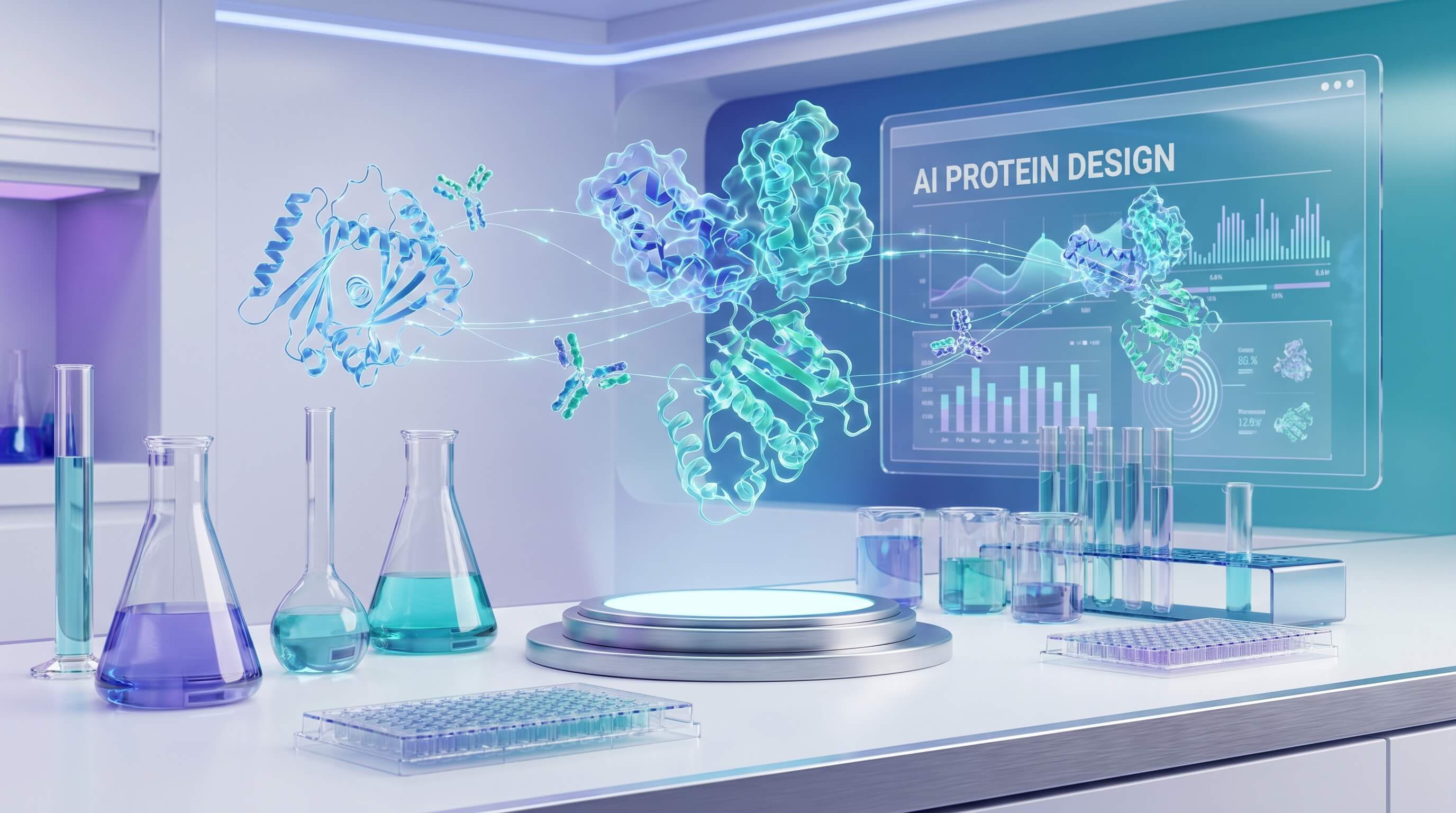
AI protein design has moved past the stage where every breakthrough lives inside a benchmark chart. The more interesting shift now is practical: computational models are finally starting to survive contact with the wet lab. That matters because drug discovery has never suffered from a shortage of clever predictions. It has suffered from the brutal attrition that happens when elegant in silico ideas meet messy biology, expensive synthesis, and experimental reality.
The new story in science and biotech is not that AI can imagine new proteins. It is that a growing number of research groups and companies are building systems that close the loop between model output, synthesis, assay, and redesign. That feedback loop is where protein design stops being a demo and starts looking like infrastructure for therapeutics, enzyme engineering, and diagnostics.
Protein design is leaving the leaderboard era
For the last several years, AI in biology has been dominated by a few headline capabilities. AlphaFold made protein structure prediction vastly more useful. Protein language models showed that sequence data could be treated a bit like natural language. Generative systems then promised to design entirely new proteins with desired properties. Those developments were real, but they also encouraged a familiar failure mode: the field became very good at celebrating model performance before enough attention was paid to whether a proposed protein could actually be expressed, folded, and validated in the lab.
That concern is why the current moment feels more substantial. Recent reporting and published work point to a broader transition from benchmark-centric evaluation to experimental validation. Drug Target Review recently highlighted a cluster of 2026 studies where AI-designed molecules and biological tools were not only generated computationally but also tested in preclinical settings. That may sound incremental, but it changes the standard of evidence. A model is no longer judged only by whether it predicts a promising candidate. It is judged by whether the candidate survives synthesis, binds as expected, and produces a measurable biological effect.
Once that becomes the bar, the economics of the field start to change. A model that saves weeks of screening but still produces low-quality candidates is less interesting than a model that cuts search space while preserving experimental hit rates. In drug discovery, the goal is not more plausible molecules on a slide. It is fewer expensive dead ends.
The hardest targets are what make this interesting
One reason protein design has attracted so much attention is that biology still contains large regions of therapeutic darkness. Many disease-relevant proteins are difficult to target because they do not present stable, well-behaved binding pockets. Intrinsically disordered regions are a classic example. They matter in cancer and neurodegenerative disease, but their flexible, shifting structures make them poor fits for traditional small-molecule discovery.
That is why the recent work from David Baker’s lab drew so much attention. As covered by Chemistry World, the team used a generative design approach called logos to create binders for disordered protein regions that had long been treated as effectively undruggable. The reported numbers were striking: 39 tight binders from 43 tested targets. More important than the ratio, though, was what it implied. If AI-guided design can generate binders for moving, structurally ambiguous targets, then it expands the class of proteins researchers can reasonably pursue instead of only optimizing the same tractable targets everyone else is already chasing.
This is where AI becomes scientifically valuable rather than merely operationally efficient. It helps biologists explore regions of molecular design space that were previously too expensive, too uncertain, or too labor-intensive to search with conventional methods.
Design tools are becoming usable by working biologists
Another underrated shift is usability. A great protein model has limited impact if only a small group of machine learning specialists can operate it. MIT recently profiled OpenProtein.AI, a company founded by researchers with MIT roots that is trying to make advanced protein-design tooling accessible through a no-code interface. That is a bigger deal than it sounds. In most life-science organizations, the bottleneck is not only the quality of the model. It is the translation layer between computational methods and the people actually running experiments.
When protein engineers can upload data, compare candidates, and fine-tune workflows without building custom ML pipelines from scratch, adoption looks very different. The platformization of these tools could do for computational biology what cloud infrastructure did for software startups: reduce the activation energy required to try ambitious things.
There is also a strategic consequence here. The best biological AI systems may not end up being the ones with the flashiest raw models. They may be the ones that integrate model access, experiment tracking, assay feedback, and collaboration workflows into a single environment that wet-lab teams can trust. In other words, the moat may increasingly sit in the design-build-test cycle rather than the model checkpoint alone.
Pharma is treating AI as pipeline machinery, not a side project
Large pharmaceutical companies have become more explicit about this change. AstraZeneca, for example, said in late 2025 that more than 90 percent of its small-molecule discovery pipeline is AI assisted, while also pushing AI deeper into biologics and peptide design. Its MapDiff work on inverse protein folding reflects a broader industry move: using AI not as a separate innovation lab experiment but as a layer embedded across discovery and design.
That integration matters because most biotech hype cycles collapse at the handoff point. A model impresses in a paper, but it never becomes part of a durable operating system for research teams. When a major pharma company starts describing AI as part of routine discovery machinery, it suggests the field is maturing from isolated technical success into process change.
It also reveals what companies actually care about. They want systems that improve hit identification, help optimize candidates faster, reduce assay waste, and raise the odds that programs entering preclinical work have stronger underlying evidence. In practice, the winning tools will be the ones that improve portfolio decisions, not just protein aesthetics.
What still gets in the way
None of this means AI protein design is solved. Biology remains unforgiving. Training data are uneven, assay conditions vary, and many desirable traits are difficult to optimize simultaneously. A candidate may bind well and still fail because of manufacturability, stability, immunogenicity, toxicity, or weak behavior in vivo. The wet lab is still where optimism goes to be audited.
There is also a risk that the field over-corrects into a new kind of hype. Experimental validation is better than synthetic benchmarks, but a few strong case studies are not the same thing as broad, repeatable reliability across target classes. Scientists still need to ask hard questions about specificity, reproducibility, and how well these models generalize beyond carefully chosen demonstrations.
And then there is the practical bottleneck of data generation. The next advantage may come from organizations that can connect automated experimentation, high-throughput screening, and rich feedback capture to their design models. In protein engineering, good models matter. Good loops matter more.
Why this field matters now
The reason to watch AI protein design in 2026 is not that it will magically eliminate the cost and complexity of drug discovery. It will not. The reason to watch it is that the discipline is finally converging on the right question: can AI help scientists produce molecules that work in the world, not just on paper?
That sounds modest, but it is exactly the right ambition. If the answer keeps trending toward yes, the effect could be substantial. Researchers get faster iteration cycles. Smaller teams can pursue harder targets. Drug programs that once required years of blind search may begin with better priors. And the boundary between computational design and experimental biology gets less rigid each year.
The wet lab is still the final judge. What has changed is that AI is becoming a more credible witness.