AI Protein Design Is Becoming a Lab Discipline
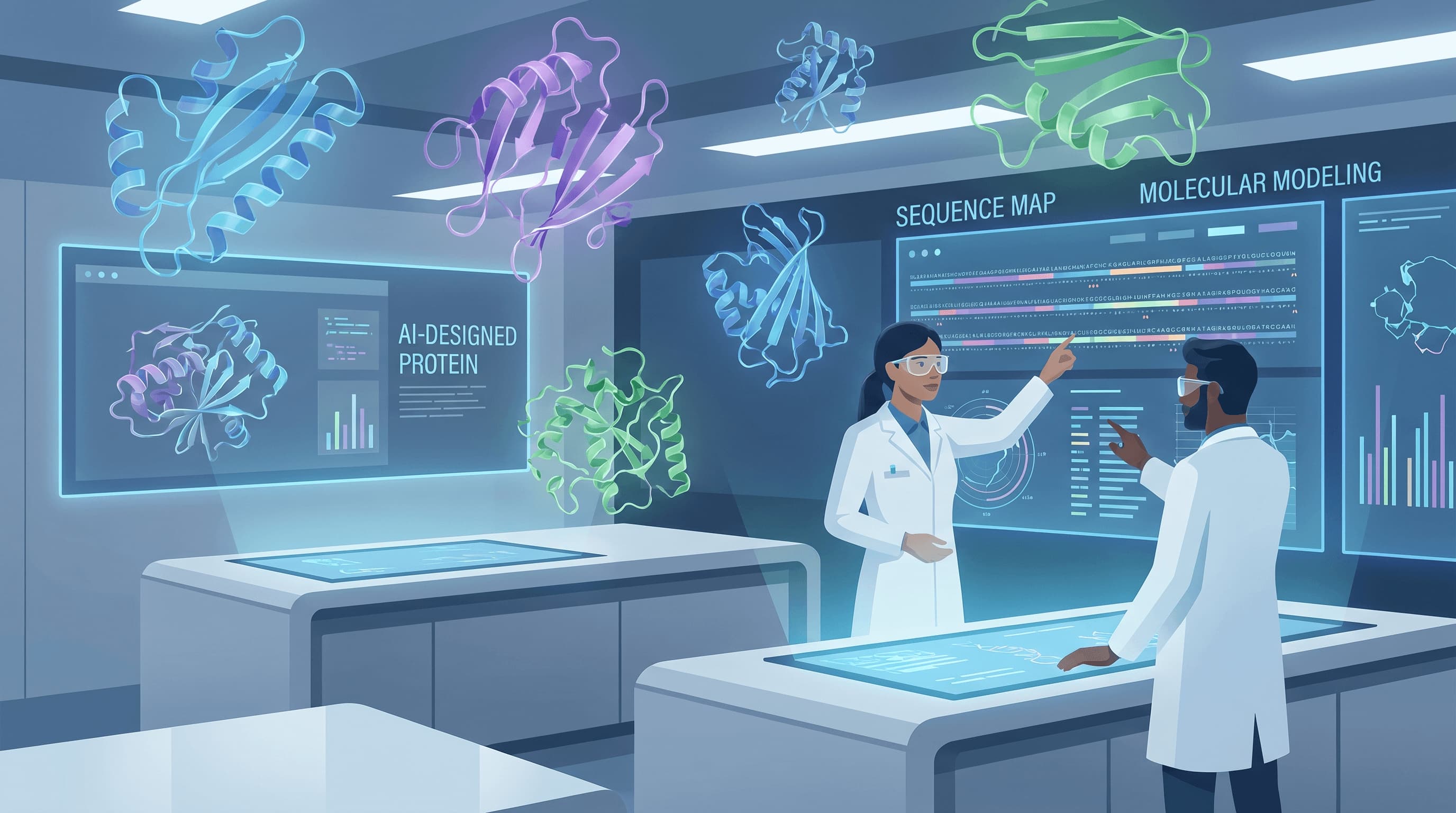
The landscape of protein science is undergoing a profound transformation, propelled by the relentless advance of artificial intelligence (AI). For years, the focus of AI in this domain centered on predicting protein structures from amino acid sequences, a challenge famously tackled by systems like AlphaFold. While groundbreaking, structure prediction alone represents only one facet of the larger ambition: to design entirely new proteins with specific, desired functions. Today, that ambition is rapidly materializing, as AI-driven protein design transitions from a theoretical concept to a practical, iterative lab discipline.
This critical shift marks a departure from simply understanding existing biological machinery to actively engineering novel biological components. The recent progress, particularly with generative AI models, is not merely incremental; it is transformative. As highlighted by recent coverage in Nature, AI tools are now capable of designing proteins from scratch, generating structures and sequences that have never existed in nature, yet possess properties crucial for therapeutic, industrial, or diagnostic applications. This capability fundamentally alters the pace and scope of innovation in biotechnology and drug discovery.
Generative AI Models Drive De Novo Design
At the heart of this revolution are advanced generative AI models, particularly those based on diffusion architectures. Researchers at institutions like MIT have been at the forefront, developing methods such as FrameDiff, FrameFlow, MultiFlow, and the widely recognized RFdiffusion. Unlike earlier predictive models, these systems are not just interpreting existing data; they are creating it. They learn the underlying principles of protein folding and function from vast datasets, then apply this knowledge to synthesize novel protein structures and corresponding amino acid sequences that meet specified design criteria.
These diffusion models excel at generating diverse protein scaffolds and binding sites, often starting from minimal input, such as a desired shape or a target molecule to bind. The outputs are then subjected to rigorous in silico filtering, assessing stability, solubility, and potential for manufacturability. Crucially, a growing number of these computationally designed proteins are moving beyond theoretical validation, demonstrating their intended properties in vitro through experimental assays. This progression from digital blueprint to tangible biological entity underscores the maturity of these AI tools.
Beyond Prediction: The Engineering Workflow Emerges
While AlphaFold-class systems instilled unprecedented confidence in our ability to predict protein structures, de novo protein design introduces a far more complex set of constraints. Designing a protein requires not only a stable fold but also specific binding affinities, enzymatic activity, thermal stability, and often, manufacturability at scale. This necessitates an integrated engineering workflow that tightly couples generative AI with a series of validation and refinement steps.
The modern protein design pipeline now looks like this: A generative model proposes novel protein candidates based on functional requirements. These candidates are then passed through computational filters that predict their stability, solubility, and potential interactions. Promising designs proceed to DNA synthesis and expression in biological systems. Finally, the synthesized proteins undergo rigorous wet-lab validation to confirm their desired properties. The results of these experiments then feed back into the AI models, refining their parameters and improving future design iterations. This closed-loop system is the hallmark of a true engineering discipline.
Implications for Biotech Teams
For biotechnology and pharmaceutical teams, this paradigm shift has profound implications. The traditional approach, often reliant on directed evolution or rational design based on existing protein scaffolds, is now augmented by the ability to explore a vastly expanded design space. This means faster lead identification, the potential to tackle previously intractable biological targets, and the creation of entirely new classes of therapeutics or industrial enzymes.
However, leveraging these capabilities demands new skill sets and organizational structures. Teams must integrate computational biologists proficient in machine learning (ML) and generative AI with structural biologists, biochemists, and assay development specialists. The interface between in silico design and wet-lab experimentation becomes the critical bottleneck and the primary driver of success. Companies that can seamlessly bridge these two worlds will gain a significant competitive advantage.
Bottlenecks and the Critical Role of Wet-Lab Throughput
Despite the remarkable progress in AI models, significant bottlenecks remain. The computational demands of training and running advanced diffusion models are substantial, requiring access to powerful GPU clusters. While inference times are improving, the sheer volume of potential designs still necessitates efficient filtering and prioritization strategies.
Crucially, the rate-limiting step is increasingly shifting from design generation to experimental validation. Generating millions of candidate proteins is computationally feasible, but synthesizing and testing them in the lab is expensive and time-consuming. The throughput of DNA synthesis, protein expression, purification, and functional assays directly dictates how quickly the design-test-learn cycle can iterate. A highly accurate AI model is only as useful as the speed at which its predictions can be validated and refined in the physical world.
Therefore, investment in high-throughput automation, microfluidics, and advanced robotics for wet-lab experimentation is as critical as, if not more critical than, further advancements in AI model quality alone. The ability to rapidly synthesize, express, and characterize hundreds or thousands of protein variants in parallel is what transforms AI's imaginative power into practical, validated biological solutions. Without this, even the most brilliant AI designs remain theoretical.
Actionable Takeaways for the Future of Protein Engineering
The transition of AI protein design into a robust lab discipline presents clear directives for organizations aiming to lead in this space. First, prioritize the development of integrated platforms that seamlessly connect generative AI models with in silico filtering tools and automated wet-lab pipelines. This means investing in robust data infrastructure and APIs that allow for smooth data flow and feedback loops.
Second, foster truly interdisciplinary teams. Success hinges on close collaboration between AI/ML engineers, computational chemists, protein biochemists, and automation specialists. Training programs that bridge these disciplines will be invaluable. Third, aggressively invest in scaling wet-lab capabilities. This includes adopting advanced automation, developing new high-throughput screening methods, and optimizing protein synthesis and characterization workflows. The future of protein engineering is not just about smarter algorithms; it's about smarter, faster, and more integrated experimental validation. The lab bench, empowered by AI, is where the next generation of biological innovation will truly take shape.