AI model routing is becoming core enterprise infrastructure
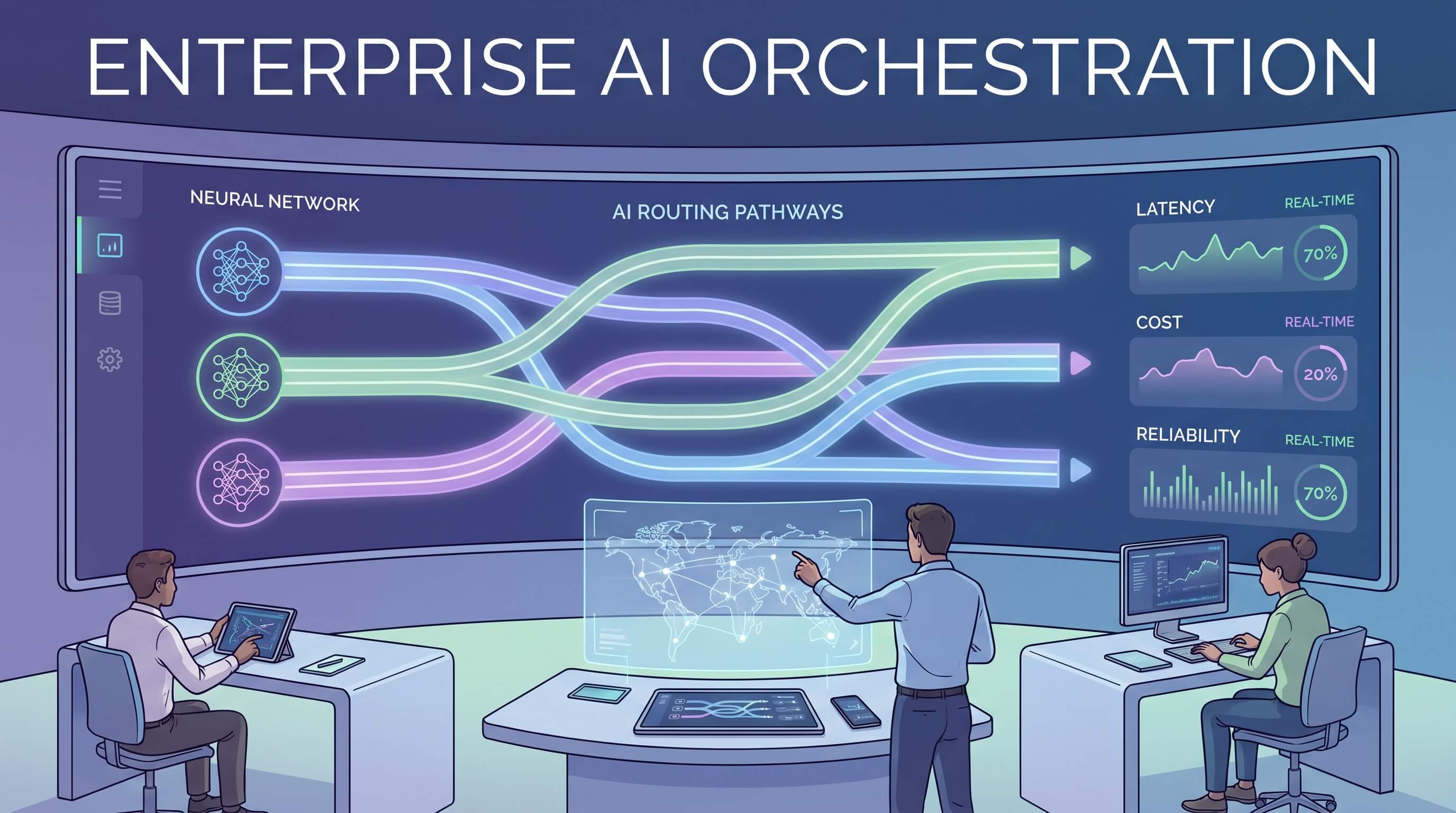
For the first two years of the generative AI boom, most companies asked the wrong question. They compared models as if the winner would become a permanent standard, then built products around a single provider and hoped the economics would improve later. That worked for prototypes. It does not work for production systems that have to survive budget reviews, compliance checks, vendor outages, and wildly different task types.
The more useful question in 2026 is not which model is best. It is how requests should move through a system that can choose among models intelligently. That is why model routing is becoming one of the most important layers in enterprise AI architecture. The routing layer decides when a lightweight model is good enough, when a reasoning model is worth the extra cost, when a task should hit retrieval before generation, and when the safest answer is no answer at all.
From model worship to workload design
There is a simple reason this shift is happening. Enterprise workloads are messy. A customer support platform may need a cheap summarizer for one request, a multilingual classifier for the next, and a stronger model for an escalation draft. A developer assistant may use a small model for prompt rewriting, a code-specialized model for implementation, and a more expensive reasoning model for architecture questions. Treating every request like it deserves the most capable model is financially sloppy. Treating every request like it deserves the cheapest model produces mediocre results.
NVIDIA’s recent blueprint for cost-efficient LLM routing makes the underlying logic explicit. Route simple tasks such as rewriting or open-ended FAQ answers to smaller models, and reserve expensive reasoning capacity for complex work such as code generation. That sounds obvious, but many production teams still have no formal mechanism for doing it. They have prompt templates, provider dashboards, and escalating API bills, but not a routing policy.
Why the routing layer matters
A good routing layer does four jobs at once. First, it classifies the task. Second, it applies business rules around budget, risk, and latency. Third, it chooses a provider or model family. Fourth, it records what happened so the system can be audited and improved. In practice, that means routing is not just a cost tool. It is where governance starts to become operational.
This is also where enterprise AI stops looking like a chatbot feature and starts looking like infrastructure. Once multiple applications share a routing and policy layer, the organization can manage rate limits, failover, redaction rules, prompt caching, and vendor switching in one place. That matters because the cost of AI is not just tokens. It is also the operational drag of managing scattered integrations.
Latency, reliability, and the hidden economics of AI
Cost is usually the headline, but latency and reliability are just as important. Many teams discover that the user experience breaks long before the budget does. A system that takes eight seconds to answer is technically functional and practically annoying. A system that works beautifully until one provider has a regional incident is not robust enough for business operations. Routing creates room for graceful degradation. A task can move from a premium model to a faster backup, or from a full generation path to retrieval plus templating, without the product collapsing.
This is one reason AI gateways are growing up fast. They act as traffic managers between internal applications and external model providers. In mature deployments, the gateway becomes the place for authentication, logging, rate limiting, budget controls, fallback policies, and experimentation. That is not glamorous, but it is how AI moves from demo to dependable service.
Evaluation becomes more important than benchmark scores
Routing only works if teams know what they are optimizing for. Public benchmarks help, but they do not answer the real production question: which system configuration gives acceptable output quality at an acceptable cost for this exact workflow? Enterprise evaluation is moving away from leaderboard obsession and toward scenario-based testing. Teams now care more about pass rates on their own customer support flows, claims reviews, coding tasks, or internal search use cases than about a one-point benchmark win on a general test set.
That changes the role of model selection. The strongest model is no longer the default answer. It is one option inside a measured system. In many cases, a small model plus retrieval plus validation beats a giant model used blindly. In others, a high-end reasoning model is worth every cent because the downstream cost of a wrong answer is far higher than the inference bill. Routing makes those tradeoffs explicit instead of accidental.
The vendor lock-in problem is finally getting practical attention
There is another reason enterprises like routing: it reduces strategic dependence on one provider. Companies still have preferences, but they are increasingly uneasy about building mission-critical systems around a single API, pricing model, or safety posture. A routing layer gives teams leverage. It becomes easier to test new models, swap providers, or move some workloads to Open Source deployments without rewriting every application.
That flexibility also changes procurement conversations. Instead of buying a model, companies are buying an operating approach. The winning architecture is often a portfolio: premium frontier models for hard tasks, cheaper models for repetitive ones, and specialized systems for classification, retrieval, or guardrails. The router is what makes that portfolio usable.
What smart teams should do next
The immediate takeaway is not that every company needs a massive orchestration platform. It is that any company serious about enterprise AI should stop wiring products directly to one model and calling the job finished. Start with an internal gateway. Log prompts and outcomes carefully. Define a few task classes. Add fallback rules. Measure latency, cost per successful task, and failure modes, not just aggregate token spend. If you cannot explain why a request went to a given model, your system is not mature yet.
The enterprise AI stack is becoming more layered, not less. That may disappoint people who want one model to solve everything. But it is healthy. Mature systems tend to separate concerns. Databases, networks, and identity did not stay simple as they became important. AI will not either. In that context, model routing is not a side optimization. It is becoming the control plane that turns generative AI from an expensive experiment into infrastructure a business can trust.