AI Game Masters and Dynamic NPCs: How Language Models Are Changing Video Game Design
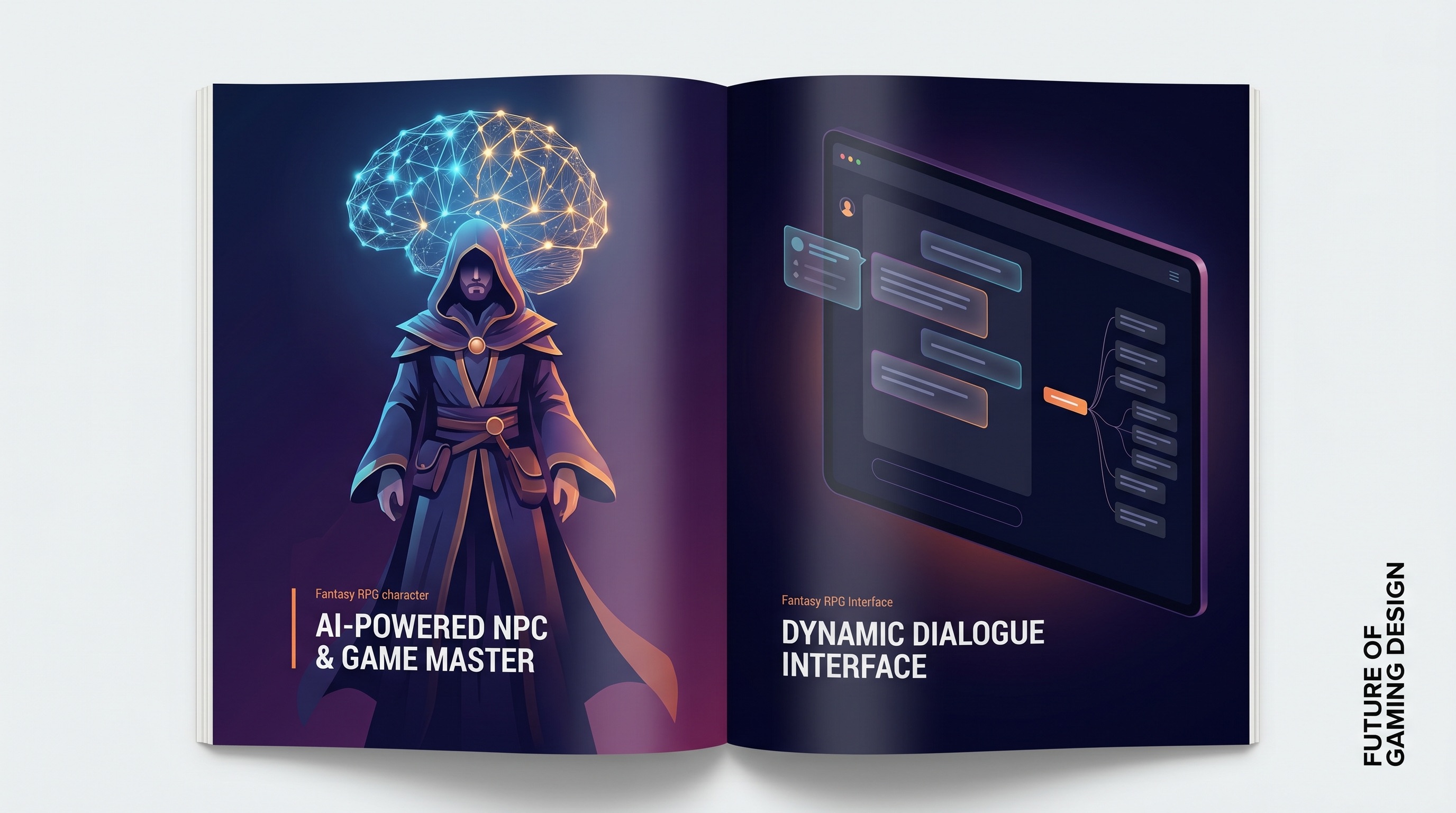
For decades, the NPCs in video games have been elaborate fictions. They delivered quest objectives, sold goods, and died convincingly, but they operated from finite decision trees — every conversation a branch the designer anticipated and scripted. Players learned quickly that the mercenaries and innkeepers populating game worlds were puppets, their illusion of life dependent on never being asked something outside their script. That constraint has defined the medium's relationship with artificial characters since Pong gave way to story-driven games.
Language models are dismantling that constraint. The same technology that lets someone hold an open-ended conversation with a chatbot is now being woven into game characters that can respond to anything a player says, remember what happened hours ago in the session, and maintain a persistent personality across an unbounded conversation. The technology is genuinely new. What remains unsolved is how to build games around it.
What Changes When NPCs Can Actually Talk Back
Traditional NPC dialogue uses behavior trees and finite state machines: if player says X, NPC responds with Y, branch to state Z. This produces characters that are coherent within their scripts but brittle outside them. Ask a medieval blacksmith about quantum physics and you get a blank response or a confused canned line. The designer couldn't anticipate that question, so the system has nothing to say.
An LLM-backed NPC doesn't branch — it generates. Given a character definition (role, personality, knowledge, goals, voice, what they know about the game world), the model can respond to essentially any input while staying in character. The blacksmith can decline to answer about quantum physics in character ("I haven't the faintest idea what you're talking about, traveler") without breaking immersion, and can answer deep questions about the town's politics, the war last year, or why she seems nervous, none of which the designer specifically scripted.
The difference isn't just dialogue depth — it's the nature of the player relationship with the game world. Characters with persistent memory can recall that the player helped them last session, hold grudges, develop genuine relationships. That transforms what "NPC" means.
The Companies Building This Infrastructure
Inworld AI is the most prominent infrastructure company in the space. Its platform lets developers define characters with personality traits, emotional states, goals, knowledge limits, and relationships, then provides a runtime that handles LLM inference, memory management, and real-time voice synthesis. Inworld has shipped integrations with several games including a Roblox experience with over 10 million plays, and has partnerships with major studios working on unannounced titles. Characters built on Inworld can remember what players said to them in previous sessions and update their emotional state based on how they're treated.
NVIDIA ACE (Avatar Cloud Engine) is a competing infrastructure play targeting the hardware angle. Announced at CES 2024 and expanded at GTC 2025, ACE bundles LLM inference, speech recognition, and voice synthesis in a pipeline designed to run partially on-device using NVIDIA GPUs. The company demonstrated a bartender NPC named Jin in a cyberpunk bar scene having fluent, context-aware conversation at real-time speeds. NVIDIA's pitch is that RTX 4090-class GPUs and above can run enough of the inference locally to achieve low latency without routing every sentence to a cloud server.
Convai targets the middle market — smaller studios that can't afford to build their own pipelines. Its platform offers a character creation interface, a knowledge base for game lore, voice integration, and multimodal awareness (characters can "see" the game environment and respond to what's happening around them, not just what the player says). Convai has had traction in VR training applications and educational games where naturalistic conversation matters more than in fast-paced action titles.
Replica Studios focuses on voice and emotion, providing AI voice actors whose performances can be generated dynamically rather than pre-recorded. This addresses a bottleneck: even if an LLM can generate infinite dialogue text, you still need a voice for it. Replica's technology generates speech with appropriate emotional tone in real time, synchronized to the generated text.
The AI Dungeon Master Model
Beyond individual NPCs, a more ambitious application puts LLMs in the role of game master — an orchestrating intelligence that manages narrative, tracks world state, and generates responsive content across an entire game session. This is essentially what AI Dungeon pioneered in text form: an LLM running a tabletop RPG-style adventure that adapts to player choices rather than following a linear script.
What makes this technically demanding is state management. A game master needs to track what has happened (the player killed the mayor, allied with the thieves guild, discovered the artifact), maintain internal consistency (the mayor is dead — no NPC should reference him as alive), and generate new content that is coherent with accumulated history. Large context windows (current frontier models can handle hundreds of thousands of tokens) help, but fitting an entire game session worth of events into a context window, structuring it for reliable recall, and inferring what the model needs to know at any given moment is a hard systems problem on top of the model problem.
Several studios experimenting with procedural narrative are working on hybrid approaches: structured game state in a database, with LLMs summarizing and retrieving relevant context on demand rather than holding everything in the model's context. This mirrors how RAG (Retrieval Augmented Generation) works in enterprise AI applications.
What AAA Studios Are Actually Doing
Ubisoft demonstrated a "NEO NPC" tech demo for Assassin's Creed in early 2024, showing a character who could respond to open-ended player questions in character. The demo was technically impressive. What hasn't shipped is a AAA game with these characters in production at scale.
The hesitation is real and not just conservatism. Large game productions have strict requirements that LLM-backed characters currently struggle to meet:
- Content control: An LLM generating responses in real time might say something that violates content guidelines, contradicts the story, or embarrasses the publisher. Sophisticated guardrails exist but add latency and can reduce response quality.
- Localization: Most shipped AAA games support 10–20 languages. Current AI voice synthesis has strong English performance and much weaker coverage elsewhere, and the cost of real-time inference multiplied across languages is substantial.
- Latency: Cloud inference introduces 200–600ms latency that is acceptable in slow-paced RPG conversation but breaks the feeling of a fast-paced encounter. On-device inference works for powerful gaming PCs but not consoles or mid-range hardware.
- Cost at scale: A game with 10 million players having conversations with NPCs generates enormous inference costs. The economics of cloud LLM inference at game scale haven't resolved to a sustainable model yet.
Indie studios, VR applications, and games specifically designed around conversation are the first adopters, precisely because they can constrain the scope in ways that mitigate these problems.
Design Questions the Technology Raises
The deeper challenge may be less technical than creative. Games are designed experiences — narrative tension requires constraints, challenge requires failure states, drama requires characters who don't always give players what they want. An infinitely accommodating NPC might be more realistic but less interesting as a game character.
The best traditional game writing uses character voice, limited information, and conflicting motivations to create drama. An LLM can generate infinite dialogue, but generating dialogue with strategic friction — the character who won't tell you what you need to know, the ally whose loyalty has limits — requires careful prompt design and system constraints. The technology democratizes conversation; it doesn't automatically make conversations meaningful.
Game designers are starting to treat "character constitution" (the document that defines what an AI character knows, believes, values, and refuses to do) as a craft skill as important as traditional writing. The output of an LLM-backed character is only as good as the constraints and context given to the model.
Actionable Takeaways
- The infrastructure layer is maturing: Inworld, Convai, and NVIDIA ACE have moved from demos to deployable SDKs. Developers who want to experiment have real tools, not just research papers.
- Start with bounded use cases: Tutorial guides, ambient flavor characters, and companion characters in single-player experiences are lower-stakes testing grounds than quest-critical NPCs whose failures would break the main narrative.
- Latency and cost are the current ceiling: Until on-device inference for competitive NPUs and mid-range GPUs is solved, this technology will remain limited to high-end PC, VR, and games specifically designed around the constraint.
- The game design problem is harder than the AI problem: Studios that invest in LLM-backed NPCs without rethinking dialogue design will get uncanny valley conversation — technically impressive but narratively hollow.
- Watch the 2026–2027 release window: Several studios have been building with this technology in production for 12–18 months. The first wave of shipped titles with LLM-backed characters will reveal what the technology actually means for players, not just demos.