AI Evaluation Stacks Are Becoming Product Infrastructure
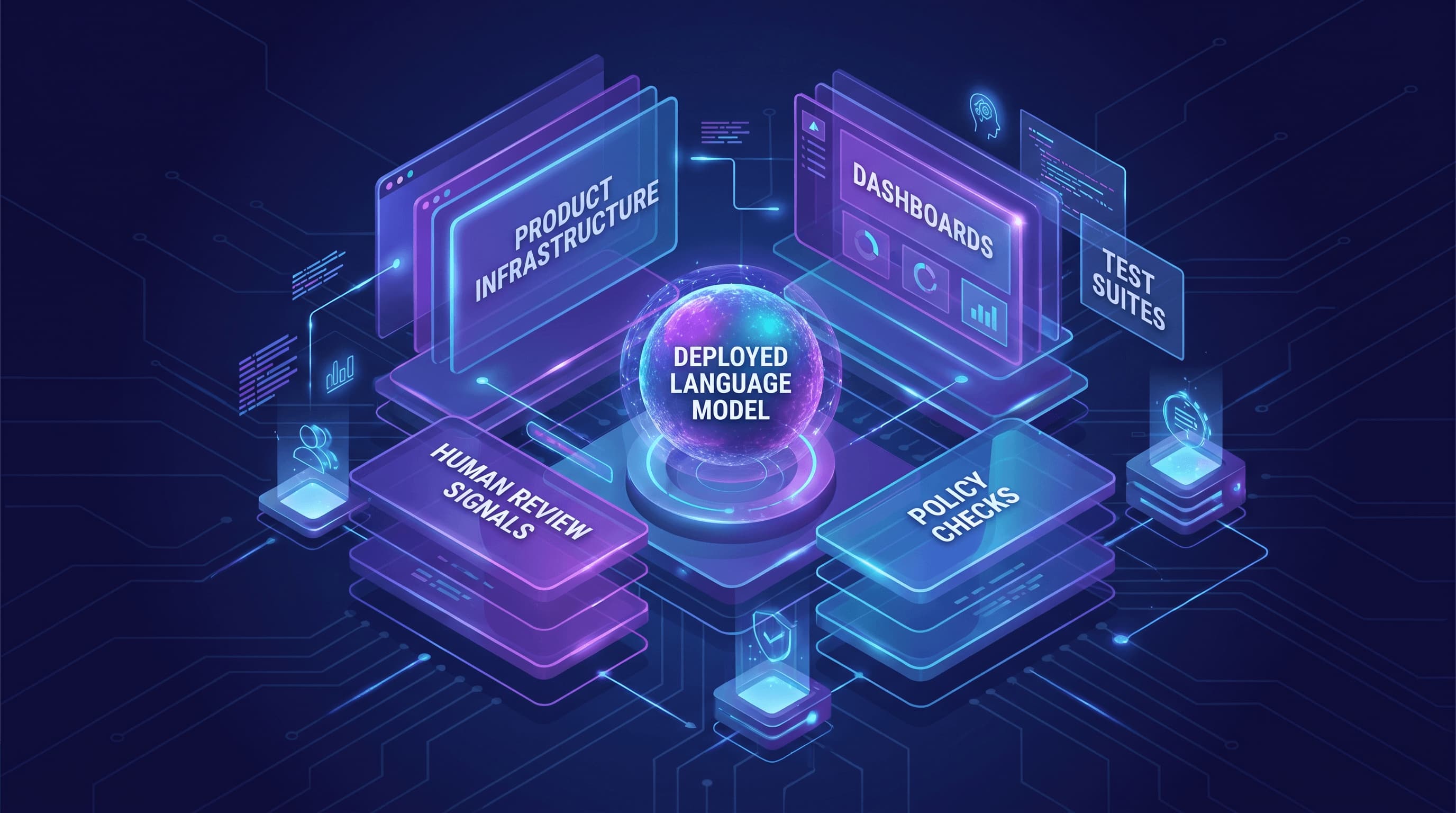
For years, the conversation around AI development, particularly for large language models (LLMs), centered on pre-training: the monumental task of gathering vast datasets and training ever-larger models with billions or even trillions of parameters. While pre-training remains foundational, a significant, often underappreciated, shift is underway in enterprise AI. Evaluation, once largely confined to academic benchmarks or post-hoc analysis by researchers, is rapidly evolving into a core piece of product infrastructure. This isn't just about measuring performance; it's about determining whether an AI system is safe to ship, reliable to operate, and efficient enough to justify its existence in a production environment.
This transformation reflects a maturing industry. Enterprises are moving beyond experimental AI projects to integrate AI deeply into their products and workflows. With this integration comes a heightened demand for predictability, control, and accountability. The ability to rigorously and continuously evaluate AI behavior, rather than simply relying on a model's raw capabilities, is becoming the true differentiator. It's the mechanism that ensures AI systems align with business objectives, ethical guidelines, and user expectations, transforming evaluation from a research afterthought into a critical component of model governance and LLMOps.
The Post-Training Imperative: Shaping AI Behavior
The journey from a pre-trained model to a production-ready AI system is rarely a straight line. Pre-training equips models with a broad understanding of language and patterns, but it doesn't inherently imbue them with specific desired behaviors, safety guardrails, or alignment with corporate values. This is where post-training refinement becomes indispensable. Research into techniques like Anthropic's Constitutional AI illustrates this perfectly: it describes a process of self-critiques, revisions, supervised fine-tuning (SFT), and Reinforcement Learning from AI Feedback (RLAIF) as ways to shape model behavior after initial pre-training.
These post-training methods are, at their core, sophisticated forms of iterative evaluation and refinement. They involve defining criteria (explicitly or implicitly), generating responses, evaluating those responses against the criteria, and then using that feedback to further train the model. IBM's explanation of RLHF (Reinforcement Learning from Human Feedback) further clarifies this: it's about training a reward model from human feedback when the desired goals are hard to specify directly. This highlights why evaluation criteria are paramount, both before and after any tuning process. Without clear criteria, whether human-defined or AI-generated, the refinement process lacks direction, and the resulting model's behavior becomes unpredictable.
Building a Robust Enterprise AI Evaluation Stack
Moving evaluation from a theoretical exercise to a practical, integrated part of product development requires a robust, multi-faceted stack. This infrastructure ensures that AI systems meet stringent operational and ethical standards before and after deployment. The components of such a stack are diverse and interconnected:
Task-Specific Benchmarks and Datasets
Generic benchmarks like GLUE or MMLU are useful for broad capability assessment, but enterprise AI demands custom, task-specific benchmarks. These involve creating proprietary datasets that accurately reflect the nuances, domain language, and specific performance requirements of the intended application. A model might excel on general knowledge but fail spectacularly on internal customer support queries without tailored evaluation.
Human-in-the-Loop Review
Automated metrics can only capture so much. Human review remains critical for assessing subjective qualities like tone, creativity, empathy, safety, and adherence to complex brand guidelines. Expert human annotators or domain specialists provide invaluable qualitative feedback, identifying subtle failures or emergent behaviors that purely quantitative methods might miss. This often involves setting up clear rubrics and workflows for human assessment.
Policy and Compliance Checks
For many industries, regulatory compliance and internal policy adherence are non-negotiable. The evaluation stack must include automated and manual checks to ensure AI outputs comply with legal requirements (e.g., GDPR, HIPAA), ethical guidelines (e.g., fairness, bias mitigation), and company-specific policies (e.g., acceptable content, data privacy). This can involve specific classifiers or rule-based systems.
Latency, Cost, and Throughput Measurement
Operational efficiency is paramount for production AI. The evaluation stack must continuously measure key performance indicators (KPIs) like inference latency, throughput (queries per second), and the computational cost per inference (e.g., GPU/CPU utilization, memory footprint). A model that provides excellent answers but costs too much or responds too slowly is not viable for many real-world applications. These metrics directly impact the total cost of ownership and user experience.
Hallucination and Factual Accuracy Testing
One of the most persistent challenges with generative AI is the tendency to "hallucinate" – generating factually incorrect but confidently presented information. Dedicated evaluation components are essential to test for hallucinations, often by cross-referencing generated content against trusted knowledge bases or by prompting models with known factual queries and assessing accuracy. This is particularly critical for applications involving sensitive information or decision-making.
Automated Regression Suites and Release Gates
Just as in traditional software development, AI models require robust regression testing. As models are fine-tuned, updated, or integrated into new systems, it's crucial to ensure that new versions do not introduce silent regressions on previously established performance or safety criteria. An AI evaluation stack integrates these regression suites into CI/CD pipelines, acting as automated release gates that prevent models from being deployed if they fail critical tests.
The New Competitive Edge: Measuring What Matters
In the past, the race often seemed to be about who could deploy the largest model or achieve the highest score on a few academic benchmarks. That era is fading. Enterprises no longer win by picking the largest model alone; they win by meticulously measuring the specific behaviors they care about and refusing to tolerate silent regressions. The real competitive advantage comes from having the infrastructure and processes in place to reliably evaluate, iterate, and govern AI systems throughout their lifecycle. This allows organizations to build AI that is not just powerful, but also trustworthy, predictable, and aligned with their strategic goals.
Navigating the Pitfalls and Tradeoffs
While essential, AI evaluation is not without its challenges. It can, if poorly implemented, devolve into bureaucratic theater, where metrics are collected but rarely acted upon. Weak or unrepresentative datasets can create a false sense of confidence, leading to the deployment of brittle models that fail in real-world scenarios. Furthermore, some critical qualities, such as genuine creativity, nuanced ethical reasoning, or long-term societal impact, remain inherently hard to score numerically, requiring a blend of quantitative metrics and qualitative expert judgment.
Actionable Takeaways for Enterprise AI Teams
To truly leverage AI, organizations must:
- Invest in Dedicated Evaluation Infrastructure: Treat evaluation tools and platforms as first-class citizens, not afterthoughts. This includes dedicated MLOps/LLMOps teams focused on building and maintaining these systems.
- Define Clear Success Criteria Upfront: Before deploying any AI model, clearly articulate what "success" looks like in measurable terms, encompassing not just accuracy but also safety, fairness, cost, and latency.
- Integrate Evaluation Throughout the AI Lifecycle: Embed evaluation into every stage, from initial model selection and fine-tuning to continuous monitoring in production. It's an ongoing process, not a one-time event.
- Combine Quantitative and Qualitative Methods: Leverage automated metrics for scale and efficiency, but always complement them with expert human review for nuance, subjective qualities, and emergent risks.
- Establish AI Governance Frameworks: Implement clear policies and procedures for model validation, approval, and deployment, with evaluation data serving as the cornerstone of these decisions.