AI Earbuds That Translate in Real Time: What Sony, Apple, Google, and Bose Actually Deliver in 2026
The Babel Fish Is Almost Here — But Not Quite
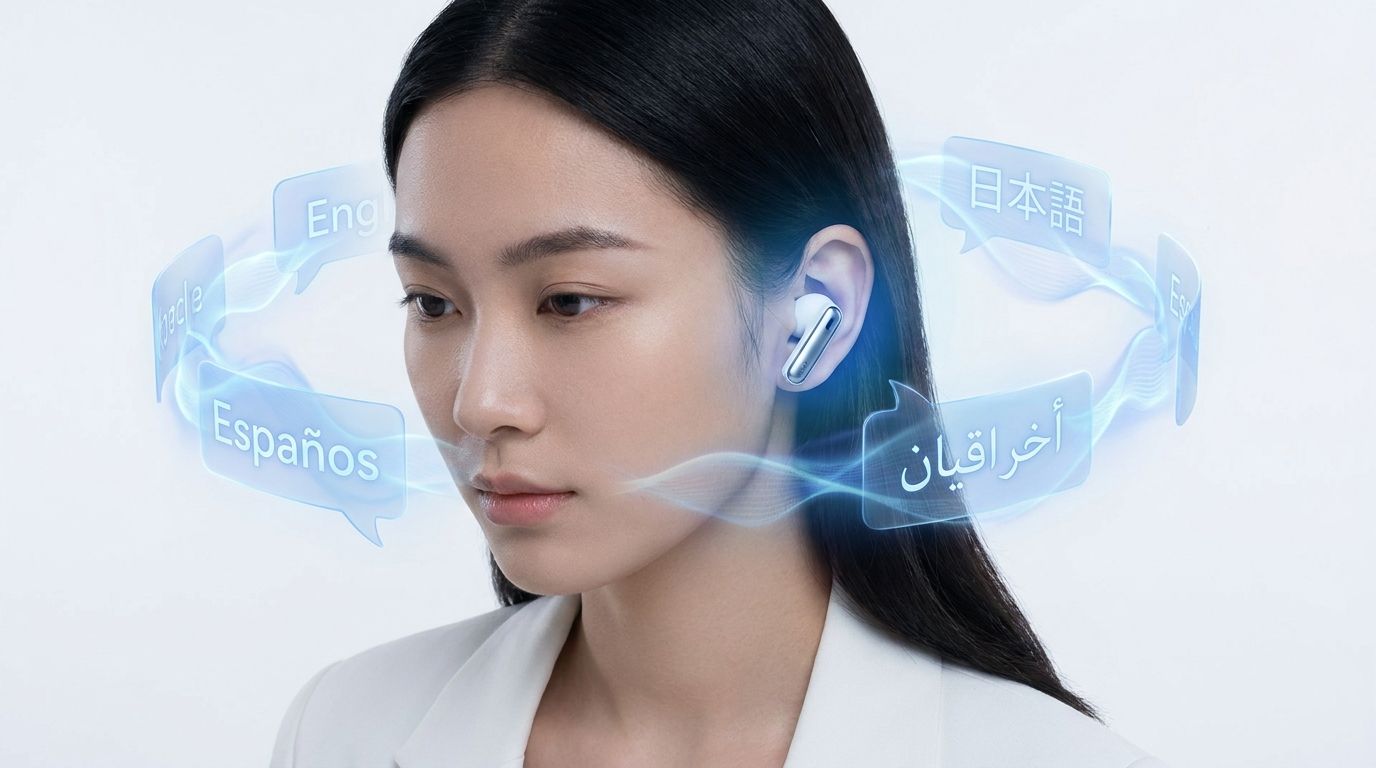
For decades, the idea of earbuds that whisper instant translations into your ear belonged to science fiction. In 2026, it is no longer fiction — but it is not quite the seamless experience the marketing suggests either. Apple, Google, Sony, and Bose are each staking their own claim to this feature set, and the gap between their approaches is significant. If you are planning to rely on AI earbuds for travel, business negotiations, or medical appointments, the differences between these products could mean the difference between a smooth conversation and an embarrassing miscommunication.
The core thesis is straightforward: Apple's AirPods Pro 3 and Google's Pixel Buds Pro 2 are the only mainstream earbuds with genuinely functional real-time conversation translation today. Sony's WF-1000XM6 leads in audio quality and noise cancellation but does not offer native translation. Bose's QuietComfort Ultra 2nd Gen does the same — world-class ANC, AI-powered call clarity, but no translate mode. Here is what you need to know before spending $250–$300 on a promise.
Apple AirPods Pro 3: The Most Polished Implementation
Launched in September 2025 alongside iOS 19 and Apple Intelligence, the AirPods Pro 3 introduced Live Translation as a flagship feature. The system uses on-device Apple Intelligence models combined with your iPhone's processing power to capture speech, translate it, and deliver audio to your ear — all within roughly 1 to 1.5 seconds of the speaker finishing a sentence. That latency is fast enough to follow most conversational exchanges without losing the thread.
At launch, supported languages included English, French, German, Portuguese, and Spanish. By late 2025, the list expanded to include Italian, Japanese, Korean, and both Simplified and Traditional Mandarin Chinese — ten languages total. The EU rollout followed in November 2025. Notably, Live Translation is not exclusive to AirPods Pro 3: it also runs on AirPods Max 2 and AirPods 4 with ANC, all requiring an Apple Intelligence-capable iPhone running iOS 26 or later.
The two-user scenario is where Apple's implementation genuinely impresses. When both parties wear AirPods, the system automatically routes translated audio to each listener while the other speaks. When only one person has AirPods, the iPhone screen can display a live transcription in the other person's language. Real-world reviewers at Macworld and Engadget confirmed the feature works well in quiet environments, with accuracy high enough for practical conversations. Accuracy drops noticeably with heavy accents, fast speech, and strong background noise.
- Languages: 10 (English, French, German, Spanish, Portuguese, Italian, Japanese, Korean, Mandarin Simplified, Mandarin Traditional)
- Latency: 1–1.5 seconds
- Requires: Apple Intelligence-capable iPhone, iOS 26+
- Price: $249
Google Pixel Buds Pro 2: The Best Option for Android Users
Google has been doing earbud translation longer than anyone else — the original Pixel Buds launched this feature back in 2017 — and the Pixel Buds Pro 2 represent the most refined version of that work. The implementation is powered by Gemini 2.5 Flash Native Audio and Google Translate, giving it access to over 70 languages, far broader coverage than Apple's ten.
Latency sits in the same 1–2 second range as AirPods Pro 3 under good network conditions, though the Pixel Buds system is more dependent on a stable data connection than Apple's hybrid on-device approach. The practical advantage of Google's model is ecosystem openness: while the Pixel Buds Pro 2 pairs most cleanly with Pixel phones, Android Central's head-to-head comparison confirmed that Google's translation layer works across Android 6 and later, including Samsung and OnePlus devices. That is a significant edge for users who are not locked into a specific Android OEM.
Android Central's testing found that translation through Pixel Buds Pro 2 feels more native — fewer hand-offs between apps, smoother audio handback — though accuracy in fast-paced multilingual conversations was comparable to AirPods Pro 3. Where Google falls short is in the two-user scenario: there is no equivalent of Apple's dual-AirPods translation mode. One person speaks, the translation surfaces; turn-taking must be deliberate.
- Languages: 70+
- Latency: 1–2 seconds (network-dependent)
- Requires: Android 6+ (best with Pixel phone)
- Price: $229
Sony WF-1000XM6: Exceptional Earbuds, No Native Translation
Sony's WF-1000XM6, released in mid-2026 with a redesigned pill-shaped form factor, is by most accounts the finest-sounding pair of true wireless earbuds available right now. The dual-processor setup with eight adaptive microphones delivers class-leading adaptive noise cancellation. DSEE Ultimate with Edge-AI upscales compressed audio in real time. LDAC and Bluetooth LE Audio support place it at the top of the audiophile shortlist.
But Sony made a deliberate choice: the WF-1000XM6 does not include built-in real-time translation. If you want translation, you need to use a third-party app such as Google Translate on your paired phone, with audio routed through the earbuds. That works, but it adds friction — you are launching a separate app, granting microphone access, and managing UI during a live conversation. For occasional use while traveling, that friction is manageable. For business meetings where you need translation to run invisibly in the background, it is not.
Sony's focus remains squarely on audio fidelity and noise isolation. If translation is a secondary concern and audio quality is the primary one, the XM6 earns its $279–$299 price. If translation is central to your use case, Sony is not the right choice today.
Bose QuietComfort Ultra Earbuds 2nd Gen: AI for Calls, Not Conversations
The Bose QuietComfort Ultra Earbuds 2nd Gen, launched in summer 2025, refined an already excellent product with Bluetooth 5.4, LE Audio support, wireless charging, and a new AI SpeechClarity feature that uses machine learning to isolate human speech during calls and suppress background noise. It is genuinely impressive for phone calls and video meetings.
Like Sony, however, Bose does not offer native real-time translation. The AI on board is entirely devoted to noise suppression and call quality — not language conversion. A March 2026 firmware update improved ANC controls further but added no translation capabilities. The QC Ultra 2 is a strong pick for frequent travelers who need reliable ANC and excellent call quality, but if you need to converse with someone who speaks a different language, you are back to holding up your phone.
The Honest Limitations of Current Translation Tech
Even the best implementations — AirPods Pro 3 and Pixel Buds Pro 2 — share a set of real-world constraints that no marketing page will emphasize:
- Latency under noise: In loud environments like airport terminals or restaurants, both systems slow down and drop accuracy. A 1-second delay in a quiet room becomes a 2–3 second delay when the mic has to fight ambient sound.
- Slang, idiom, and dialect: Both Apple and Google systems struggle with regional dialects, colloquial shorthand, and fast native-speed speech. A Mexican Spanish speaker and a Castilian Spanish speaker will get different accuracy levels.
- Phone dependency: Neither system is fully on-device. Both offload at least some processing to a paired smartphone. No phone signal or dead battery means no translation.
- Medical and legal contexts: Accuracy claims of 98%+ come from clean lab conditions. In a clinical consultation or legal deposition, that 2% error rate on a critical term is unacceptable. Human interpreters remain essential for high-stakes professional settings.
- Turn-taking discipline: Current systems interpret one speaker at a time. Interruptions, overlapping speech, and rapid back-and-forth degrade output significantly.
Real-World Use Cases: Where Each Product Fits
Travel: AirPods Pro 3 for iPhone users; Pixel Buds Pro 2 for Android. Both handle tourist-level interactions — ordering food, asking directions, hotel check-ins — very competently in their ten or seventy supported languages respectively.
Business meetings: AirPods Pro 3 performs best here due to the dual-user translation mode and tighter iPhone integration. A Pixel 9 paired with Pixel Buds Pro 2 works well for one-on-one calls but is less elegant for face-to-face meetings with two participants who need translation simultaneously.
Medical appointments: Use AI translation earbuds only for preliminary context-gathering. For any diagnostic conversation, prescription discussion, or consent process, engage a certified medical interpreter. The latency, accuracy limits, and lack of medical vocabulary depth make current earbud translation unsuitable as the sole communication tool.
Buying Guidance: Who Should Get What — and When to Wait
Buy AirPods Pro 3 now if you are on iPhone, travel internationally at least a few times per year, and want translation as a native seamless feature. The ten-language set covers most Western and East Asian travel contexts. The dual-user translation mode is a genuine differentiator.
Buy Pixel Buds Pro 2 now if you are on Android and need coverage beyond Apple's ten languages — particularly for Southeast Asian, Middle Eastern, or Eastern European languages. The 70-language library is the broadest of any mainstream pair today.
Buy Sony WF-1000XM6 if audio quality is your top priority and translation is a nice-to-have rather than a need-to-have. Pair it with Google Translate on your phone for occasional use. Do not buy it expecting anything resembling seamless live translation.
Buy Bose QuietComfort Ultra 2nd Gen if you spend most of your day on calls and need the best AI-powered call clarity available, and translation simply is not a requirement. It remains a best-in-class choice for that specific use case.
Wait if your primary need is multilingual conference room translation or clinical-grade accuracy. The technology is improving rapidly — iOS 26 beta already hints at expanded language support — but current limitations around latency, ambient noise handling, and dialect accuracy mean a 2027 product cycle will likely be meaningfully better for demanding professional contexts.