AI coding agents need observability before they deserve more autonomy
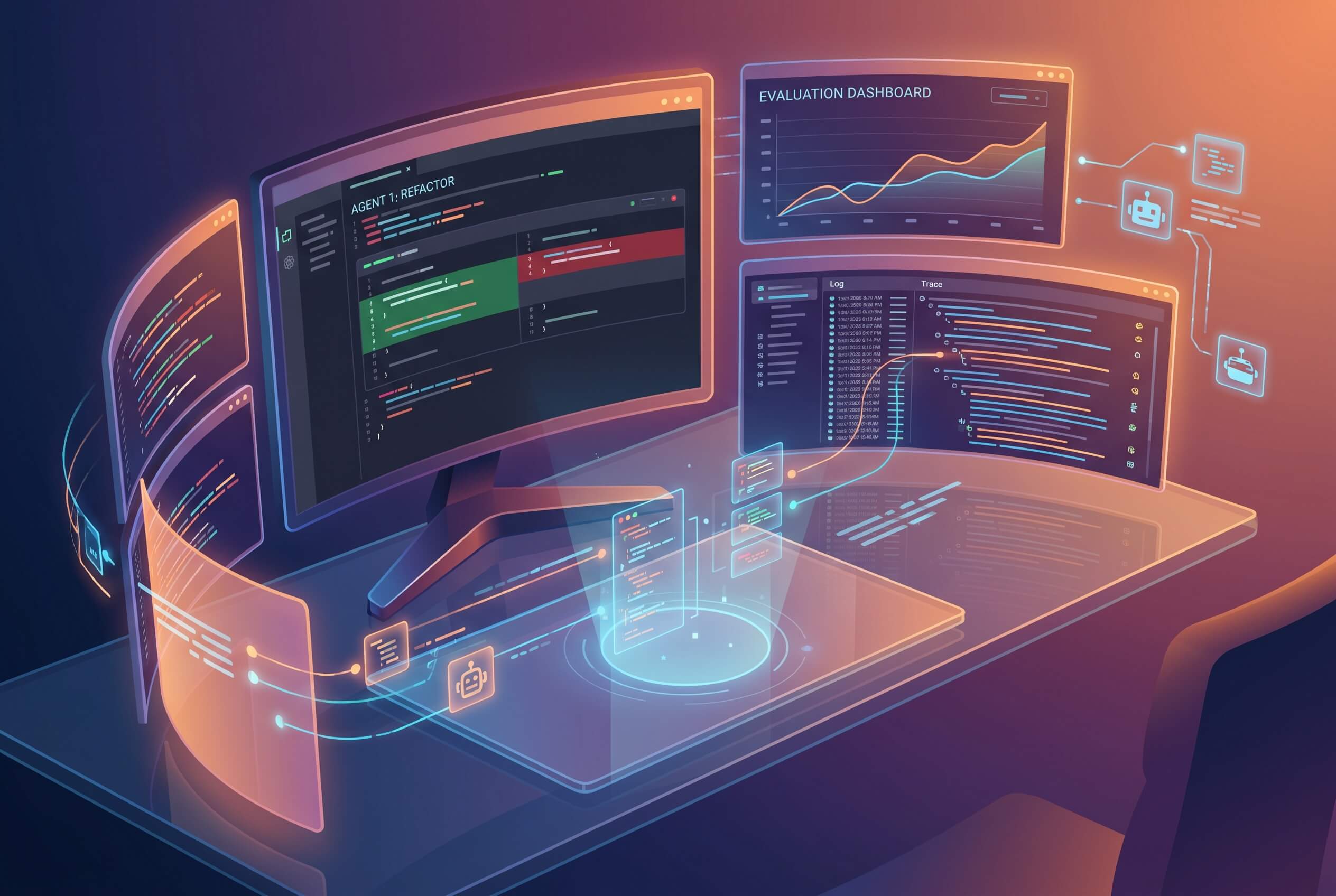
The software industry spent the last two years arguing about whether AI can write useful code. That question is no longer the interesting one. In many teams, AI already writes enough code to be operationally relevant. The harder question now is whether organizations can observe, evaluate, and govern the behavior of coding agents well enough to let them take on more responsibility. Without that layer, additional autonomy is less a productivity breakthrough than a new source of invisible risk.
This is why observability is emerging as one of the most important developer-tool categories around AI coding. Traditional software observability tells teams what an application did in production. Coding-agent observability needs to tell teams what an AI system attempted, which tools it called, what context it saw, how it reasoned about a change, what files it touched, what tests it chose to run, what it ignored, and why reviewers should trust or reject the result. In other words, it is not enough to inspect the final diff. Teams increasingly need a trace of the machine workflow that produced it.
Code generation scaled faster than review systems
That mismatch is becoming obvious. AI can generate code at a pace that older review habits were never designed for. Even Qodo, in a 2026 discussion of AI code review patterns, argues that context, severity, and specialist-agent workflows will matter more than simple comment volume as AI-driven review matures. SonarSource makes a parallel point from the static-analysis side: automated code review is most valuable when it catches bugs, security issues, and standards violations consistently across both human-written and AI-generated code.
The important shift is that generated code does not just increase output. It increases the amount of output that must be interpreted. That creates a new burden on senior engineers, security teams, and platform teams. If the organization cannot separate high-confidence changes from risky ones, velocity gains become fragile very quickly.
Observability is what turns an agent from magic into infrastructure
Well-behaved infrastructure is inspectable. That rule applies just as much to AI agents as it does to distributed systems. A coding agent that can open issues, change files, query documentation, run tests, or invoke external tools is effectively participating in the software delivery pipeline. Once it reaches that status, teams need more than a pleasant chat transcript or a commit summary.
They need event logs, tool traces, execution graphs, policy checkpoints, and evaluation artifacts. They need to know whether the agent based a change on stale documentation, whether it skipped a critical test suite for speed, whether it edited adjacent files with high blast radius, and whether similar tasks have failed before. Observability is the mechanism that makes those questions answerable at scale.
This is also where the market is getting more interesting. The next generation of developer tools will likely compete not only on how clever their models are, but on how legible their agent behavior becomes. A team may prefer a slightly less aggressive agent if its decision trail is easier to inspect and its failure modes are easier to contain.
Why evals are part of the same stack
Observability without evaluation can still leave teams with a beautiful dashboard and no real confidence. Evals give structure to trust. If an agent regularly handles dependency upgrades, test fixes, refactors, documentation generation, or structured code review, teams need repeatable ways to measure whether it performs acceptably in each workflow. That means benchmark tasks, policy rules, severity thresholds, and feedback loops that improve over time.
The important nuance is that generic benchmarks are not enough. A coding agent may perform well on public tasks and still fail badly inside a company’s actual codebase, with its own architecture, compliance rules, and deployment conventions. That is why internal evals are becoming strategic. They tell teams not whether an AI model is broadly impressive, but whether it is safe and useful in their environment.
The real risk is hidden automation debt
Every major automation wave creates a new kind of debt. With AI coding agents, one of the biggest risks is hidden automation debt, meaning code or workflow decisions that look productive in the moment but quietly accumulate fragility because nobody fully understands how or why they were produced. A human engineer can create that kind of debt too, of course. The difference is scale. Agents can produce more changes, faster, and with less social friction, which makes weak oversight more dangerous.
That is why pure acceleration metrics are misleading. Number of accepted diffs, lines changed, or tickets closed can look great while review quality, architectural consistency, and operational safety are drifting in the wrong direction. Observability helps teams see whether the system is compounding trust or merely compounding output.
What good developer teams should do now
Teams adopting AI coding agents should treat them less like brilliant interns and more like new production systems. Start with narrow scopes. Instrument every workflow. Capture tool use, context sources, diffs, test outcomes, and review feedback. Build lightweight policy gates for high-risk file areas and security-sensitive changes. Separate low-risk automation from changes that still require strong human signoff.
Just as important, teams should invest in their own rubric for what a good agent-produced change looks like. Correctness is only part of the answer. There is also readability, architectural fit, rollback safety, test quality, and alignment with internal standards. If those criteria remain implicit, the organization will struggle to scale agent use responsibly.
The practical takeaway
The next real competition in developer tools will not be won solely by whoever generates the most code. It will be won by whoever makes AI-assisted software development trustworthy enough for real operational use. That requires more than model quality. It requires observability, evaluation, and control surfaces that fit how software teams actually manage risk.
AI coding agents may eventually earn much more autonomy. But they do not get there by charisma, demo velocity, or clever prose in a pull request. They get there by becoming visible enough to audit, measurable enough to improve, and constrained enough to trust. Until then, observability is not an optional add-on. It is the price of admission.