AI Infrastructure Capital Is Reshaping Startup Strategy
The New Reality of AI Venture Funding
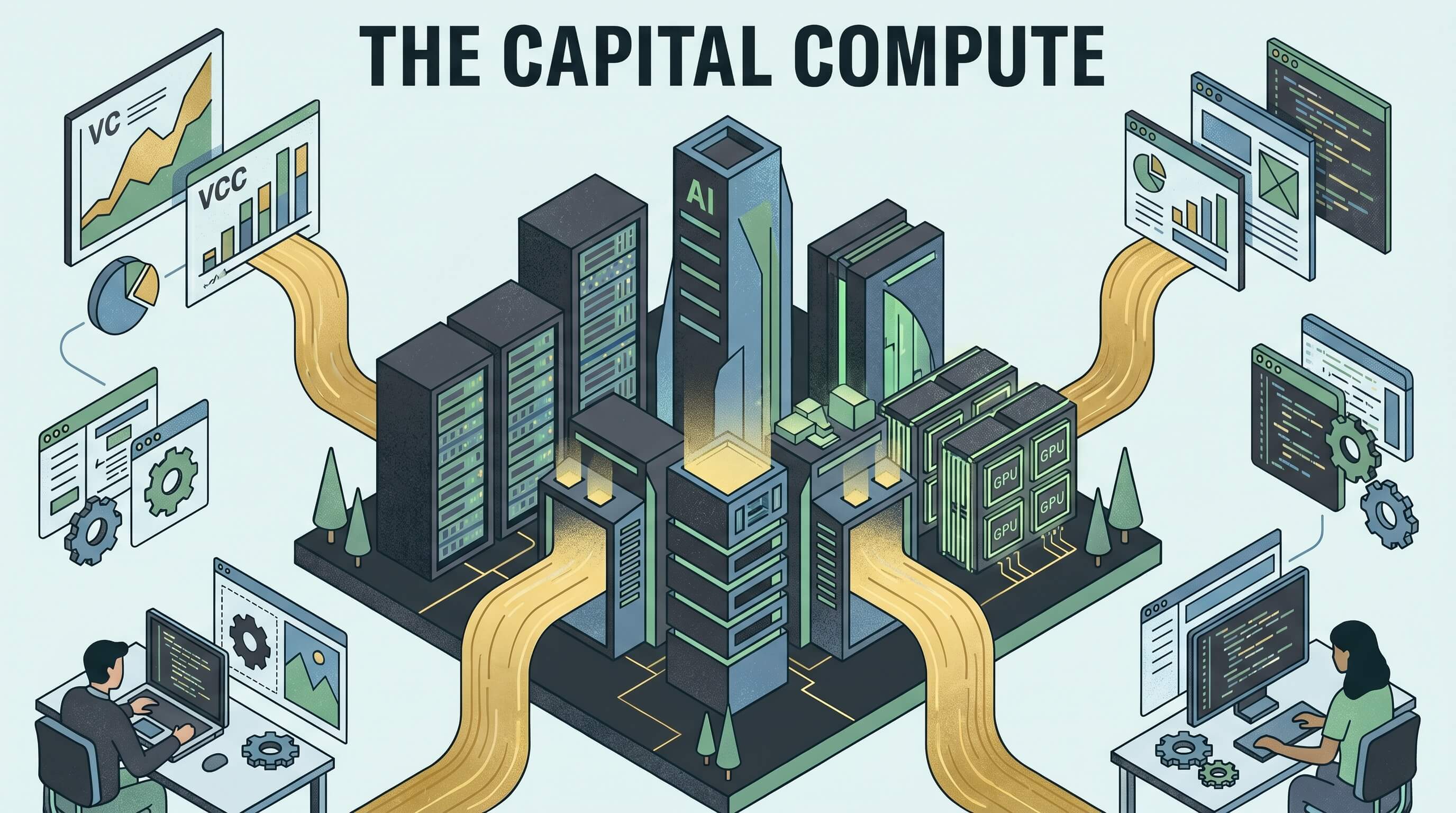
The venture capital figures for the first quarter of 2026 confirm a trend that has been solidifying for months: the AI funding boom is not a rising tide lifting all boats. It is a highly concentrated torrent of capital flowing into a select few areas—GPU clouds, custom silicon, data center construction, and the largest foundational model labs. While headlines celebrate record-breaking investment in AI, the reality on the ground is that this capital is consolidating, creating a new center of gravity that fundamentally reshapes the strategic landscape for every other startup.
This is not merely a funding trend; it is a market-defining shift driven by physical constraints. The generative AI revolution runs on massively parallel computation, which requires immense amounts of electricity, cooling, and advanced networking. Consequently, the most significant barriers to scale are no longer just software engineering challenges but capital-intensive infrastructure problems. For founders building applications on top of this stack, understanding these underlying economics is no longer optional. It is the primary determinant of a viable business model, product strategy, and potential exit path.
How Infrastructure Economics Squeezes Application-Layer Startups
The concentration of capital at the infrastructure layer creates significant downstream pressure. Startups that are effectively thin wrappers around a third-party API are finding their position increasingly precarious. The economics are stark and unforgiving, creating challenges in two key areas.
The Tyranny of Inference Costs
When your core product relies on API calls to a large foundational model, your cost of goods sold (COGS) is largely outside your control. Every user query, every generated report, and every automated summary incurs an inference cost dictated by your provider. This makes it incredibly difficult to build a defensible gross margin. While you might acquire customers with a compelling user experience, your profitability is perpetually tethered to the pricing whims of the infrastructure giants. As these providers seek to recoup their massive capital expenditures, you can expect these costs to remain significant, squeezing your margins and limiting your ability to scale profitably.
The Enterprise Shift from Novelty to Measurable ROI
The initial wave of enterprise AI adoption was driven by novelty and the fear of missing out. A compelling demo was often enough to secure a pilot project. That era is definitively over. Enterprise buyers in 2026 are sophisticated and demanding. They now ask pointed questions about total cost of ownership, data privacy, model reliability, and, most importantly, measurable return on investment. They are no longer buying "AI"; they are buying solutions to specific business problems. A product that simply offers a conversational interface to a general-purpose model is no longer defensible. Buyers want to see exactly how a tool will reduce operational costs, increase revenue, or mitigate risk, with clear metrics to back it up.
Finding Defensible Ground: Viable Strategies for Founders
While the landscape is challenging, it is far from impossible. The key is to shift focus away from areas where you directly compete with the infrastructure layer and toward opportunities where capital is not the primary moat. Founders can still build highly valuable and scalable companies by focusing on capital-efficient strategies.
Own the Workflow, Not Just the Model
Instead of building a horizontal tool, build a vertical one that solves a complete, industry-specific problem. The value is not in providing access to a large language model but in deeply integrating that model into a critical business workflow. For example, a tool for M&A lawyers that automates due diligence by analyzing data rooms, or a platform for radiologists that pre-screens diagnostic images for anomalies. In these cases, the moat is the domain expertise, the proprietary data loop you create, and the stickiness of being embedded in a user's daily operations.
Build the Essential Plumbing and Data-Centric Tools
The most valuable asset in the AI stack is often the high-quality, proprietary data used for training and fine-tuning. This creates a massive opportunity for startups building the essential "plumbing." This includes tools for data labeling, data cleaning, synthetic data generation, and privacy-preserving technologies like data clean rooms. These businesses are less glamorous but are critical enablers for the entire ecosystem. They are highly defensible because they solve a persistent, complex problem that every company deploying AI faces.
Compete on Efficiency at the Edge
Counter the high cost of centralized, large-scale inference by developing smaller, highly optimized models designed to run on-device or at the network edge. This approach offers significant advantages in cost, latency, and privacy. Use cases in industrial IoT, autonomous retail, and consumer hardware are immense. Technologies like WebAssembly (WASI) are emerging as a standard for deploying secure and portable computational modules, making it easier to run sophisticated logic, including AI models, outside of centralized data centers.
Actionable Takeaways for Operators
Navigating this new environment requires a deliberate and clear-eyed strategy. Founders and operators should internalize the following principles:
- Recalibrate Your Funding Strategy: Unless you are building foundational infrastructure, do not structure your business to require mega-rounds of funding. Focus on capital efficiency and a clear path to revenue that does not depend on massive, speculative investment.
- Model Your Unit Economics Obsessively: Treat inference costs as a primary component of your COGS from day one. If your business model cannot withstand a 2x increase in API costs, it is not robust. Explore smaller open-source models or fine-tuning to gain more control over your cost structure.
- Sell a Solution, Not a Feature: Move beyond demos and ROI calculators. Sell a complete solution that embeds deeply into a customer's workflow. The value is in solving the entire business problem, not just providing a piece of technology.
- Design for a Multi-Model World: Avoid building your entire product on a single model provider. Architect your system with an abstraction layer that allows you to swap models from different providers (e.g., Anthropic, Google, OpenAI, or open-source alternatives). This provides leverage, prevents lock-in, and allows you to optimize for the best cost-performance ratio for different tasks.