The Enterprise Perimeter Now Includes Every AI Agent
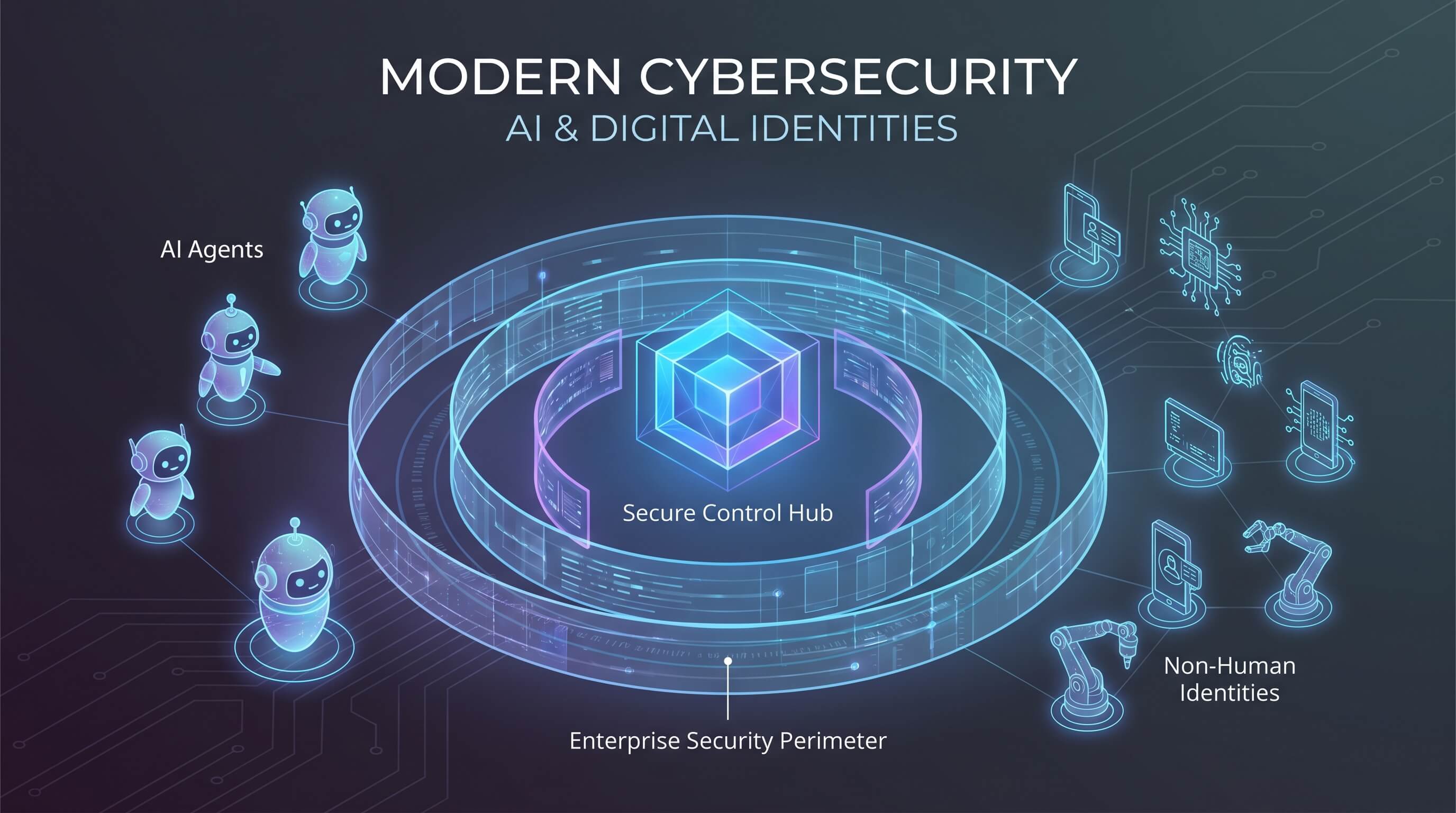
Enterprise security teams spent years hardening controls around human users: phishing-resistant MFA, endpoint posture, conditional access, and identity governance. That work matters, but it has also created a dangerous blind spot. The fastest-growing attack surface in many organizations is no longer the employee account. It is the sprawling population of non-human identities, including service accounts, workloads, API integrations, bots, automation pipelines, and now AI agents acting across business systems with delegated authority.
AI agents intensify this shift because they do not simply authenticate to one application and wait for instructions. They chain tools, retrieve data, call APIs, make decisions, trigger workflows, and increasingly operate with broad permissions across cloud, SaaS, and internal systems. In practice, many enterprises are deploying agentic capability on top of weak machine identity hygiene: shared secrets, hard-coded credentials, excessive token scopes, poor inventory, and little lifecycle governance. That combination creates an attack surface that is expanding faster than most IAM, security, and risk programs are prepared to control.
Why non-human identities have become a priority risk
Non-human identities have existed for years, but their scale and power have changed. Cloud-native architectures created large populations of service principals, workload identities, ephemeral compute roles, automation accounts, and third-party integrations. AI adoption is now pushing that growth curve steeper. Every new agent, orchestration platform, plugin, retrieval connector, and background workflow introduces additional credentials, permissions, trust relationships, and execution paths.
Unlike human users, these identities are often created quickly, owned ambiguously, and monitored inconsistently. They may bypass normal joiner-mover-leaver processes. They are frequently exempted from MFA because they cannot complete interactive challenges. Their secrets are often stored in code repositories, CI/CD variables, configuration files, notebooks, browser extensions, or vendor platforms outside the core IAM stack. Many are overprivileged because narrowing scope takes time, while broad access makes prototypes work immediately.
Attackers understand this. A compromised API key, leaked token, or misconfigured service account can provide quiet, durable access without needing to phish an employee. When that identity belongs to an AI-enabled workflow, the blast radius can be larger: access to sensitive data, the ability to trigger downstream actions, and the appearance of legitimate automated behavior that blends into operational noise.
How AI agents make the problem worse
1. They multiply identities faster than governance can catch up
Agent deployments rarely arrive as one centrally governed platform. They emerge through pilots in engineering, support, finance, marketing, and operations. Teams connect agents to ticketing systems, CRMs, code repositories, messaging tools, document stores, and internal knowledge bases. Each connection typically requires credentials, tokens, roles, or delegated access. The identity count grows faster than the control environment.
2. They encourage broad permissions for convenience
Early agent implementations often start with “just make it work” privileges. Read access becomes read-write. Limited repository scope becomes org-wide access. Temporary test tokens become production dependencies. Because agents depend on chaining actions across multiple systems, teams commonly grant the union of all possible permissions instead of the minimum necessary set for a specific task.
3. They create indirect abuse paths
An attacker does not always need to steal the agent’s credential. Prompt injection, malicious tool output, poisoned knowledge sources, or compromised upstream integrations can influence an agent to use its legitimate permissions in harmful ways. If the identity behind the agent is overprivileged, the attacker can turn application logic into operational leverage.
4. They weaken accountability
When an agent takes an action, who is accountable? The business owner, the developer, the platform team, the model provider, or the identity team? In many enterprises, the answer is unclear. That ambiguity slows revocation, weakens logging standards, and leaves incident responders guessing whether an action was authorized automation, model error, or malicious use.
Common control gaps enterprises should expect to find
Most organizations assessing this area discover the same patterns: incomplete inventory of machine identities, no authoritative owner recorded for service accounts, long-lived secrets with no rotation policy, inconsistent vault usage, excessive permissions, limited monitoring of token use, third-party SaaS integrations outside procurement review, and no standard approval process for connecting AI agents to enterprise data or action systems.
Another major gap is policy asymmetry. Human identities usually have strong governance requirements, while machine identities are treated as implementation details. That is no longer defensible. If a non-human identity can read customer records, approve changes, send messages, execute code, or trigger payments, it should face controls proportionate to that risk, not weaker controls because no human logs in interactively.
Governance recommendations that matter now
Establish a machine identity inventory with named ownership
Every non-human identity should have a recorded owner, purpose, environment, connected systems, credential type, privilege level, and review date. No orphaned service accounts, no unknown agent connectors, no production secrets without a business owner.
Classify agent permissions by action sensitivity
Separate identities that only retrieve information from those that can modify records, trigger workflows, move funds, change infrastructure, or access regulated data. Apply higher approval thresholds, tighter scopes, and stronger logging to action-capable agents.
Default to ephemeral credentials and brokered access
Replace static API keys and long-lived secrets wherever possible with short-lived tokens, workload identity federation, just-in-time access, and centrally mediated secret retrieval. If an agent platform cannot support modern credential handling, that limitation should count against production approval.
Require least privilege by task, not by platform
Do not give one agent broad access because it might eventually need it. Design permissions around specific workflows. If necessary, split one agentic process into multiple identities with separate scopes and controls.
Implement policy gates for high-risk actions
For sensitive operations, add human approval, transaction limits, environment restrictions, or dual-control checkpoints. The goal is not to eliminate autonomy everywhere, but to ensure autonomy is bounded where the business impact is highest.
Log agent decisions and identity use in a way investigators can follow
Security teams need traceability across prompt, retrieved context, tool calls, credential use, downstream actions, and resulting changes. Standard authentication logs alone are insufficient when the risk includes indirect manipulation of an agent’s behavior.
Create a formal review path for agent deployments
Security, IAM, and risk teams should define a lightweight but mandatory review for any agent that connects to enterprise systems. At minimum, review data access, action permissions, credential model, monitoring, failure handling, and kill-switch capability.
The strategic shift security leaders need to make
The real issue is not that AI agents are uniquely dangerous. It is that they are arriving on top of identity estates that were already under-governed on the non-human side. Enterprises that continue to center identity strategy almost exclusively on workforce users will miss where operational authority is actually moving. More decisions, more data access, and more business actions are being delegated to software entities.
The organizations that handle this well will treat machine and agent identities as first-class security subjects, with governance expectations equal to their power. That means inventory before scale, least privilege before convenience, ephemeral access before static secrets, and accountable ownership before experimentation spreads. AI agents can create real enterprise value, but only if the identities behind them are governed with the same seriousness as the humans who once performed those tasks.
The perimeter has shifted again. This time, it is not just around devices or users. It is around every non-human identity your business allows to think, decide, connect, and act.