AI Agents Are Making Observability a Product Requirement
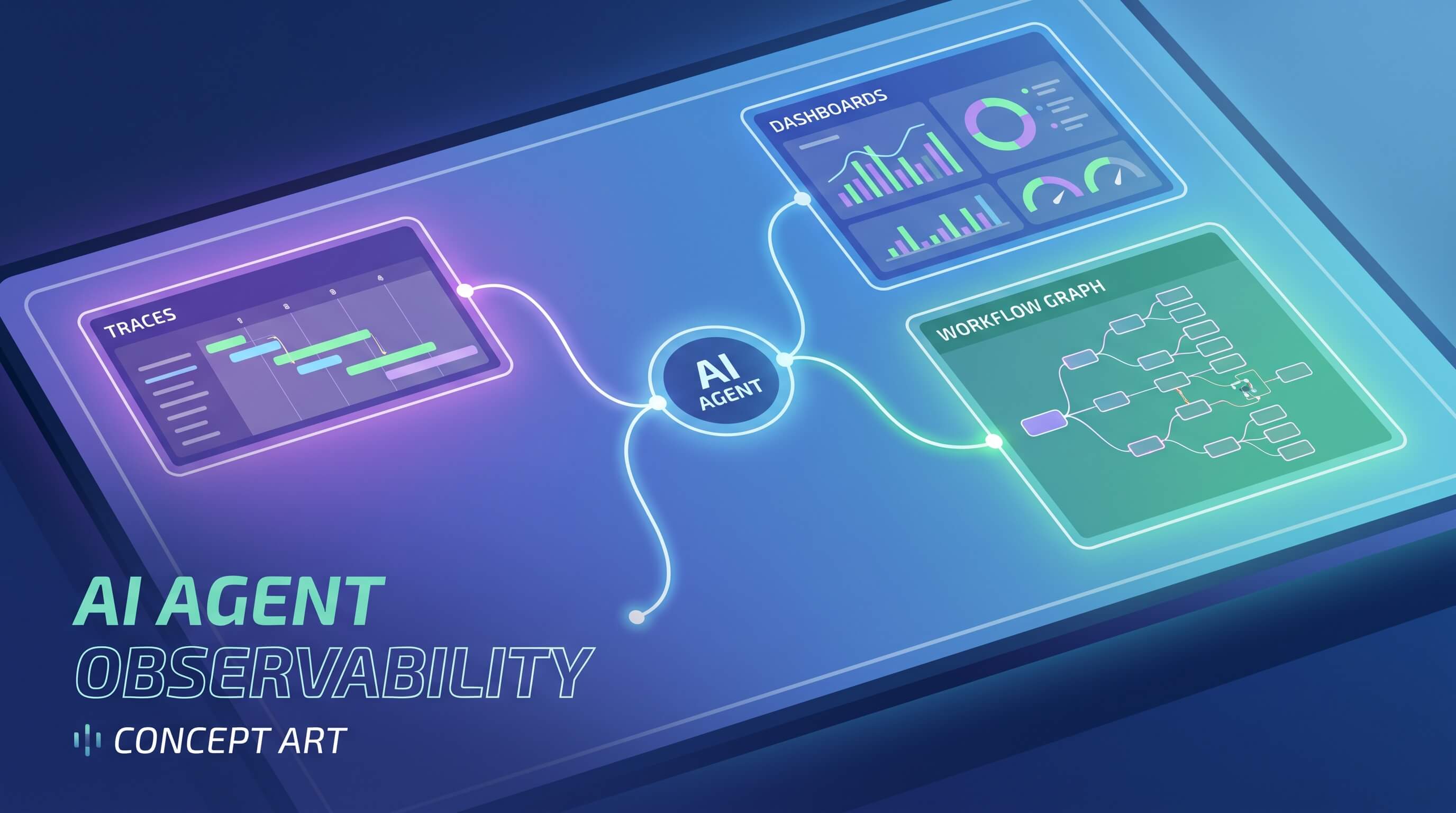
AI agents are changing the standard for what software teams need to see, measure, and explain. In traditional applications, observability was often treated as an engineering discipline that helped teams debug incidents, monitor uptime, and improve performance behind the scenes. With AI agents, that boundary is disappearing. Observability is moving into the product layer because agent behavior is not fully deterministic, because it unfolds across multiple tools and decision steps, and because users increasingly need proof that the system acted correctly.
This shift matters because AI products are no longer judged only by whether they eventually return an answer. They are judged by whether teams can understand what happened, whether customers can trust the outcome, and whether operators can intervene before small failures become expensive ones. When an agent can search, plan, call APIs, write data, trigger workflows, or communicate with customers, visibility becomes part of the value proposition. In practice, that means observability is becoming a product requirement, not just an infrastructure feature.
Why agent systems change the observability equation
Most software observability stacks were designed around services, requests, databases, and infrastructure health. Those signals are still essential, but they are not enough for agentic systems. An AI agent can fail while every server metric looks healthy. Latency may be acceptable, CPU may be normal, and API availability may be green, yet the user experience can still break because the agent chose the wrong tool, misunderstood intent, exceeded a token budget, looped through redundant steps, or produced an answer that looked polished but was operationally unsafe.
That creates a different requirement. Teams need to observe not only systems, but also behavior. They need traces that show how an agent interpreted a task, which tools it selected, what context it retrieved, what intermediate steps it took, where uncertainty appeared, and why a final action was taken. Without that level of visibility, support teams cannot explain failures, product teams cannot improve design, and governance teams cannot verify acceptable use.
In other words, agent observability is not just about answering, Is the system up? It is about answering, What did the agent try to do, why did it do that, and should we trust the result?
Observability is now part of the user experience
One of the clearest signs of this change is that users increasingly expect visible traces of agent reasoning and execution, even when they do not ask for full chain-of-thought or internal model details. They want to know which sources were consulted, whether an external system was updated, whether approval was required, and whether the answer came from retrieved knowledge, live tool use, or model inference. This is especially important in enterprise products, where a confident answer without provenance can create more risk than value.
That does not mean every product should expose raw internal logs to customers. It means the product needs observable affordances. A good agent interface may show action history, source references, approval checkpoints, confidence cues, or state transitions such as searching, drafting, validating, and completing. These are product decisions, not only platform decisions. They reduce user anxiety, lower support burden, and make failures easier to recover from.
When observability enters the interface, it starts to shape adoption. Users trust systems they can inspect. They return to systems that help them understand both success and failure. For AI agents, transparency is often inseparable from usability.
Support, compliance, and operations all depend on the same signals
Another reason observability is becoming a product requirement is that multiple teams depend on the same evidence trail. Customer support needs enough context to diagnose why an agent took an unexpected action. Product managers need to see where workflows stall or where users abandon tasks. Security and compliance teams need records of tool access, data movement, and approval boundaries. Reliability engineers need to identify patterns that predict incidents before customers report them.
In conventional software, these needs were sometimes served by separate systems. In agent products, they converge. The same execution trace that helps an engineer debug a failed tool call can help a compliance reviewer confirm that sensitive actions required approval. The same event log that helps a support agent explain a wrong outcome can help a product team redesign a brittle workflow step.
That convergence creates a strong business case for designing observability early. If teams wait until after launch, they often discover that the most important questions cannot be answered retroactively because the relevant events were never captured in structured form.
What teams actually need to instrument
Making observability useful for AI agents requires a broader instrumentation model than standard application monitoring. Teams should capture infrastructure telemetry, but they should also record the lifecycle of agent execution in a way that maps to product and operational decisions.
Core signals worth capturing
- Task and session identity: a durable identifier for each user request, workflow, and agent run.
- Tool usage: which tools were considered, selected, called, retried, or skipped.
- Retrieval context: what knowledge sources were queried and what context window constraints shaped the result.
- State transitions: steps such as planning, acting, waiting, escalating, asking for approval, and completing.
- Guardrail events: policy checks, blocked actions, redactions, or fallback behaviors.
- Cost and latency boundaries: enough data to detect expensive loops, slow dependencies, or degraded responsiveness.
- Human intervention points: when a user corrected, approved, rejected, or redirected the agent.
- Outcome quality markers: task completion, abandonment, rollback, retry, or downstream error signals.
The goal is not maximal logging. The goal is decision-useful logging. If an event cannot help improve trust, reliability, support, or governance, it probably does not need to be first-class.
Product design needs observable failure modes
A mature agent product does not assume the model will always be right. It assumes failures will happen and designs the interface so those failures can be seen, contained, and corrected. That is where observability stops being a dashboard problem and becomes a product design principle.
For example, if an agent is about to trigger a meaningful external action, the product can show the planned action, the source of the instruction, and the tool that will execute it. If retrieval quality is weak, the product can surface that the answer is based on limited context. If a workflow stalls because a dependency times out, the user can see that the system is waiting on a tool rather than silently failing. These are observable failure modes. They make the system easier to trust because they make it easier to challenge.
Teams that ignore this often create the worst possible combination: highly autonomous behavior with low inspectability. That may work in a demo, but it does not scale in production.
How to treat observability as a requirement from the start
Teams building agent products should define observability alongside core product requirements, not after them. A practical approach is to ask a short set of design questions before implementation:
- What actions can the agent take that users, operators, or auditors may need to review later?
- What failure types are most likely, and how will they become visible in the product?
- Which events need structured capture for support, analytics, and governance?
- Where should humans be able to intervene, approve, or override?
- What minimum execution history should a user see to trust important outcomes?
These questions usually lead to better architecture. They encourage durable task IDs, cleaner state machines, explicit tool boundaries, better approval design, and clearer ownership of telemetry across product and platform teams.
The important mindset change is simple: if an agent can act, then its behavior must be inspectable. If it cannot be inspected, it is not ready to be treated as a dependable product capability.
The next competitive edge is visible reliability
As more companies add agents to their products, raw model access will be less differentiating than operational trust. The winners will not only be the teams with clever prompts or broad tool access. They will be the teams that can make agent behavior legible, controllable, and continuously improvable in production.
That is why observability is moving up the stack. It is no longer just for SRE dashboards and post-incident reviews. It is becoming part of onboarding, support, compliance, pricing logic, and product trust. AI agents are making software more powerful, but they are also making opaque systems less acceptable.
For builders, the actionable takeaway is clear. Instrument agent behavior early, expose the right level of execution visibility to users, and design intervention paths before you need them. Treat traces, state transitions, approvals, and outcome signals as product assets. In the agent era, observable behavior is not a nice-to-have. It is part of what the product is.