Age Verification Is Becoming Core Product Architecture
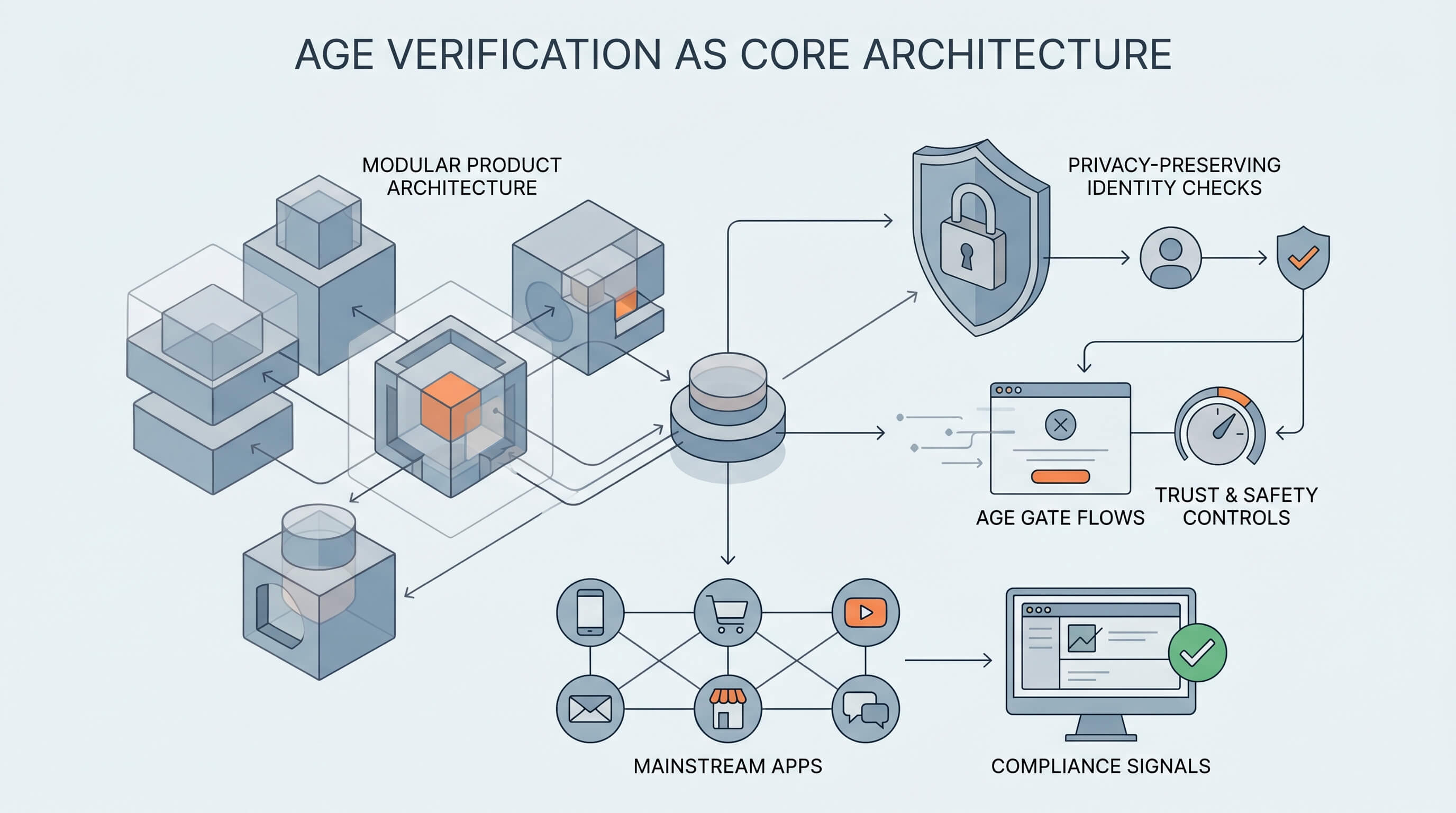
Age verification used to sit at the edge of product strategy. For many teams, it was treated as a niche compliance feature tied to adult content, gambling, or a narrow set of regulated transactions. That framing is breaking down quickly. Today, social apps, gaming platforms, creator tools, marketplaces, livestreaming services, and AI products are all being pushed to prove that they understand who can access what, at what age, and under which rules.
The important shift is not simply that more services may need an age gate. It is that age verification now affects core product architecture. Teams can no longer treat it as a standalone modal dropped in at the last minute. They have to design identity signals, privacy safeguards, jurisdiction logic, fallback flows, abuse resistance, consent handling, and conversion impact together. In other words, age checks are becoming a systems problem, not just a compliance checkbox.
Why age verification moved into the mainstream
Several forces are converging at once. Regulators are paying closer attention to child safety online. Platform operators face more scrutiny around harmful content, addictive patterns, and access to adult or high-risk experiences. At the same time, the spread of AI-generated content, creator monetization, and direct-to-consumer digital services has blurred the line between obviously regulated products and mainstream products with occasional sensitive surfaces.
A social platform may not think of itself as an adult service, yet it might host sexually explicit communities. A gaming app may need to distinguish between general play, chat, loot-box spending, and mature live events. A generative AI product may need stronger controls when users ask for explicit outputs or enter age-sensitive workflows. The practical result is that product teams now need a reliable way to classify users by eligibility without collecting more personal data than necessary.
Age checks are really an identity and risk design problem
Product leaders often talk about age verification as if it were one technical choice. In practice, it is a bundle of architectural decisions. Are you estimating age, verifying age, or verifying parental authority? Are you checking once at signup or continuously based on risky actions? Are you storing full identity documents, derived attributes, or just a pass token from a third-party provider? Each option changes the privacy profile, operational burden, and user experience.
This is why age verification increasingly sits beside identity, fraud, and trust-and-safety systems. A good architecture separates the decision the product needs, such as over 13, over 16, or over 18, from the raw evidence used to support that decision. That separation lets teams minimize sensitive data exposure, reduce legal risk, and support multiple verification methods over time.
Privacy becomes a product requirement, not a legal footnote
The fastest way to damage trust is to ask users for highly sensitive documents without explaining why, how long the data is retained, or what alternatives exist. Mainstream services cannot afford to treat age checks like a black box. If users feel they are being forced into invasive identity collection just to browse, chat, or try a feature, they will drop off or route around the system.
That means privacy has to be designed into the flow. Teams should prefer attribute-based proofs over raw document storage when possible. They should define strict retention windows, segment access to verification data, and make clear which actions trigger a check. A service that only needs to know whether a user is an adult should not architect itself around permanent storage of passports or selfies unless there is no better option.
A practical example: livestream commerce
Imagine a mainstream livestream shopping app that introduces categories such as alcohol tastings, wellness products, and late-night creator content. The old approach would add a simple 18+ splash screen. The stronger approach maps risk at the feature level. Browsing general streams stays lightweight. Entering an alcohol event triggers an adult eligibility check. Purchasing a regulated product may require a stronger local-law verification step. The architecture is modular because the risk is modular.
User flow now matters as much as legal defensibility
Many age verification projects fail not because the policy is wrong, but because the journey is clumsy. If the first experience is confusing, repetitive, or overly intrusive, support tickets spike and conversion falls. This is especially true for mainstream products where most users do not expect identity friction.
Teams therefore need to think in layers. Low-risk areas may only need self-declaration plus behavioral safeguards. Medium-risk features may justify reusable age tokens from trusted providers. High-risk purchases or content zones may require stronger evidence. Designing these layers well helps preserve access for legitimate users while keeping sensitive interactions behind proportionate controls.
Good flow design also includes fallback paths. What happens when facial age estimation returns low confidence? What if a user lacks a government ID? What if local rules in one market allow telecom or card-based age checks while another market requires document review? Architecture matters because the real world is messy, and one verification method will not fit every user or jurisdiction.
Regulation is forcing product, legal, and engineering to work together earlier
One reason this topic feels heavier now is that it crosses functions that do not always plan together. Legal teams focus on liability and regional requirements. Product teams focus on growth and usability. Security teams worry about storing sensitive evidence. Engineering teams need vendor integrations, decision engines, audit trails, and resilience. Age verification exposes the cost of keeping those conversations separate for too long.
The healthier pattern is to treat age assurance as a shared architectural layer. That means defining policy thresholds, approved evidence types, escalation rules, data retention limits, and user messaging before launch. It also means building enough abstraction to swap vendors, update thresholds, or localize flows without rewriting the entire product every time regulations shift.
A practical example: AI companion apps
Consider an AI companion app with general chat, mental wellness prompts, romantic roleplay, and creator-built characters. A single yes-or-no age gate is too crude. The team may decide that general chat is open to teens, relationship simulation requires adult status, and some creator spaces require both adult status and stronger moderation. Suddenly age verification is not a splash page. It is part of entitlement design, recommendation logic, reporting, and account state management.
What strong age verification architecture looks like
The best systems are not defined by the toughest check. They are defined by proportionality, modularity, and clarity. Product teams should know which user actions create age-related risk, which confidence level each action requires, and which evidence types can satisfy that threshold. They should store as little sensitive data as possible, log decisions cleanly for audit purposes, and give users understandable reasons when access is limited.
They also need to plan for change. Rules will vary by country, platform, and product category. Vendors will improve or fail. Public expectations around privacy will harden. A brittle age-check flow hardcoded into signup will age badly. A policy-driven architecture with reusable signals, region-aware rules, and clear UX hooks will hold up much better.
Actionable takeaways for product teams
Start by mapping where age actually matters in your product, not where tradition says it matters. Separate low, medium, and high-risk surfaces. Choose the minimum proof needed for each one. Keep raw identity data out of your core product stack whenever possible, and design for reusable age status rather than repeated friction. In parallel, write clear user messaging so verification feels predictable instead of suspicious.
Most importantly, stop treating age verification as a fringe add-on. If your service touches sensitive content, regulated goods, youth safety, or identity-linked access, age checks now belong in your core architecture roadmap. The teams that handle this well will not just reduce compliance risk. They will build products that feel safer, more trustworthy, and more resilient as mainstream digital services enter a far more age-aware era.