The 2026 RAM Crunch Is Rewriting PC Buying Math
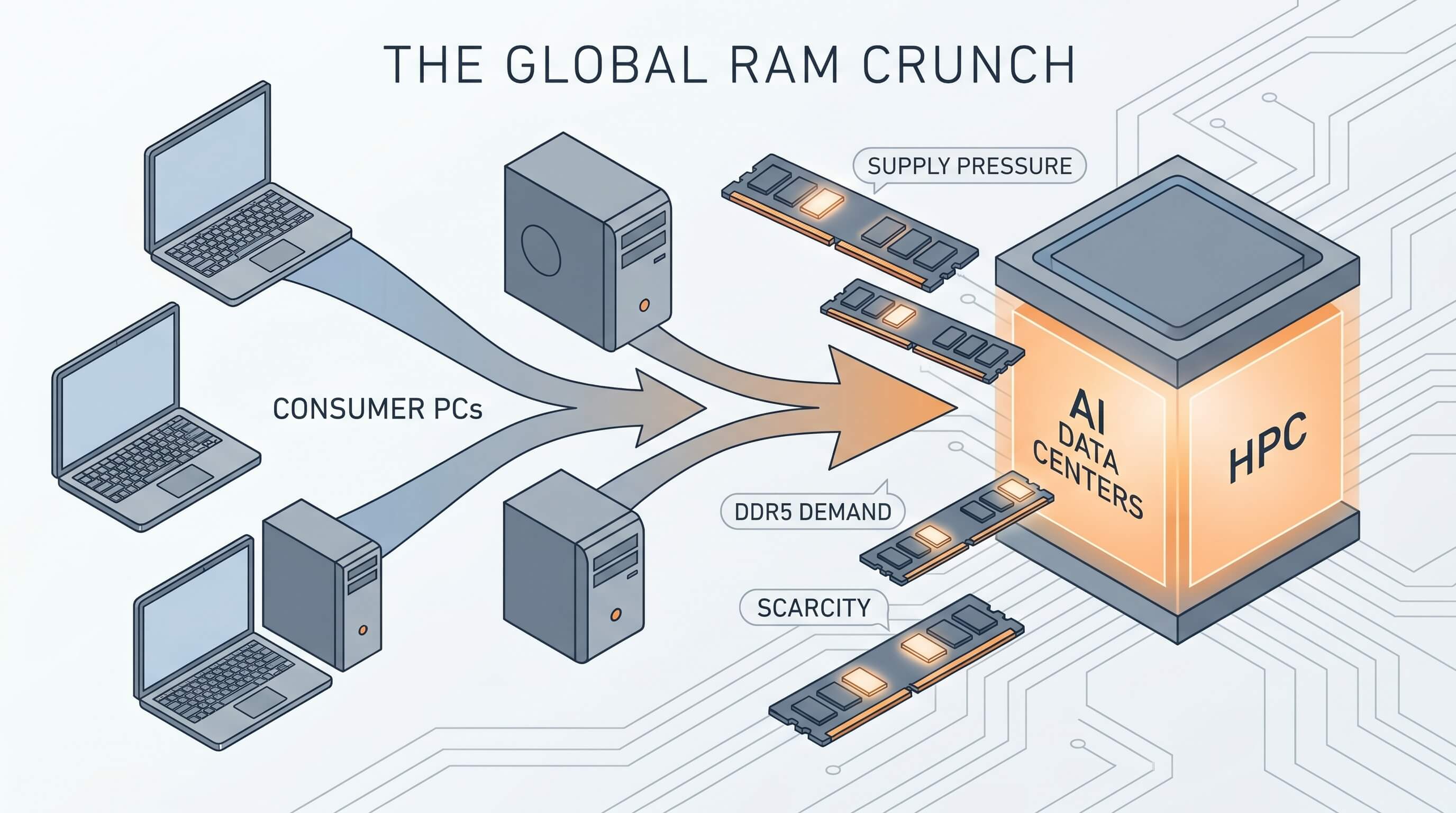
For years, buyers could treat RAM as one of the easier PC decisions. You picked a class of machine, matched the memory to the workload, and assumed the upgrade path would stay relatively predictable. That assumption is breaking down in 2026. The global memory market has tightened sharply as AI infrastructure consumes more fabrication capacity, and the result is not just higher component pricing. It is a change in how laptop makers, desktop vendors, and consumers think about the value of a PC configuration.
The thesis here is not that every machine is suddenly unaffordable. It is that memory is no longer behaving like a quiet commodity in the background. As DRAM pricing rises and manufacturers steer supply toward higher-margin AI and server demand, mainstream PC buyers are feeling the effects in subtler ways: thinner upgrade ladders, more aggressive upselling, fewer sensible low-end configurations, and a bigger penalty for buying too little memory too early.
Why AI is distorting a market that used to feel routine
Memory makers follow margin. When hyperscalers and AI system builders need huge volumes of high-performance memory, it makes financial sense for Samsung, SK Hynix, Micron, and their ecosystem partners to prioritize those segments. High Bandwidth Memory grabs most of the headlines, but the spillover matters just as much. Capacity, packaging focus, and road map attention move toward the workloads paying the highest premiums. Conventional DRAM and LPDDR do not disappear, but they stop being the unquestioned center of gravity.
That shift matters because modern PCs need more memory than their predecessors even before you add AI features. Browsers are heavier, creative workloads are broader, background sync never stops, and local AI features are nudging minimum system requirements upward. When memory becomes more expensive at the exact moment software wants more of it, the definition of a sensible baseline changes.
The old 8GB comfort zone is eroding fast
In a budget laptop market, 8GB used to be the configuration vendors could get away with while still delivering a machine that felt acceptable for mainstream use. In 2026, that looks increasingly like a short-lived compromise rather than a stable purchase. The problem is not that 8GB can never boot a browser and office suite. The problem is that modern workflows stack memory-hungry apps, browser tabs, video conferencing, cloud sync, and background AI features in ways that turn marginal capacity into visible friction.
That is why 16GB is drifting from premium recommendation to practical floor for a lot of buyers. It gives the machine room to age. It reduces swap pressure. It keeps daily multitasking from collapsing under small bursts of load. In a cheaper market, consumers could under-buy and upgrade later. In a tighter memory market, especially with soldered designs, that safety valve is weaker.
Vendors are changing the ladder, not just the sticker price
The most interesting effect of the RAM crunch is not always a line-item price increase. It is the way PC vendors reshape product tiers. Low-cost configurations become less attractive, mid-tier models absorb larger markups, and premium machines justify their pricing with memory bundled into a broader platform story. A laptop that once had rational steps from 8GB to 16GB to 32GB may now steer buyers more aggressively toward a narrower set of options.
That is especially visible in thin-and-light laptops where LPDDR is soldered and memory cannot be corrected later. If the machine ships with too little RAM, the mistake is permanent. Vendors know this, and many are using memory capacity as a sharper segmentation tool. That can boost average selling prices without requiring dramatic changes to the CPU or chassis.
Why the upgrade question now matters more than the benchmark
Consumers still spend too much time comparing peak processor performance and too little time thinking about capacity limits. For many real-world workloads, insufficient RAM degrades the experience earlier and more consistently than a slightly weaker CPU. A machine with a decent processor and constrained memory can feel slow every day. A machine with a slightly slower processor and enough RAM often feels stable for years.
This is why the 2026 market rewards buyers who think in lifespan, not launch-day specs. If you expect to keep a laptop for four or five years, paying more upfront for 16GB or 32GB may be less about chasing luxury and more about protecting the machine from early obsolescence. The hidden cost of buying low memory is not just performance loss. It is replacement pressure.
AI PCs complicate the picture further
Manufacturers love to market AI PCs as a new class of device, but local AI features pull memory demand in awkward ways. Some tasks are light enough to run comfortably on mainstream machines. Others benefit from more memory headroom even if the NPU handles part of the inference. Add creative software, browser-based AI tools, background indexing, or occasional local models, and the gap between a passable system and a pleasant system widens.
That means the AI PC wave is colliding with the RAM crunch at exactly the wrong time for buyers who hoped on-device AI would arrive as a cheap default. Instead, local AI features are helping normalize higher memory baselines just as memory becomes more expensive to provision. Vendors will keep advertising the silicon. Buyers should watch the memory line first.
Desktop builders are not immune
It is tempting to assume the problem belongs mostly to laptops because they are harder to upgrade. Desktops still have an advantage, but they are not isolated from the broader market. Rising DDR5 pricing affects new builds, and motherboard-platform choices can lock buyers into expensive upgrade paths. Even enthusiasts who plan to add RAM later may find the later market less friendly than expected if pricing remains volatile or if preferred kits disappear.
There is another twist. Some builders may respond by sticking with older platforms longer because DDR4 remains cheaper or because the performance benefit from a full platform jump does not justify the total system cost. That slows the normal upgrade cycle, which can distort demand further. Expensive memory does not just hurt this quarter's buyers. It changes timing across the market.
What smart buyers should do
First, treat memory as a primary buying decision, not a configurable afterthought. If a laptop is soldered, assume the listed capacity is the capacity you will live with for the machine’s life. Second, price the whole lifespan. A laptop that is slightly more expensive but ships with 16GB or 32GB may be the cheaper machine if it postpones replacement by two years. Third, be suspicious of AI branding that is not matched by sensible memory. A flashy NPU badge on an 8GB machine is a warning sign, not a value signal.
For desktop buyers, it is worth deciding whether you want short-term affordability or longer runway. If you are entering a new platform, buy enough memory for the work you expect in two years, not just for the tasks you run this week. If you are staying on an older platform, be honest about whether that decision reflects budget discipline or false economy.
The bigger lesson
The RAM crunch is a reminder that AI reshapes hardware markets indirectly as well as directly. Not every buyer needs a data center GPU, but many buyers will still pay the downstream cost of AI demand through higher memory pricing and worse configuration tradeoffs. That is why 2026 feels different. The pain is no longer confined to niche accelerator cards. It is showing up in the core bill of materials for ordinary PCs.
Memory used to be the part of the spec sheet you could fix later or stop thinking about. In this market, it has become a strategic decision again. That is not a glamorous shift, but it is one that will define whether your next PC feels current in 2028 or cramped by next spring.