Der Charakter-Referenzblatt-Generator: Verwandeln Sie Eine Beschreibung in ein Drei-Ansichten-Turnaround
Warum dieser Prompt wichtig ist
Commissioning a professional character turnaround sheet typically costs $150-$400 and takes several days of back-and-forth revision, which is a real bottleneck for a solo developer or small studio that needs a rough but usable reference today to keep pre-production moving, not a final production asset.
Wofür wir ihn verwenden
A solo indie game developer has designed an NPC on paper — a dwarf blacksmith with a specific beard, apron, and hammer — and needs a turnaround sheet before handing the character off to a contract artist or feeding it into a 3D modeling reference, without paying for a full commissioned turnaround just to get the project started.
Prompt
Act as a character design assistant specializing in consistent multi-angle reference sheets for game, comic, and animation artists.

Context:
- Character description: [FULL DESCRIPTION — age, build, face, hair, clothing, props, and any distinguishing features like scars or accessories]
- Art style: [E.G. SEMI-REALISTIC PAINTERLY FANTASY GAME ART, CEL-SHADED ANIME, FLAT VECTOR CARTOON, PIXEL ART]
- Intended use: [E.G. GAME NPC SPRITE, COMIC BOOK CHARACTER, ANIMATION RIG REFERENCE, TABLETOP RPG PORTRAIT]

Task:
Generate a single reference sheet image containing three panels of the same character side by side: a front view, a three-quarter view, and a back view. All three panels must show identical proportions, identical clothing and props, and the same art style, so the sheet can be used as a consistency reference during later production work.

Constraints:
- Plain neutral grey or white background with no scenery, props, or set dressing that would distract from the character
- Consistent lighting direction and intensity across all three panels
- Neutral standing pose (not a dynamic action pose) so proportions are easy to read and trace
- No text, labels, or watermarks baked into the image
- If the character has asymmetric details (a scar, a prop held in one hand, an off-center accessory), keep that detail consistent and on the correct side across the front and three-quarter panels

Output format:
One image, three panels arranged left to right in this order: front view, three-quarter view, back view. No additional panels, no text overlay, no border frames between panels beyond natural spacing.
Ergebnis
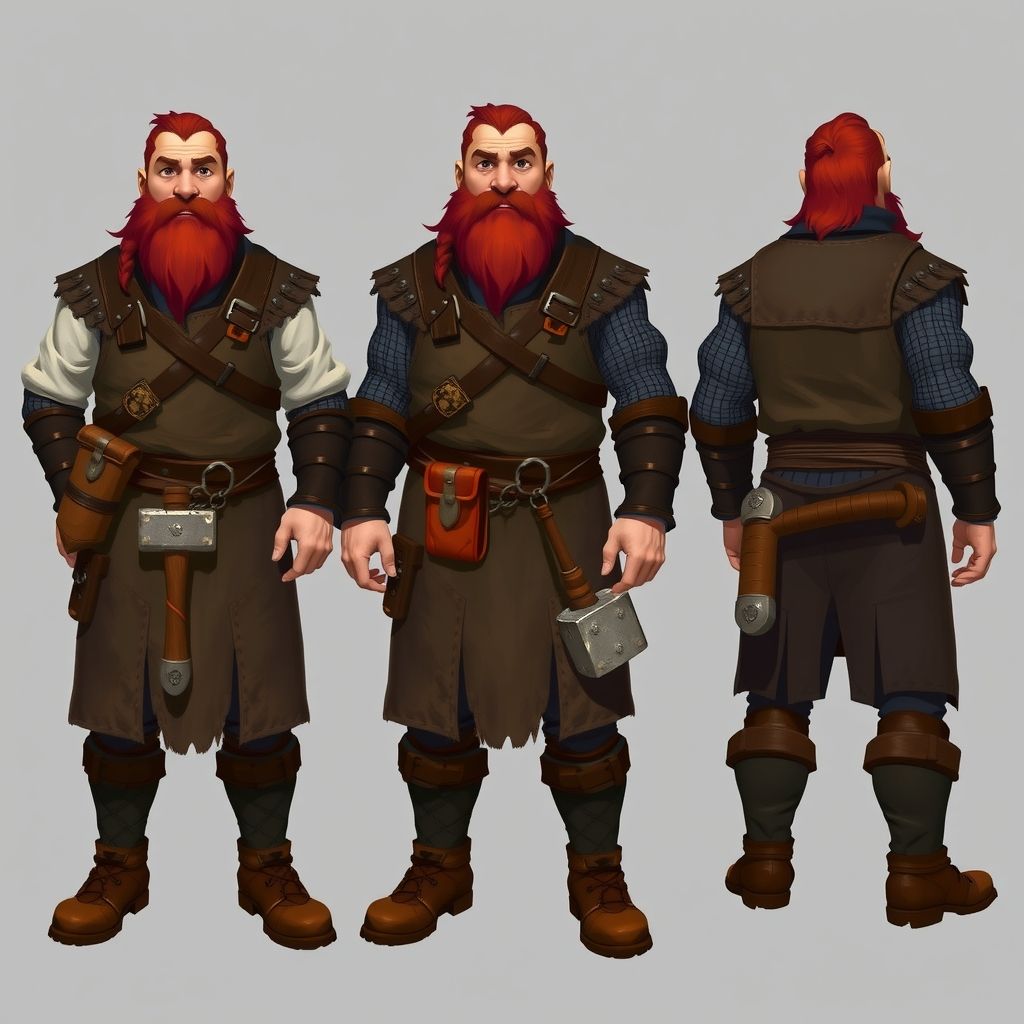
The example output above shows a dwarf blacksmith character — red braided beard, leather apron over chainmail, a battle-worn hammer on the belt — rendered in front, three-quarter, and back views on a neutral grey background, in a semi-realistic painterly fantasy game art style.
The result is genuinely usable as a rough reference: the face, beard, armor pieces, and boots stay recognizably consistent across all three panels, and the back view correctly omits the face while keeping the same silhouette and proportions. It's not perfect — look closely and the hammer has moved from a hip holster in the front panel to a hand-held grip in the three-quarter panel, and the belt pouch position shifts slightly. That's a realistic limitation of single-shot diffusion models asked to hold fine prop placement across multiple views in one image, and it's worth knowing going in: treat the output as a strong starting reference for an artist to clean up, not a pixel-perfect production asset.
Generiertes Bild
Jedes Spiel-, Comic- oder Animationsprojekt mit einem originalen Charakter braucht irgendwann ein Turnaround-Blatt: denselben Charakter aus mehreren Blickwinkeln gezeigt, damit ein Künstler, Modellierer oder Animator Proportionen und Details über Dutzende späterer Zeichnungen oder Frames hinweg konsistent halten kann. Ein solches professionell zu beauftragen ist Standardpraxis, aus gutem Grund — aber es kostet auch 150 bis 400 Dollar und dauert Tage.
Dieser Prompt erzeugt ein grobes Drei-Ansichten-Turnaround — vorne, drei viertel, hinten — in einem einzigen Bild, speziell als Arbeitsreferenz statt als fertiges Asset konzipiert.
Warum drei Ansichten, nicht die üblichen fünf oder sechs
Professionelle Turnaround-Blätter enthalten oft fünf oder sechs Winkel plus Nahaufnahmen von Händen, Gesicht und wichtigen Requisiten. Ein Einzelbild-Modell nach so vielen konsistenten Ansichten in einer Generierung zu fragen, führt zuverlässig zu Drift — Proportionen und Details verschlechtern sich, je mehr Panels man in eine einzige Ausgabe quetscht. Drei Ansichten — vorne, drei viertel, hinten — ist das Minimum, das einem Künstler tatsächlich erlaubt, Volumen und Silhouette des Charakters aus den meisten Winkeln abzuleiten.
Warum Hintergrund- und Pose-Einschränkungen wichtig sind
Die gesamte Aufgabe eines Charakter-Turnarounds ist es, den Charakter leicht referenzierbar zu machen, was bedeutet, dass alles andere im Bild Rauschen ist. Szenerie, dynamische Posen und dramatische Beleuchtung sind genau das, was man in einer fertigen Illustration will, und genau das, was ein Referenzblatt schwerer tatsächlich nutzbar macht.
Was man tatsächlich erwarten sollte
Einzelbild-Diffusionsmodelle sind gut darin, Gesicht, Farbgebung und allgemeine Silhouette des Charakters über Panels hinweg in einer Generierung konsistent zu halten. Sie sind merklich weniger zuverlässig darin, die Platzierung kleiner Requisiten konsistent zu halten — welche Hand einen Gegenstand hält, wo genau eine Tasche oder Schnalle sitzt — über alle drei Ansichten hinweg. Das ist kein Prompt-Schreibfehler, der sich mit mehr Adjektiven beheben lässt; es ist eine echte Einschränkung, einen einzelnen Modellaufruf zu bitten, feine räumliche Details über mehrere simultane Blickwinkel hinweg zu verfolgen.
Wie man das Ergebnis nutzt
Geben Sie das generierte Blatt an denjenigen weiter, der darauf aufbaut — Vertragskünstler, 3D-Modellierer, Animator — mit einem expliziten Hinweis, welche Details (falls vorhanden) zwischen den Panels abgewichen sind.