Der Budget-Optimierer: Kurzfristige Einsparungen vs. langfristige Auswirkungen modellieren, bevor Sie eine Budgetposition streichen
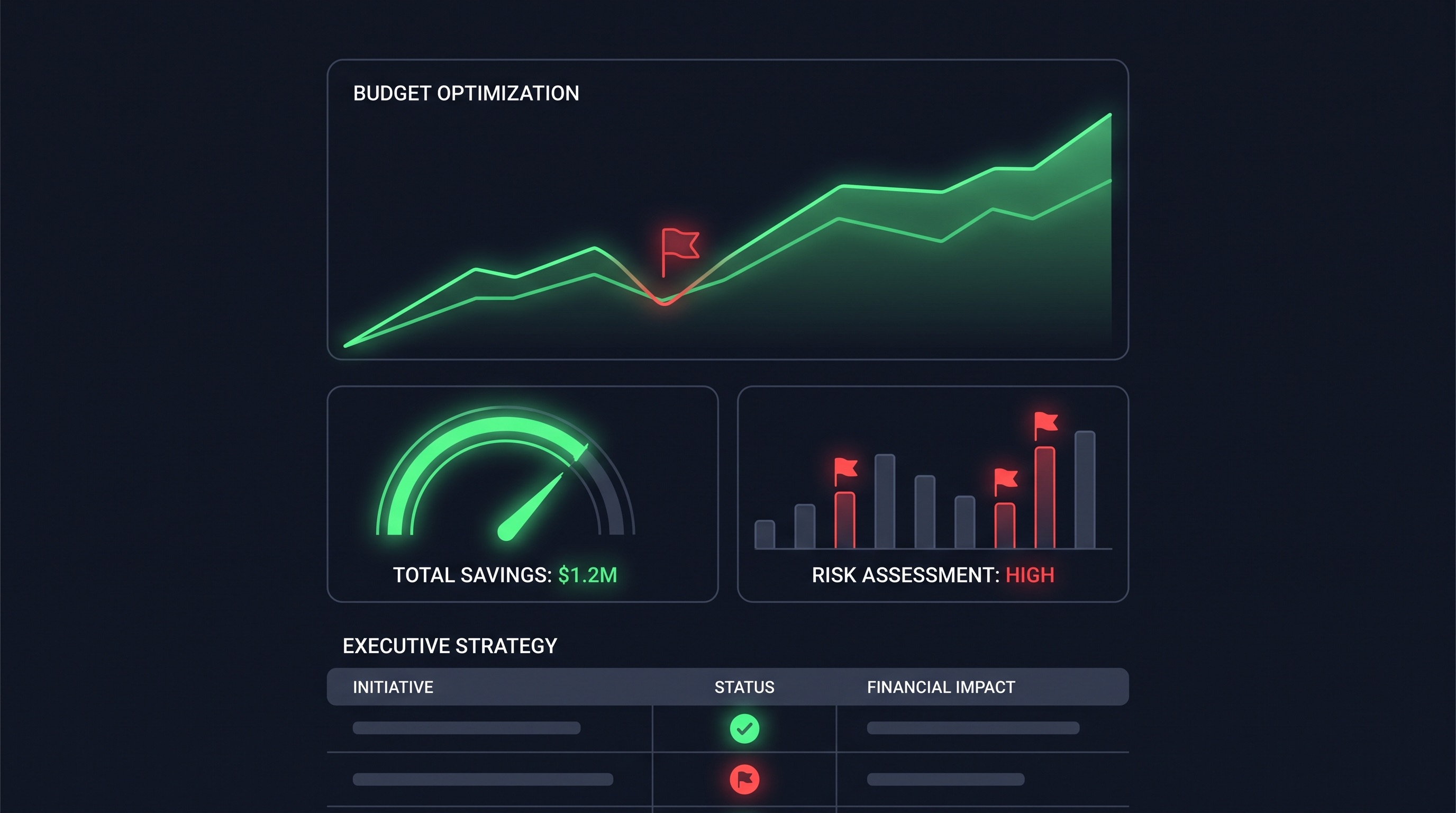
Warum dieser Prompt wichtig ist
Budget cuts made on gut feel or raw numbers eliminate the wrong 20% -- usually the tools, subscriptions, or programs that were quietly generating outsized value. Teams that cut carelessly spend the next 6-12 months rebuilding what they eliminated: rehiring vendors on worse terms, recovering lost knowledge, or replacing departed team members whose exit was triggered by a cost-cutting signal. A single well-timed 'do not cut' call on one line item can save more than all the quick wins combined.
Wofür wir ihn verwenden
Your company entered a cost-reduction cycle and your VP asked you to find 20-25% savings in your department budget. You have 48 hours before the leadership review, a spreadsheet with 30 line items, and no formal framework for distinguishing safe cuts from dangerous ones.
Prompt
Act as a CFO-level financial strategist and organizational advisor with deep expertise in [INDUSTRY/SECTOR] budget optimization.

**Context:**
You are reviewing the following budget for [TEAM/DEPARTMENT NAME] for [TIME PERIOD]:

[PASTE YOUR BUDGET HERE — include each line item, current monthly or annual amount, and whether it is fixed or variable cost]

Key constraints:
- Total reduction target: [E.G., "20% cut" or "save $150,000 this year"]
- Non-negotiable items: [LIST ANY LINE ITEMS THAT CANNOT BE TOUCHED]
- Strategic priorities this period: [E.G., "ship v2 by Q3", "maintain customer support SLA", "keep the hiring pipeline open for two roles"]
- Team headcount: [NUMBER] people

**Task:**
Analyze every line item through two simultaneous lenses:
1. Short-term impact: What exactly do we save, and how quickly does the saving hit the P&L?
2. Long-term impact: What capability, growth, retention, or competitive risk does this cut introduce over the next 12-24 months?

**Constraints:**
- Do NOT treat all cuts as equal -- flag any line item where cutting now would cost more to restore later than the short-term saving is worth
- Do NOT recommend eliminating a vendor without flagging whether the underlying business need still exists (cut the contract, not the capability)
- Model compounding effects: cuts that reduce team morale or increase attrition risk typically cost 1.5-3x the saved amount in recruiting, onboarding, and lost productivity
- For every recommendation, assign a reversibility score: Easy (back in 30 days), Hard (3-6 months to restore), or Irreversible (capability or relationship cannot be recovered)

**Output Format:**
Produce these four sections:

1. **Quick Wins** -- cuts with low long-term risk, safe to implement immediately
   Format as a table: Line Item | Monthly Saving | Annual Saving | Long-Term Risk | Reversibility

2. **Structured Reductions** -- meaningful savings that require a mitigation plan
   For each: what to cut, amount saved, capability lost, and a specific mitigation to preserve the underlying business need at lower cost.

3. **Do Not Cut** -- items that look cuttable but where the long-term cost exceeds the saving
   For each: the item, why it looks like an easy target, and the specific long-term math that argues against cutting it.

4. **Hidden Leverage** -- ways to extract more value from existing spend without cutting capability: consolidations, renegotiations, usage right-sizing, tier downgrades, and multi-year prepay options.

Close with a **Summary Table**: total identified savings, total risks flagged, recommended net reduction, and your top recommendation if leadership insists on hitting the full target.
Ergebnis
Budget Optimization Analysis -- Engineering Team, Q3 2026
Target: 22% reduction on $380,000 annual budget (save ~$84,000)
1. Quick Wins -- Implement Immediately
| Line Item | Monthly Saving | Annual Saving | Long-Term Risk | Reversibility |
|---|---|---|---|---|
| Unused Datadog seats (14 seats, 6 inactive) | $840 | $10,080 | None | Easy |
| Figma Business for contractors (switch to Dev Mode viewer) | $320 | $3,840 | None -- read-only access preserved | Easy |
| Loom Business to Loom Starter (team uses under 5 hrs/month) | $180 | $2,160 | None -- feature overage minimal | Easy |
| Remove GitHub Copilot licenses for 3 PMs with under 2% usage | $120 | $1,440 | None -- engineers retain licenses | Easy |
| Cancel Miro Premium (team uses Excalidraw for 90% of sessions) | $450 | $5,400 | Low -- switch fully to Excalidraw | Easy |
Quick Win Total: $22,920/year. No mitigation required.
2. Structured Reductions -- Require a Mitigation Plan
AWS reserved instances (current: on-demand for prod workloads)
Saving: ~$26,000/year by converting to 1-year reserved instances on 8 EC2 nodes
Capability lost: None -- same performance, committed term
Mitigation: Run AWS Cost Explorer reserved instance recommender first; only commit nodes running above 80% utilization. Lock in before Q4 pricing review.
Datadog APM to open-source Grafana + OpenTelemetry
Saving: $18,000/year
Capability lost: 4-6 weeks of engineering time to migrate dashboards
Mitigation: Assign one engineer for 3 weeks. Grafana Cloud free tier covers current query volume. Risk: do not start until v2 ships -- migration would affect on-call visibility during a critical window.
Reversibility: Hard (Datadog contract ends Oct 31 -- decide by Sept 1)
Structured Reductions Total: ~$44,000/year (with mitigation)
3. Do Not Cut
PagerDuty ($9,600/year)
Looks like: expensive alerting with free alternatives.
Why to keep it: The team had 3 P1 incidents in Q2. PagerDuty's escalation logic prevented two from becoming customer-facing outages. Cost of one missed P1: estimated $40K-$80K in SLA penalties and emergency engineering hours. Keep through the v2 launch window.
Linear ($6,240/year)
Looks like: overpriced task tracker.
Why to keep it: Engineering adopted Linear 8 months ago. Cycle time and PR throughput improved 31% in Q1. Switching costs 3-4 weeks of workflow rebuild during a critical delivery quarter. Renegotiate the annual renewal in October instead.
4. Hidden Leverage
- GitHub Enterprise to GitHub Teams: Only 3 of 18 seats use Enterprise-only features (SAML SSO, audit logs). Negotiate Teams + security add-on for those 3 users: saves $7,200/year.
- Cloudflare: You are on Business plan using under 15% of WAF rule capacity. Downgrade to Pro + Workers Paid: saves $2,400/year.
- AWS Compute Savings Plan: Compute spend has been within 8% variance for 6 months. An 80% baseline Compute Savings Plan saves ~$11,000/year with zero operational changes.
Hidden Leverage Total: ~$20,600/year
Summary Table
| Category | Annual Saving |
|---|---|
| Quick Wins | $22,920 |
| Structured Reductions | $44,000 |
| Hidden Leverage | $20,600 |
| Total Identified | $87,520 |
Target was $84,000 (22%). You are $3,520 over target with zero cuts to headcount or core infrastructure.
If leadership insists on hitting the full target today: Commit to AWS reserved instances immediately ($26K, zero risk) and implement all Quick Wins ($22.9K). Present the Datadog migration as a Q4 initiative pending v2 ship. This delivers $49K in immediate, zero-risk savings with a clear roadmap to the remainder.
Die meisten Budgetkürzungen basieren auf Rohzahlen, nicht auf einer Wirkungsanalyse. Dieser Prompt gibt Ihnen ein CFO-reifes Framework, das die langfristigen Kosten jeder Kürzung modelliert – bevor Sie etwas eliminieren, das Sie bereuen werden.
Use Case
Ihr Unternehmen befindet sich in einer Kostenreduktionsphase und Ihre VP hat Sie gebeten, 20–25 % Einsparungen in Ihrem Abteilungsbudget zu finden. Sie haben 48 Stunden Zeit bis zum Leadership Review, eine Tabelle mit 30 Budgetpositionen und kein formales Framework, um sichere Kürzungen von gefährlichen zu unterscheiden.
Why This Matters
Budgetkürzungen, die auf Bauchgefühl oder Rohzahlen beruhen, eliminieren die falschen 20 % – in der Regel die Tools, Subscriptions oder Programme, die leise überdurchschnittlichen Wert generiert haben. Teams, die unbedacht kürzen, verbringen die nächsten 6–12 Monate damit, wieder aufzubauen, was sie eliminiert haben: Anbieter zu schlechteren Konditionen neu verpflichten, verlorenes Wissen zurückgewinnen oder ausgeschiedene Teammitglieder ersetzen, deren Abgang durch ein Kostensenkungssignal ausgelöst wurde. Ein einziger gut getimter Do-not-cut-Call bei einer Budgetposition kann mehr einsparen als alle Quick Wins zusammen.
How to Use This Prompt
Fügen Sie Ihre vollständigen Budgetpositionen in den eckigen Klammern ein, geben Sie Ihr Reduktionsziel und Ihre Constraints an, und lassen Sie das Modell eine strukturierte vierteilige Analyse erstellen: Quick Wins (sichere sofortige Kürzungen), Structured Reductions (benötigen einen Mitigationsplan), Do Not Cut (sieht kürzbar aus, aber die langfristige Rechnung sagt Nein) und Hidden Leverage (mehr Wert extrahieren, ohne etwas zu kürzen).