Entscheidungsmatrix-Builder für jede wichtige Wahl
Warum dieser Prompt wichtig ist
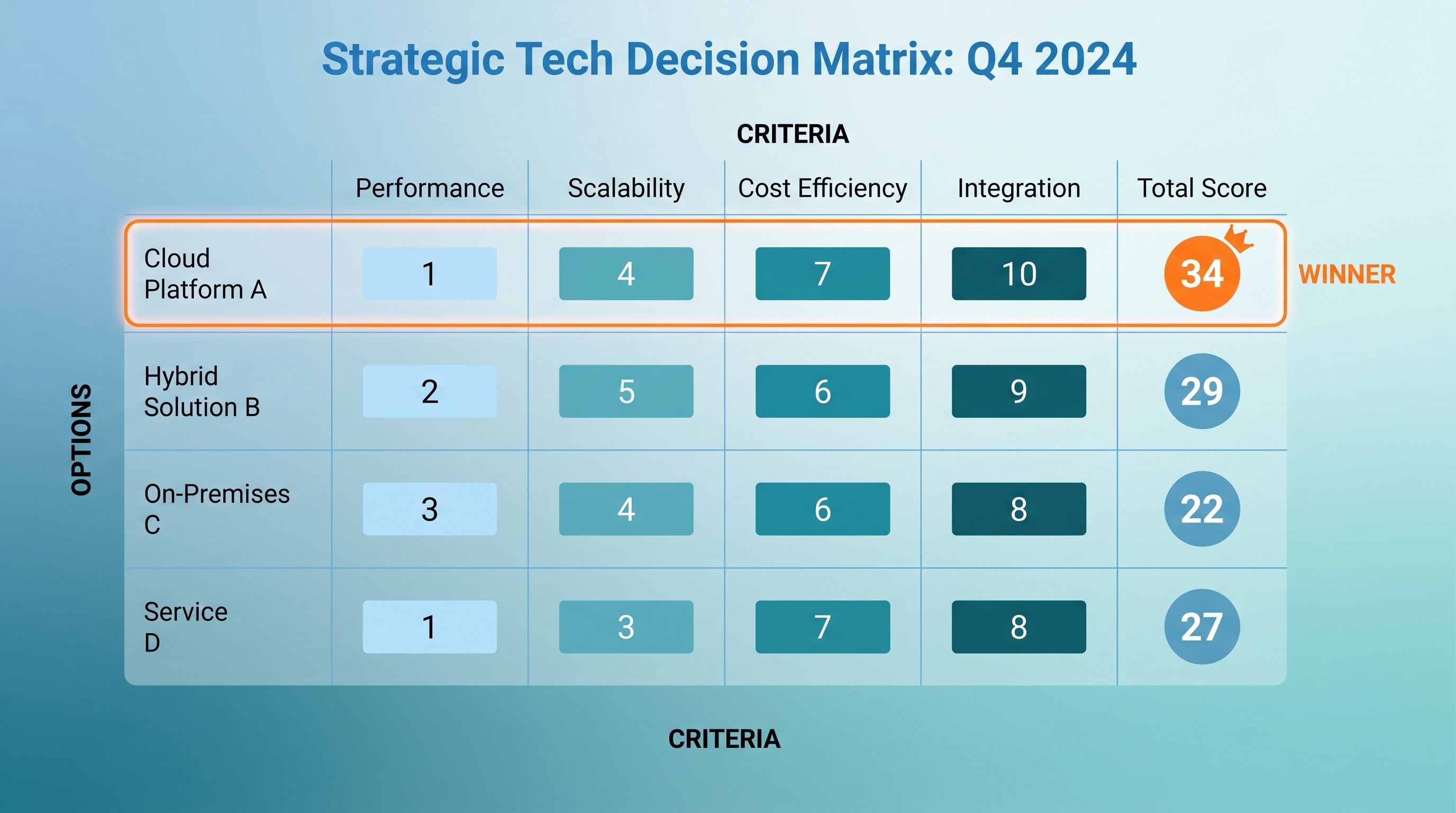
Most people make complex decisions on gut feel, which introduces cognitive biases like anchoring (over-weighting the first option seen) and recency bias (favoring the last option considered). A weighted scoring matrix forces you to define what matters before you evaluate options, separating criteria-setting from scoring — the same technique used in formal procurement, engineering design reviews, and McKinsey-style strategy work. The result is a defensible, documented decision you can explain to a team.
Wofür wir ihn verwenden
Use this prompt when you are facing a significant decision with multiple options and competing priorities — choosing a new tech stack, picking a vendor, deciding between job offers, evaluating business strategies, or selecting among product features to build next quarter.
Prompt
Act as a senior strategy consultant who specializes in structured decision-making frameworks.

I need to make a major decision and want to use a weighted scoring matrix to evaluate my options objectively.

My decision: [DESCRIBE YOUR DECISION IN 1-2 SENTENCES]

My options:
1. [OPTION A]
2. [OPTION B]
3. [OPTION C]
(Add more if needed)

My criteria for evaluating these options (list what matters most):
- [CRITERION 1, e.g. cost]
- [CRITERION 2, e.g. implementation time]
- [CRITERION 3, e.g. team capability]
- [CRITERION 4, e.g. long-term scalability]
(Add or remove criteria as needed)

Constraints and context:
- [ANY HARD CONSTRAINTS — e.g. budget cap, deadline, must-have features]
- [RELEVANT CONTEXT — e.g. team size, current situation, strategic goals]

Do the following:
1. Review my criteria and suggest adjustments if any important factor is missing or if two criteria overlap significantly.
2. Ask me to assign weights to each criterion (1-5, where 5 = most important) — or assign sensible weights yourself based on the context I provided and explain your reasoning.
3. Score each option against every criterion on a scale of 1-10.
4. Calculate the weighted score for each option (score × weight, summed).
5. Present a clean scoring table with: criteria | weight | scores per option | weighted scores | totals.
6. Identify the winning option and explain in 2-3 sentences why it scored highest.
7. Flag any minority concern: if the runner-up is close or if the top scorer has a critical weakness, call it out explicitly.

Output format:
- Start with the scoring table (use markdown table formatting)
- Follow with a 3-paragraph analysis: winner rationale, key tradeoffs, one risk to watch
Ergebnis
Scoring Matrix: Cloud Provider for Our SaaS Product
| Criterion | Weight | AWS | GCP | Azure | AWS x W | GCP x W | Azure x W |
|---|---|---|---|---|---|---|---|
| Cost at scale | 5 | 7 | 8 | 6 | 35 | 40 | 30 |
| ML/AI tooling | 4 | 8 | 9 | 7 | 32 | 36 | 28 |
| Team familiarity | 5 | 9 | 5 | 6 | 45 | 25 | 30 |
| Enterprise support | 3 | 9 | 7 | 9 | 27 | 21 | 27 |
| Vendor lock-in risk | 3 | 5 | 6 | 5 | 15 | 18 | 15 |
| TOTAL | 20 | 154 | 140 | 130 |
Winner: AWS (154 points)
AWS wins primarily because of team familiarity (weight 5), which carries the most points. Ramp-up time for a new platform would cost 3-4 engineering months — a real cost that GCP marginal ML advantage does not offset at your current AI workload scale.
Key tradeoff: GCP leads on ML/AI tooling and is the better long-term bet if AI inference becomes your core product. If your roadmap shifts heavily toward custom model serving in the next 12 months, revisit this matrix with ML tooling weighted at 5 instead of 4 — GCP would likely overtake AWS.
Risk to watch: AWS scored lowest on vendor lock-in risk across all three providers. Before committing, audit which AWS-specific services you plan to use. If the answer includes proprietary services like Lambda, DynamoDB, and SageMaker together, your vendor dependency compounds fast.
Schluss mit Bauchgefühl-Entscheidungen bei wichtigen Weichenstellungen
Jede bedeutende Entscheidung hat dasselbe Problem: zu viele Optionen, zu viele Kriterien und ein Gehirn, das auf Abkürzungen aus ist. Sie wägen Optionen im Kopf ab, lassen sich von der zuletzt betrachteten beeinflussen und landen bei einer Wahl, die Sie nicht klar begründen können.
Die gewichtete Entscheidungsmatrix gehört zu den ältesten und zuverlässigsten Werkzeugen der strukturierten Entscheidungsfindung — seit Jahrzehnten genutzt in öffentlichen Ausschreibungen, technischen Konstruktionsprüfungen und Unternehmensberatungen. Dieser Prompt bringt dieses Framework direkt in Claude.
Was der Prompt tut
Sie beschreiben Ihre Entscheidung, listen Ihre Optionen auf und benennen die relevanten Kriterien. Die KI prüft zunächst Ihre Kriterien auf Lücken oder Überschneidungen, vergibt dann Gewichtungen, bewertet jede Option, berechnet die Matrix und liefert eine Punktetabelle plus eine dreiteilige Analyse: Begründung für den Gewinner, zentrale Abwägungen und ein zu beobachtendes Risiko.
Der Schritt zur Einschränkungsdefinition ist bewusst gesetzt. Indem Sie die Gewichtungen vor dem Betrachten der Scores festlegen, verhindern Sie, dass Sie die Kriterien im Nachhinein an eine vorher festgelegte Antwort anpassen — ein häufiger Fehler bei informellen Entscheidungsprozessen.
Wann Sie ihn einsetzen
- Auswahl einer Technologieplattform oder eines Anbieters
- Bewertung von Jobangeboten oder Karriereschritten
- Auswahl von Produktfeatures für den nächsten Sprint oder das Quartal
- Vergleich von Geschäftsstrategien oder Go-to-Market-Ansätzen
- Jede Entscheidung, bei der Sie eine dokumentierte Begründung für ein Team oder Stakeholder benötigen
Funktioniert am besten mit
Claude Sonnet 4.6 verarbeitet strukturierten Output und mehrstufiges Reasoning zuverlässig. GPT-4o ist eine solide Alternative. Bei Entscheidungen mit mehr als fünf Kriterien oder sechs Optionen empfiehlt es sich, die Analyse in zwei Durchläufe aufzuteilen: zuerst die Kriteriengewichtung, dann die Bewertung.