Dieser Meeting-Briefing-Prompt macht aus verstreuten Notizen eine Vorbereitung in 5 Minuten
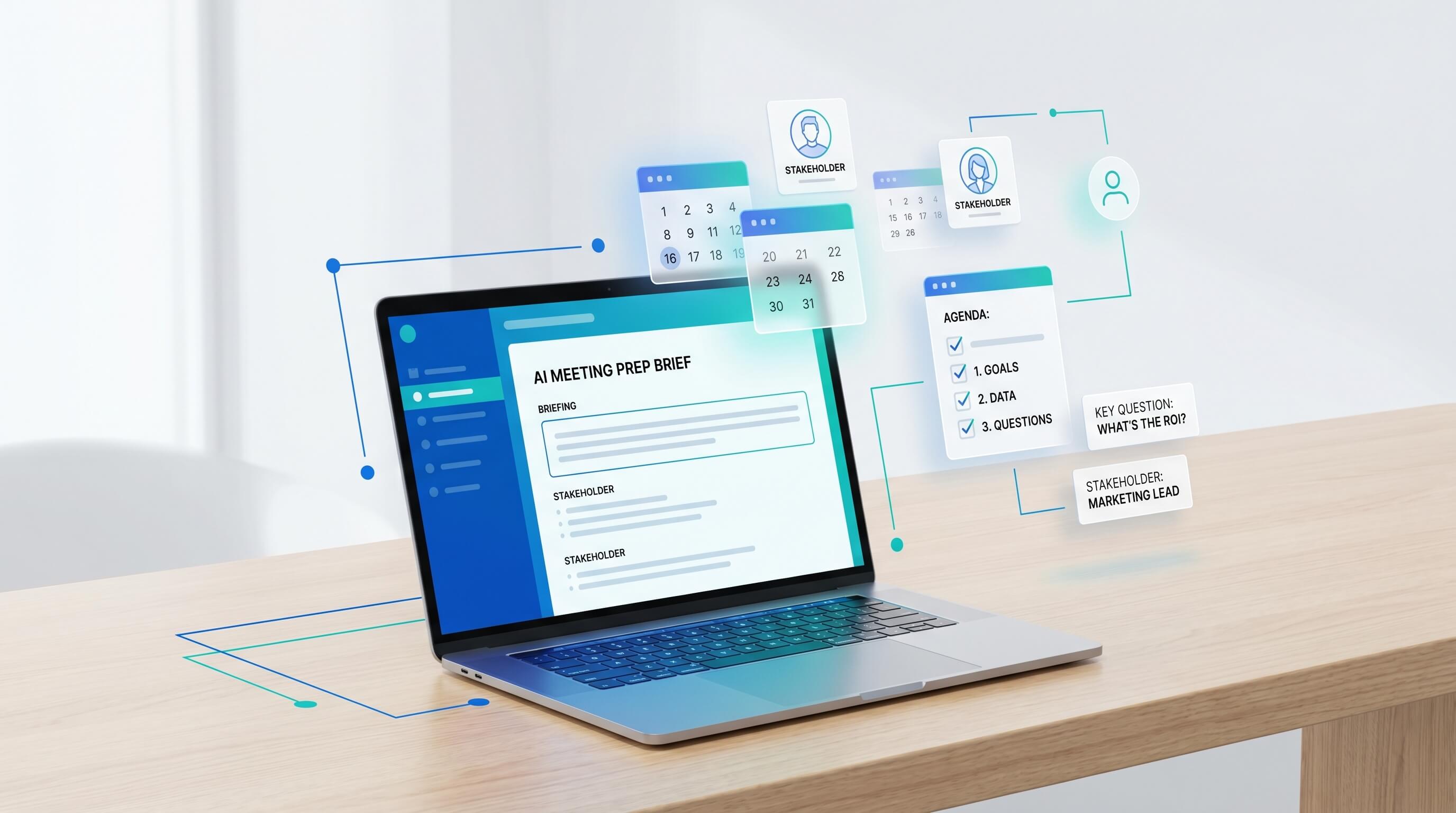
Warum dieser Prompt wichtig ist
Weak meeting prep wastes attention twice: first in the meeting, then in the cleanup after nobody leaves with a clear decision. A structured brief helps you surface hidden stakeholder tension, ask better questions, and protect important outcomes before the conversation drifts into status updates.
Wofür wir ihn verwenden
Use this prompt when you have a client call, internal review, stakeholder alignment meeting, or board prep session coming up fast and your context is scattered across notes, Slack threads, email fragments, and half-written agendas.
Prompt
Role: Act as a chief of staff preparing an executive for an upcoming meeting.

Context: I will give you the meeting title, attendees, my role, the agenda if I have one, recent context from email or chat, known sensitivities, and the outcome I want. Some of the material may be incomplete, messy, or contradictory.

Task: Create a decision-ready meeting brief that helps me walk into the meeting prepared in under five minutes.

Constraints:
- Use only the information provided. If something is missing, label it as an assumption or an open question.
- Do not invent company facts, metrics, or people.
- Prioritize what is actionable before the meeting, during the meeting, and immediately after.
- Highlight political or stakeholder risks if the context suggests them.
- Keep the brief concise but specific.
- If the agenda is weak, suggest a sharper structure.
- If any attendee likely has different incentives, call that out.

Output Format:
1. Meeting Snapshot
   - Meeting title: [MEETING TITLE]
   - Date/time: [DATE/TIME]
   - My role: [YOUR ROLE]
   - Desired outcome: [DESIRED OUTCOME]

2. Who Is in the Room
   - For each attendee: likely priorities, influence level, and what they may care about most

3. What Matters Most
   - Top 3 issues likely to shape the conversation
   - Why each issue matters now

4. Recommended Opening
   - A 30-second opener I can actually say

5. Questions to Ask
   - 5 to 7 sharp questions in priority order

6. Risks and Tensions
   - Misalignment risks
   - Topics to avoid or handle carefully
   - Assumptions that need confirmation

7. Decision Paths
   - Best-case outcome
   - Acceptable fallback
   - Walk-away condition

8. Follow-up Checklist
   - Immediate next steps, owners, and deadlines

Input to use:
- Meeting title: [MEETING TITLE]
- Date/time: [DATE/TIME]
- My role: [YOUR ROLE]
- Desired outcome: [DESIRED OUTCOME]
- Attendees: [ATTENDEES]
- Agenda: [AGENDA]
- Background context: [PASTE EMAILS/NOTES/CHAT]
- Known sensitivities: [SENSITIVITIES]
- Constraints: [TIME/POLITICAL/TECHNICAL CONSTRAINTS]
Ergebnis
Meeting Snapshot - Meeting title: Q3 renewal and expansion review with Northstar Health - Date/time: Tuesday, 10:00 AM - My role: VP of Customer Success - Desired outcome: Secure a 12-month renewal, protect pricing, and gain verbal alignment on expanding analytics seats in Q4
Who Is in the Room - Dana Lewis, CIO: Final internal recommender. Cares about reliability, compliance posture, and whether your team can support rollout without creating operational noise. High influence. - Mark Feldman, Procurement Lead: Focused on discount pressure and contract terms. Medium-to-high influence because he can slow the deal even if he cannot kill it alone. - Priya Shah, Director of Data Operations: Day-to-day champion. Wants better dashboard performance and faster support escalation. High practical influence because her team lives with the product.
What Matters Most 1. Pricing pressure. Procurement will likely frame market softness as justification for a discount. This matters now because once the conversation anchors on price, it is hard to move back to value. 2. Product trust. Priya’s team experienced two slow-report incidents last quarter. If not addressed early, that history will weaken any expansion ask. 3. Expansion timing. The analytics seat expansion is plausible, but only if Dana believes the adoption plan is controlled and low-risk.
Recommended Opening "Thanks for making time. I’d like to use this session to confirm what Northstar needs from the next 12 months, address the reporting issues directly, and see whether we have the right conditions to expand analytics access without adding rollout risk."
Questions to Ask 1. Since the reporting incidents, what concerns are still unresolved for your team? 2. Which renewal outcome would make this feel like a strong decision internally? 3. Where do you expect the biggest adoption bottlenecks if analytics seats expand in Q4? 4. What would procurement need to see beyond price to move quickly? 5. Which success metrics matter most to Dana over the next two quarters? 6. Are there compliance or change-management concerns that would block a broader rollout?
Risks and Tensions - Dana may support the product strategically while still asking Priya to prove operational readiness. - Procurement may use the incident history to seek concessions beyond standard discount bands. - Assumption to confirm: Priya is still willing to act as internal champion if support commitments are tightened.
Decision Paths - Best case: renewal confirmed at near-current pricing with a Q4 expansion plan tied to a success checkpoint. - Acceptable fallback: renewal closes now, expansion deferred pending a 60-day performance review. - Walk-away condition: customer demands pricing terms that create an unhealthy precedent without a meaningful scope commitment.
Follow-up Checklist - Send a written support-improvement summary by end of day, owner: VP Customer Success - Share a phased adoption plan for analytics seats by Thursday, owner: Solutions Architect - Confirm procurement redlines and approval timeline within 48 hours, owner: Account Executive
Die meisten Meetings scheitern nicht daran, dass keine agenda existiert. Sie scheitern daran, dass die Person im Raum das eigentliche Gespräch vorher nicht sauber vorbereitet hat.
Genau für dieses Problem ist dieser Prompt gebaut. Sie geben dem Modell ein unordentliches Paket aus Teilnehmern, halbfertigen agenda-Punkten, aktuellen E-Mails und dem gewünschten Ergebnis. Daraus entsteht ein strukturiertes Briefing, das Interessen, mögliche Spannungen, einen besseren Einstieg und die Fragen sichtbar macht, die eine Entscheidung wirklich voranbringen.
Das Design des Prompts ist entscheidend. Der Teil Role lässt das Modell wie ein chief of staff denken statt wie ein allgemeiner Assistent. Der Teil Context erlaubt unvollständiges Material, weil Meeting-Vorbereitung in der Praxis oft genau so aussieht. Die Constraints begrenzen Halluzinationen und zwingen das Modell, Fakten, Annahmen und offene Fragen zu trennen. Das Output Format hält das Ergebnis kompakt und unter Zeitdruck nutzbar.
Der Wert dieses Prompts liegt darin, dass er mehr tut als nur zusammenzufassen. Er hilft Ihnen, den Raum zu lesen, bevor Sie ihn betreten. Das ist besonders nützlich bei Vertragsverlängerungen, Executive-Reviews, funktionsübergreifenden Planungssitzungen und allen Meetings, in denen unterschiedliche Teilnehmer unterschiedliche Anreize haben.
Wenn Sie nur einen Arbeits-Prompt speichern und jede Woche wiederverwenden würden, wäre das ein starker Kandidat. Er verkürzt die Vorbereitungszeit, verbessert die Qualität Ihrer Fragen und erleichtert das Nachfassen, weil wahrscheinliche Entscheidungswege bereits klar vorliegen.