20 Hooks, die Menschen beim Scrollen stoppen — ein psychologischer Trigger-Generator
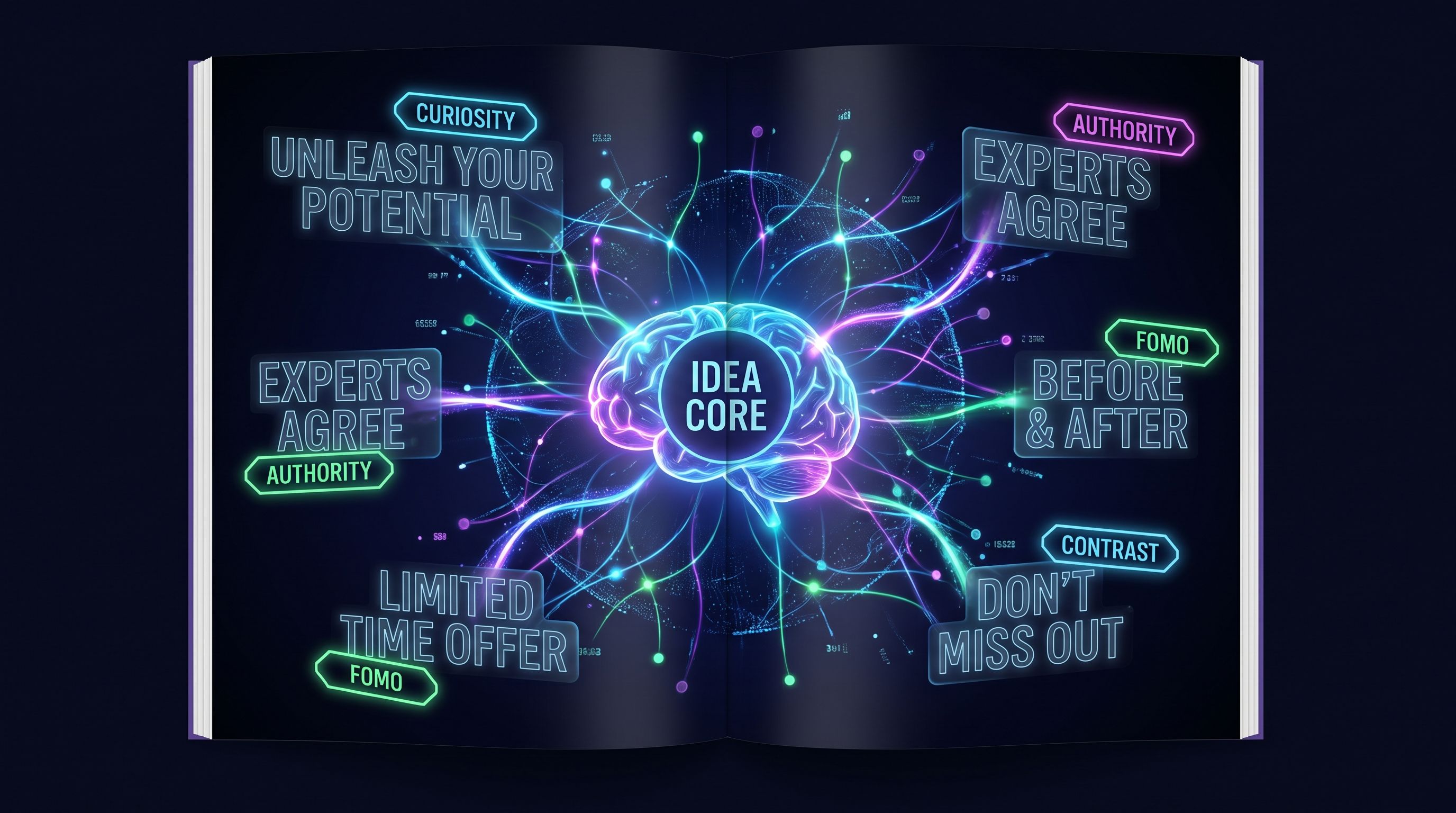
Warum dieser Prompt wichtig ist
Most content creators reuse the same 2–3 hook patterns until their audience goes numb. The real failure happens before the first paragraph: a hook that doesn't match how attention actually works means the content never gets read, no matter how good it is. Without labeling the psychological trigger behind each line, you can't learn what actually resonates with your specific audience — you're just guessing repeatedly. This prompt forces variety across 20 distinct mechanisms and teaches you the science behind each one.
Wofür wir ihn verwenden
You have a new piece of content to publish — a LinkedIn post, YouTube video, newsletter issue, or blog — and you need to test multiple angles before committing to one. You know the topic cold but can't find the angle that will actually make someone stop scrolling. Paste in your topic, audience, platform, and goal and get 20 distinct, psychologically-grounded hooks ready to evaluate.
Prompt
Act as a world-class content strategist and copywriter who specializes in attention psychology and viral content mechanics.

Context: I'm creating content for [PLATFORM: e.g., LinkedIn / Twitter-X / YouTube / Newsletter] targeting [TARGET AUDIENCE: e.g., "B2B SaaS founders", "fitness beginners over 40", "junior developers"]. The topic I want to write about is: [TOPIC OR MAIN IDEA].

My goal: [CONTENT GOAL: e.g., "drive newsletter signups", "get shares from peers", "position myself as an expert", "sell a course"].

Task: Generate exactly 20 hooks for this topic. Each hook must be distinct — no two hooks may use the same psychological trigger or structural pattern.

For each hook:
1. Write the hook (1–2 lines, punchy and complete)
2. Label the psychological trigger it uses
3. Rate its estimated emotional intensity (Low / Medium / High)

Psychological triggers to draw from (mix these, do not repeat):
Curiosity gap, Pattern interrupt, Social proof, Authority, Loss aversion, Specificity, Contrarian take, Before/after transformation, Controversy, FOMO, Insider knowledge, Aspirational identity, Shock/surprise, Story hook, Problem agitation, Counter-intuitive truth, Status appeal, Empathy/shared pain, Humor, Urgency

Constraints:
- No hooks longer than 2 sentences
- At least 4 hooks must use numbers or specific data points
- At least 3 hooks must be contrarian or challenge a common assumption
- Hooks must feel native to [PLATFORM] — not copied from a different medium
- Do NOT use the phrases "Are you tired of..." or "Most people don't know..."

Output format:
Hook #[N]
[Hook text]
Trigger: [name]
Intensity: [Low/Medium/High]
---

After all 20 hooks, add a section called "TOP 3 PICKS" recommending the 3 hooks most likely to perform best for my stated goal, with 1–2 sentences explaining why each made the list.
Ergebnis
Example run: Topic: "Why most productivity advice backfires for developers" | Platform: LinkedIn | Audience: Senior software engineers | Goal: Build thought leadership
Hook #1
Senior developers don't have a time management problem. They have a context-switching tax that productivity gurus have never experienced.
Trigger: Contrarian take
Intensity: High
Hook #2
I tracked every interruption in my workday for 30 days. Average deep work session: 11 minutes. Then I changed one meeting rule.
Trigger: Story hook + Specificity
Intensity: Medium
Hook #3
The GTD system was designed for a knowledge worker in 1992. Your codebase wasn't.
Trigger: Pattern interrupt
Intensity: Medium
Hook #4
Every "10x developer" tip I ignored for years turned out to be real. Here's the one that actually scaled.
Trigger: Authority + Curiosity gap
Intensity: High
Hook #5
Pomodoro timers are productivity theater. A 25-minute session is exactly long enough to get into flow — and then break it.
Trigger: Controversy
Intensity: High
Hook #6
The engineers shipping the most code don't work more hours. They've eliminated one category of work entirely.
Trigger: Curiosity gap
Intensity: Medium
Hook #7
We tell junior devs to "time-block." We don't tell them that senior engineers quietly stopped doing it three years ago.
Trigger: Insider knowledge
Intensity: High
Hook #8
What if the reason you're behind on your backlog has nothing to do with your backlog?
Trigger: Problem agitation
Intensity: Medium
... [hooks #9–20 continue with: Before/after transformation, Social proof, Aspirational identity, FOMO, Loss aversion, Urgency, Empathy/shared pain, Counter-intuitive truth, Status appeal, Humor, Shock/surprise, Authority] ...
TOP 3 PICKS for thought leadership goal:
#2 (Story hook + Specificity) — Concrete numbers signal credibility. Engineers respond to data-backed claims; "11 minutes" is memorable and shareable. Comments will pour in from people comparing their own numbers.
#7 (Insider knowledge) — Positions you as a practitioner, not a theorist. The implicit message: "I know what the seniors actually do." This builds the authority your goal requires.
#5 (Controversy) — Contrarian takes on Pomodoro specifically will generate responses from both camps — exactly the engagement that signals LinkedIn's algorithm you're worth amplifying.
Inhalte leben oder sterben durch ihre ersten zwei Zeilen. Egal wie gut die Analyse ist oder wie lange du geschrieben hast — wenn der Hook nicht mit der Funktionsweise menschlicher Aufmerksamkeit übereinstimmt, wird der Inhalt nie gelesen.
Die meisten Autoren lösen das durch Raten. Sie schreiben drei Hooks, wählen den besten und veröffentlichen. Monate später fragen sie sich, warum ihr Engagement stagniert. Das eigentliche Problem: Sie recyceln unbewusst dieselben 2–3 psychologischen Muster.
Was diesen Prompt anders macht
Dieser Prompt generiert 20 Hooks und erfordert, dass jeder einen anderen psychologischen Trigger verwendet. Er schöpft aus 20 beschrifteten Mechanismen — Neugierlücke, konträre Haltung, Verlustaversion, Insiderwissen — und erzwingt Vielfalt im Gesamtset.
Die Designentscheidungen
Der Role-Abschnitt legt eine spezifische Expertise-Kreuzung fest. Er erfordert mindestens vier Hooks mit spezifischen Zahlen. Er erfordert mindestens drei konträre Hooks, um generische Winkel zu vermeiden.
Der TOP 3 PICKS-Abschnitt
20 Hooks zu generieren ist einfach; zu wissen, welche drei tatsächlich verwendet werden sollen, erfordert Urteilsvermögen über Ziel, Zielgruppe und Kontext. Dieser Abschnitt zwingt das Modell, dieses Urteil explizit anzuwenden.