Xona Space Systems prepares to launch six satellites for its commercial GPS alternative
Xona Space Systems is preparing to launch six satellites later this month aboard a SpaceX rocket, the first production hardware for Pulsar, a commercial precision positioning and timing service the company is pitching as an alternative to GPS. TechCrunch's Tim Fernholz reported the mission on October 9, though Xona has not disclosed an exact launch date.
Xona was founded in 2019 by five engineers who met in Stanford University's aerospace engineering graduate program. The company is headquartered in Burlingame, California, and is led by CEO Brian Manning, with co-founder Tyler Reid — who wrote his PhD thesis on using low-Earth-orbit satellites to improve navigation and previously worked on self-driving cars at Ford — serving as CTO.
The problem Xona is targeting is a real limitation of existing satellite navigation: GPS, along with the European, Chinese, and Russian equivalents, is both easy to jam and not precise enough on its own for applications like autonomous farming equipment or self-driving cars. Pulsar is designed for centimeter-level geolocation, a significant jump from GPS's meter-level precision, and its signal is strong enough to be detected inside buildings and dense urban environments — conditions where GPS reception routinely degrades.
A key design choice is backward compatibility: Xona's signals can be picked up by existing GPS receivers after a relatively simple software update, rather than requiring new hardware. That matters for both adoption and regulatory approval, since it lowers the bar for device makers to add support and gives Xona an existing addressable market rather than one it has to build from scratch.
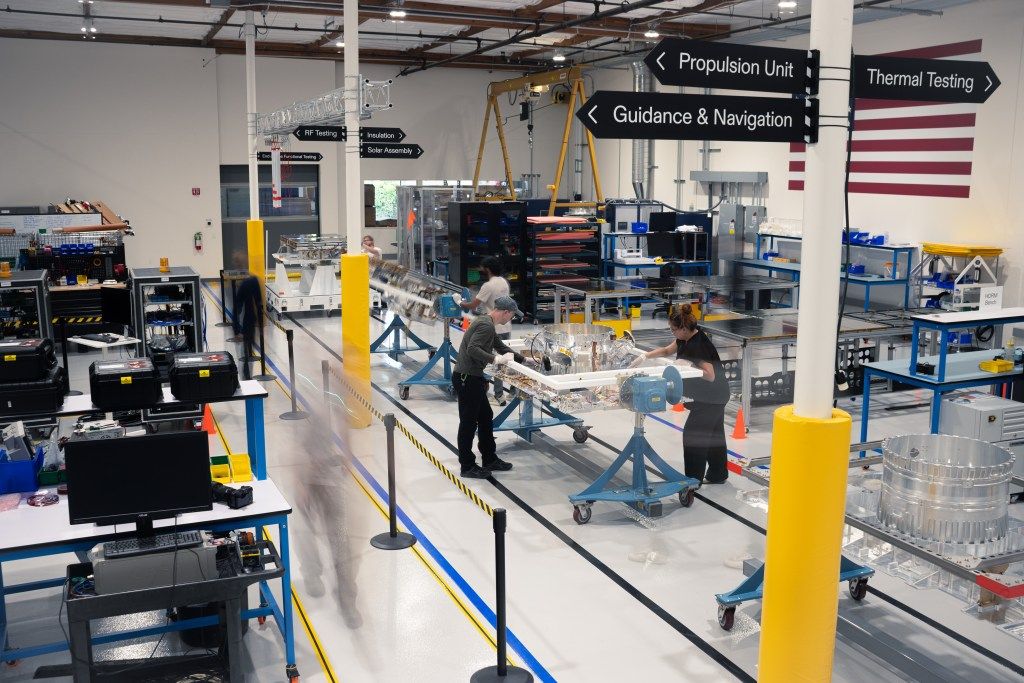
The six satellites launching this month include four built on a platform from Aerospace Labs, similar to a prototype Xona launched last year, plus two satellites built entirely in-house at Xona's Burlingame facility. Those two in-house satellites are meant to be the architectural foundation for Pulsar's full operational constellation, which Xona plans to scale to 258 satellites. The company's satellites are engineered to maintain accurate timing without expensive onboard atomic clocks, instead relying on their low orbit and frequent communication with ground-based reference stations.
Xona has raised just over $300 million from venture investors since its founding, including a $20 million contract from the U.S. Space Force — a sign of the growing government interest in resilient positioning, navigation, and timing systems as GPS jamming and spoofing have become more common tactics in active conflicts.
Once the new satellites reach orbit, Xona plans to begin beta testing with real customers. TimeBeat, a timing-technology company, is lined up as an early pilot partner; its CEO Ian Gough said the test will let TimeBeat's engineers verify and correct device timing accuracy worldwide. Because the satellites pass over mid-latitudes roughly eight times a day, that orbital geometry will shape the cadence of early testing.
Manning points to autonomous vehicles as Pulsar's primary long-term market, drawing a comparison to the safety role civil aviation navigation systems play, while noting that GPS itself is free to end users — meaning Xona's business depends on selling precision as a feature to the hardware and software companies building on top of satellite navigation, not on charging for the signal directly. Xona is targeting full coverage across the U.S., Europe, Japan, and South Korea by 2028.
Ursprünglich berichtet von TechCrunch. Lesen Sie den Originalartikel für weitere Details.
Originalquelle ansehen