Secret Sprawl wird zu einer der einfachsten Arten, die Kontrolle über einen modernen Stack zu verlieren
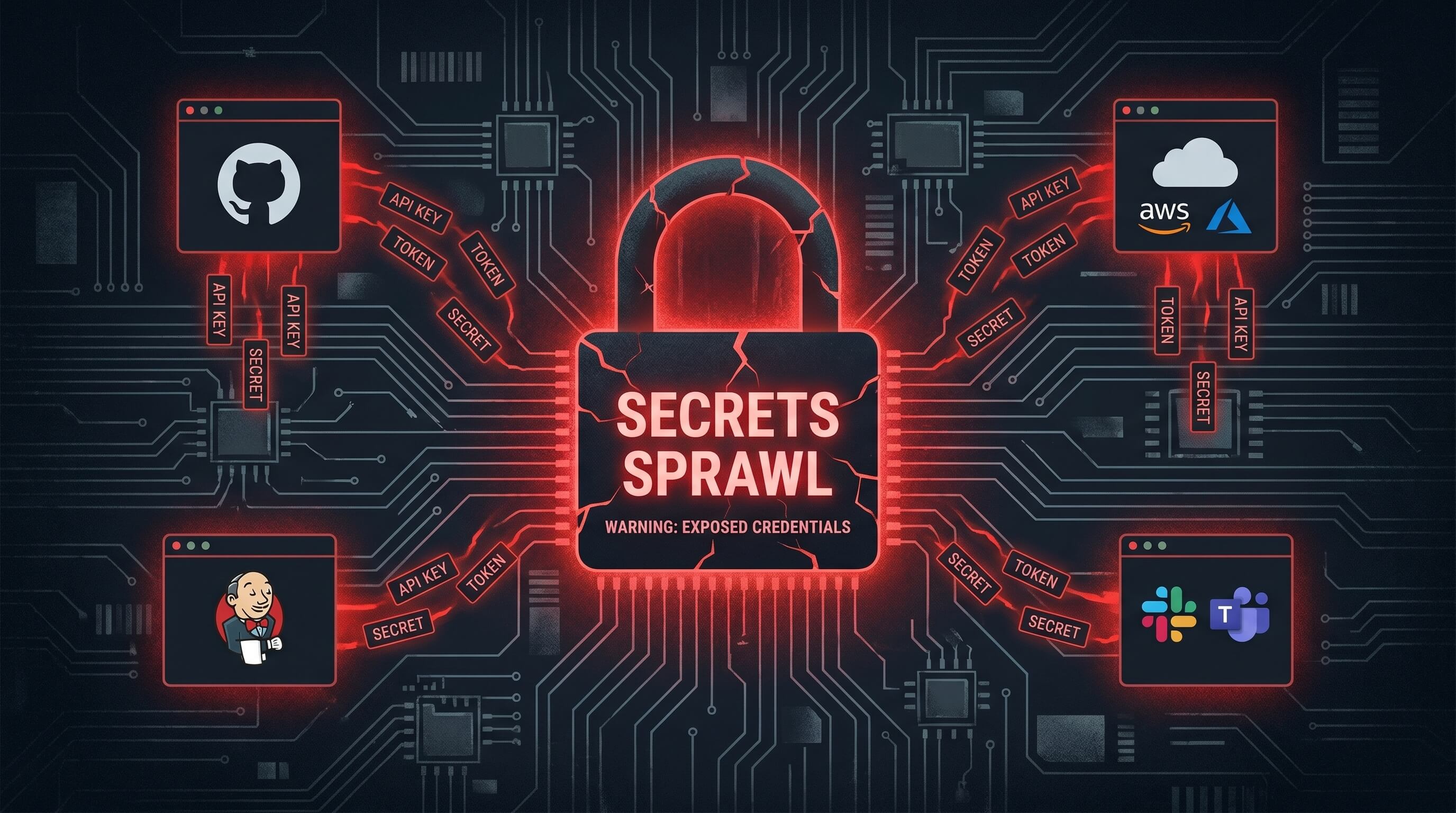
Secrets sprawl is no longer a side effect of fast software delivery. It is becoming one of the easiest ways for a company to lose control of a modern stack. API keys land in source code, long lived tokens sit in CI variables, credentials get pasted into tickets for convenience, and no one is fully sure which secrets are still active, who owns them, or how quickly they can be revoked. In many teams, that means the real perimeter is not the firewall or the VPN. It is the messy trail of machine identities scattered across code, pipelines, clouds, SaaS tools, and chat.
The thesis is simple: secrets sprawl is dangerous because it turns routine engineering speed into silent security debt. The more services, automations, agents, and environments an organization adds, the more credentials it issues, duplicates, forgets, and over privileges. Recent industry reporting from GitGuardian has reinforced the scale of the problem, noting tens of millions of newly exposed secrets in public repositories and a large share of leaked credentials remaining valid years later. That combination, high volume plus long lifetime, is exactly how operational drift becomes real exposure.
Why secrets sprawl grows faster than most teams expect
Modern stacks create secrets everywhere. A single feature can involve a cloud account, a database user, third party APIs, GitHub Actions, a container registry, observability tooling, a payment sandbox, and internal admin tools. Each step invites another token, certificate, access key, webhook secret, or service account.
The problem is not just the number of secrets. It is the number of places they can hide. Developers store them in local .env files, CI platforms keep them as repository variables, Terraform states may expose them by accident, support teams paste them into incident notes, and temporary workarounds become permanent because the system kept working. Once a credential exists in three or four places, ownership becomes fuzzy. Once ownership becomes fuzzy, rotation stops happening.
Practical example, the forgotten staging token
A team creates a staging token for a payment provider to unblock testing. It gets copied into a shared password manager, then into a CI secret, then into a Postman collection, then into a troubleshooting document. Six months later, the original engineer has moved teams. No one knows whether the token still has write access, which environments rely on it, or what will break if it is rotated. That is secrets sprawl in miniature: duplication, uncertainty, and fear of change.
Why this is really a control problem, not just a storage problem
Many organizations frame secrets management as a vault adoption project. Vaults matter, but storage is only one part of the issue. A company can buy a strong secrets manager and still lose control if the surrounding practices are weak. The deeper problem is lifecycle control: creation, distribution, use, monitoring, rotation, revocation, and auditing.
If security cannot answer basic questions, control is already slipping. Which secrets are human versus machine? Which are tied to production? Which have not been used for ninety days? Which are shared across services? Which can be rotated automatically? Which are referenced in code, logs, tickets, or container images? A vault without that operating discipline becomes a nicer drawer for the same clutter.
Where the modern attack surface keeps widening
Public GitHub leaks get attention because they are easy to visualize, but secrets sprawl is broader than source code. It extends into collaboration tools, build systems, containers, infrastructure templates, AI coding workflows, and internal scripts. The growing use of non human identities makes the issue worse because machines now talk to machines constantly, often with broad permissions and minimal review.
Consider a typical delivery path. A developer uses an AI assistant to scaffold integration code. A sample token is hardcoded during testing. The branch triggers CI, the build injects multiple secrets, logs capture a debug value, and a container image is pushed with a stray credential file left in a layer. None of these steps look dramatic alone. Together they create many recovery points for an attacker, and multiple clean up jobs for the defender.
Practical example, the incident that is bigger than the leak
Suppose a cloud access key appears in a public commit for ten minutes before it is removed. The real work starts after the deletion. Security has to determine whether the key was valid, where else it was copied, what permissions it had, whether it was used from unusual IPs, which workloads depended on it, and whether rotating it will break production. The leak is the trigger. The real cost comes from poor traceability.
What good teams do differently
Strong teams treat secrets like inventory, not like background configuration. They aim to reduce the total count, shorten lifetime, narrow scope, and increase visibility. That usually means a few disciplined moves.
1. Prefer ephemeral credentials over long lived secrets
Short lived tokens, workload identity federation, and dynamic database credentials reduce the blast radius of leakage. If a credential expires quickly and is minted just in time, it is much less useful to an attacker and much easier to reason about operationally.
2. Centralize issuance and ownership
Every secret should have an owner, a purpose, a system of record, and an expected rotation path. If a credential cannot be tied to a team and an application, it should be considered suspicious by default.
3. Scan beyond source code
Repository scanning is necessary, but it is not enough. Mature programs scan pull requests, commit history, CI logs, container images, IaC artifacts, collaboration tools, and ticketing systems. The goal is to find secrets where work actually happens, not only where policy says it should happen.
4. Design rotation before incident response
Teams often discover during a breach that they do not know how to rotate a critical secret safely. Rotation needs runbooks, dependency mapping, rehearsal, and automation before a crisis. If revocation is scary, the environment is already too fragile.
5. Shrink permissions and segment environments
A staging token should not act like production. A read only analytics credential should not write to customer systems. Smaller scopes turn inevitable mistakes into smaller incidents.
What leaders should measure
If you want to know whether secrets sprawl is improving, track a few operational metrics. Count long lived credentials. Measure mean time to revoke exposed secrets. Measure how many secrets have a named owner. Track how many environments still depend on manually distributed credentials. Track how often scanners catch leaks before merge versus after release. Those numbers show whether the organization is gaining control or just accumulating more tooling.
The strategic takeaway
Secrets sprawl becomes dangerous when it feels normal. That is why it is one of the easiest ways to lose control of a modern stack. It hides inside ordinary delivery habits, scales with every new integration, and punishes teams most when they need clarity fast. The answer is not paranoia. It is discipline: fewer secrets, shorter lifetimes, tighter scope, better visibility, and rotation that works under pressure. In a stack full of APIs, automations, and machine identities, that discipline is no longer optional. It is part of basic operational control.