جسر المفاهيم: تعلم أي موضوع تقني فوريًا من خلال ربطه بما تعرفه مسبقًا
لماذا تهم هذه المطالبة
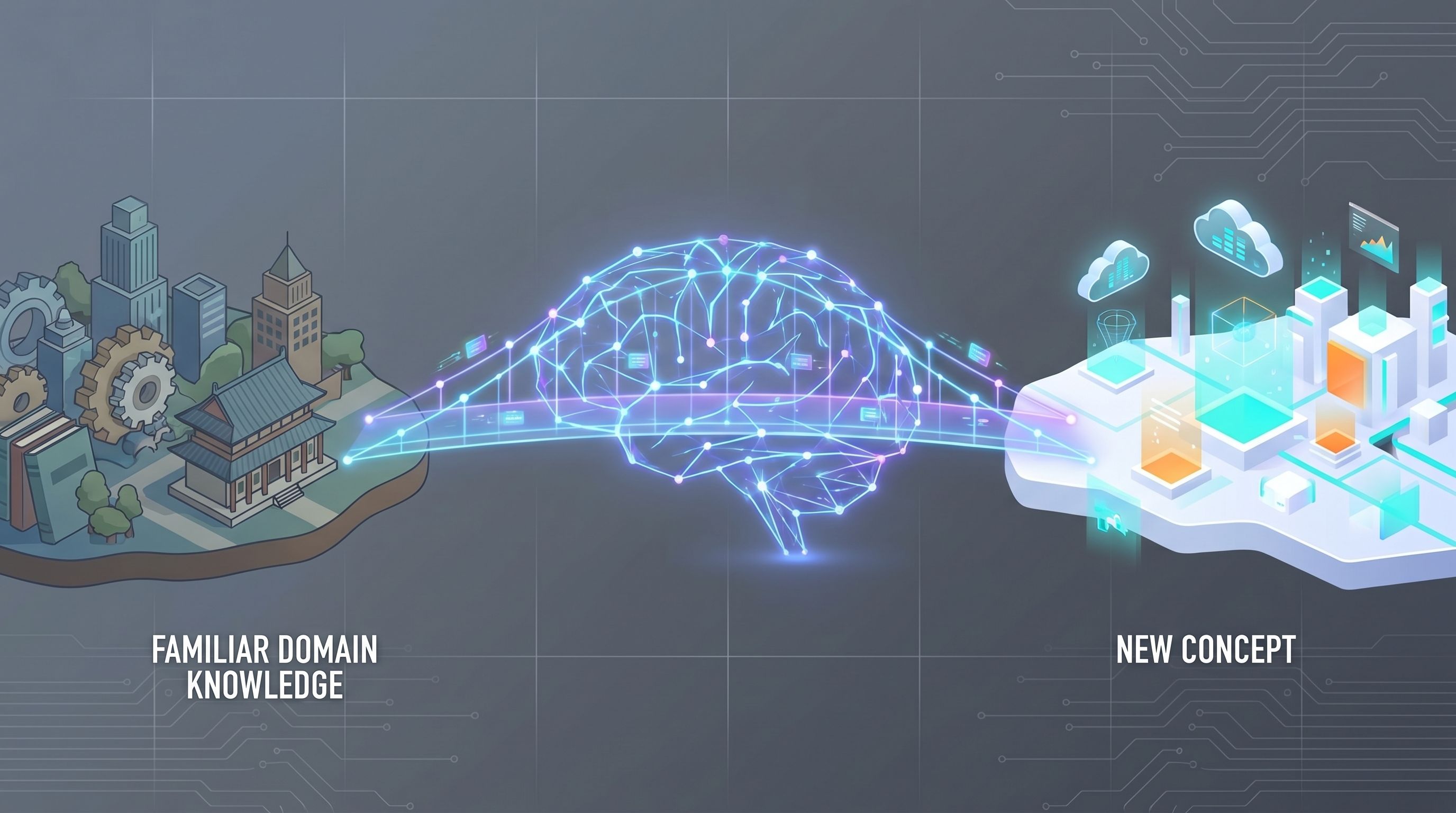
Standard technical documentation is written for people who already understand adjacent concepts in the same field. If you're a database engineer learning ML, those resources assume the wrong baseline. Anchoring new concepts to your existing mental models is measurably faster — cognitive science research on analogical transfer consistently shows 3–5x better retention when learners map new information to known structures. The prompt also forces the AI to identify where the analogy breaks, which is where most self-taught understanding fails silently.
فيم نستخدمها
You've been handed a task involving a technology you've never touched: a backend engineer suddenly needs to understand transformer attention mechanisms, a product manager needs to grasp distributed consensus before a 10am meeting, or a lawyer needs a working mental model of blockchain before a client call. You have 30 minutes and need genuine intuition, not a textbook overview.
المطالبة
Act as a master teacher and domain translator. Your job is to explain [CONCEPT YOU WANT TO LEARN] entirely through analogies drawn from [DOMAIN YOU ALREADY KNOW WELL] — without using direct technical jargon from the new concept until after it has been introduced through analogy.

Context: I have deep expertise in [DOMAIN YOU ALREADY KNOW WELL] and I am trying to build an intuitive mental model of [CONCEPT YOU WANT TO LEARN]. I do NOT want a standard textbook explanation. I want to understand it the way a colleague who knows my domain deeply would explain it over coffee.

Task: Explain [CONCEPT YOU WANT TO LEARN] by:
1. Creating a Core Mapping — a table that maps each key component of the new concept to its closest equivalent in [DOMAIN YOU ALREADY KNOW WELL]
2. Walking through 2–3 concrete scenarios using only the language and mental models of [DOMAIN YOU ALREADY KNOW WELL]
3. Identifying clearly where the analogy breaks down — the specific points where my intuition from [DOMAIN I KNOW] will mislead me about [CONCEPT YOU WANT TO LEARN]
4. Ending with 3 self-check questions I can ask myself to verify I genuinely understood it and not just pattern-matched the words

Constraints:
- Do NOT open with a Wikipedia-style overview — go straight into analogy
- Every technical term must be introduced via its analogy before being named
- The breakdown section must be honest and specific, not just "the analogy isn't perfect"
- Keep the full response under 800 words

Output Format:
## The Concept Bridge: [CONCEPT] through the lens of [DOMAIN]

### Core Mapping
[Table: New Concept Term | What It Maps To In Your Domain]

### How It Works (in your domain's language)
[2–3 scenarios told entirely in the language of [DOMAIN YOU ALREADY KNOW WELL]]

### Where the Analogy Breaks Down
[Specific, honest limitations — the places your intuition will lie to you]

### 3 Questions to Test Your Understanding
[Self-check questions that require real understanding, not recall]
النتيجة
The Concept Bridge: Transformer Attention through the lens of SQL Databases
Core Mapping
| Transformer Concept | Database Equivalent |
|---|---|
| Token | Row in a table |
| Attention weight | JOIN relevance score / query selectivity |
| Query vector (Q) | The SELECT + WHERE clause you're searching with |
| Key vector (K) | The indexed column being searched against |
| Value vector (V) | The actual data returned when a row matches |
| Multi-head attention | Running 8 parallel queries on the same table, each asking a different question |
| Context window | The table size limit — only rows within it can be JOINed |
How It Works (in database language)
Scenario 1: A single attention head. Imagine you're running: "Find all rows most relevant to the current row I'm processing." Every token simultaneously acts as both the query (what am I looking for?) and a potential result (am I relevant to others?). The attention weight is the relevance score — like a fuzzy full-text search rank rather than an exact JOIN.
Scenario 2: Multi-head attention. You run 8 different queries on the same dataset in parallel. One asks "which words are grammatically connected?", another asks "which words share meaning?", another asks about position. Each returns its own ranked result set. The outputs are then concatenated — like a UNION ALL followed by a final aggregation.
Scenario 3: The context window as table size. Your database can only hold 128,000 rows in memory at once. Any row outside that window simply doesn't exist for the current query — it can't be JOINed against or referenced. This is why context length matters: it's your working table size.
Where the Analogy Breaks Down
Weights are learned, not declared. In SQL, you define your schema and indexes explicitly. The Q, K, V matrices — the "query structure" — are learned from billions of examples. There's no schema designer.
All rows query all rows simultaneously. In SQL, you write one query at a time. In attention, every token is simultaneously acting as a query against every other token in one parallelized matrix multiplication — N² comparisons at once.
There's no primary key. A word's "identity" as a key shifts based on what surrounds it, unlike a database row with a fixed ID.
3 Questions to Test Your Understanding
- If you doubled the context window from 64K to 128K tokens, what happens to computational cost — and why? (Hint: think N².)
- Why can't a transformer "look up" information from a document it wasn't given in context, even if trained on it?
- In multi-head attention, each head learns different patterns. What would be the database equivalent of a head that specializes in long-range dependencies?
معظم الشروحات التقنية تُكتب لأشخاص يفهمون مسبقًا المفاهيم المجاورة في نفس المجال. إذا كنت مهندس قواعد بيانات تحاول فهم كيفية عمل الـ Attention في Transformer، فإن الدروس المعيارية سترجع إلى مفاهيم الجبر الخطي وبديهيات Machine Learning التي لا تملكها. Prompt «Concept Bridge» يقلب ذلك — يجبر الذكاء الاصطناعي على شرح المفهوم الجديد كليًا من خلال مجالك الحالي، ثم يحدد بصدق أين ينكسر هذا القياس.
ما الذي يجعل هذا الـ Prompt فعّالاً
الـ Prompt مبني على ثلاثة خيارات هيكلية تتجاهلها معظم Prompts التي تقول «اشرح X ببساطة»:
الـ Core Mapping يأتي أولاً. قبل أي شرح سردي، يجب على الذكاء الاصطناعي إنتاج جدول يربط كل مصطلح رئيسي في المفهوم الجديد بأقرب معادل له في مجالك. هذا يمنحك مفردات قبل القصة — بحيث عندما تتعقد القياسات، يكون لديك مرجع ترتكز عليه.
قسم الـ Breakdown إلزامي. معظم الشروحات القائمة على القياس تحذف هذا، مما يعني أنك تخرج بنموذج ذهني يُخطئ بصمت. هذا الـ Prompt يتطلب من الذكاء الاصطناعي تحديد الأماكن التي ستضللك فيها بديهيات مجالك بالضبط. هذا هو المكان الذي يفشل فيه الفهم التقني الذاتي — ليس على السطح بل عند الحواف حيث يتوقف القياس عن الصمود.
أسئلة الفحص الذاتي تستخدم الفهم وليس الاسترجاع. الأسئلة الثلاثة الختامية مصممة لتتطلب استدلالًا حقيقيًا بالنموذج الذهني، وليس مجرد إعادة ما قيل. إذا استطعت الإجابة عليها باستخدام لغة مجالك، فقد فهمت المفهوم. إذا لم تستطع، فأنت تعرف بالضبط أين تتعمق أكثر.
كيفية الاستخدام
استبدل [CONCEPT YOU WANT TO LEARN] بأي شيء: آليات الـ Attention في Transformer، الإجماع الموزع (Raft/Paxos)، Smart Contracts، هياكل بيانات CRDT، التشفير المتماثل، جدولة Kubernetes. واستبدل [DOMAIN YOU ALREADY KNOW WELL] بأقوى خبراتك الحالية: قواعد بيانات SQL، الهندسة الكهربائية، القانون المدني، نظرية الموسيقى، المحاسبة، اللوجستيات.
النموذج يعمل بشكل أفضل عندما تكون الفجوة بين المجالات كبيرة — محامٍ يتعلم Blockchain، مهندس Backend يتعلم Machine Learning، مدير منتج يتعلم الأنظمة الموزعة. كلما اتسعت الفجوة، زادت فائدة الجسر. لا تستخدمه للمفاهيم المجاورة حيث الموارد المعيارية تلبي احتياجاتك بالفعل.
ملاحظات حول النماذج
Claude Opus 4.8 ينتج أغنى القياسات وأكثر أقسام الـ Breakdown صدقًا — إنه جيد بشكل خاص في تحديد أين يضلل القياس بدلاً من مجرد القول «القياس له حدود». GPT‑4o هو بديل متين بجداول أكثر هيكلية قليلاً. تجنب النماذج الأصغر لهذا الـ Prompt؛ فهي تميل إلى إنتاج خرائط سطحية تبدو صحيحة لكنها تفتقر للتفاصيل الميكانيكية حيث يكمن الفهم.