Humanoid robots can walk through warehouses, but their hands still can't do the job
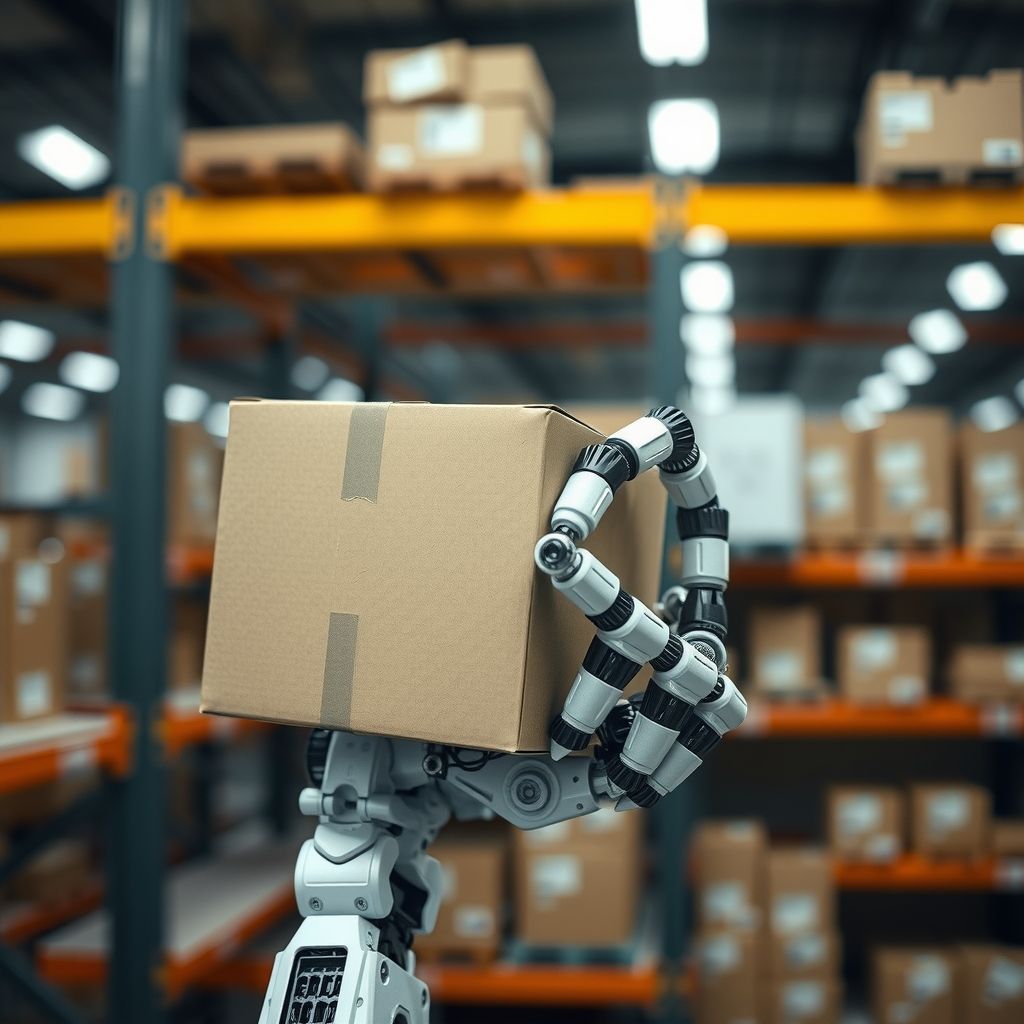
Boston Dynamics' Atlas can backflip. Tesla's Optimus can walk a factory floor. Agility's Digit can climb stairs carrying a tote. None of that is the hard part anymore. The hard part is what happens when one of these robots reaches for a loose cable, a torn bag of rice, or a box that's been dented on one corner — and has to figure out, in real time, how to grip it without crushing it or dropping it.
Locomotion is a solved engineering problem with a known recipe: reinforcement learning in physics simulators like Isaac Gym or MuJoCo, trained on millions of procedurally generated terrain variations, then transferred to hardware with a thin layer of domain-randomization tricks. Every major humanoid program from Figure to Unitree to Apptronik now ships walking and balance behavior that would have been a research paper in 2021 and is a solved checkbox in 2026. Manipulation has no equivalent recipe. That's the actual state of the humanoid robotics industry right now, and it's the opposite of what the demo videos imply.
Why hands are harder than legs
A biped's legs have roughly 12 degrees of freedom and a well-defined objective: keep the center of mass over the support polygon. A human-equivalent hand has 20-plus degrees of freedom per hand, and the objective changes with every object. Gripping a coffee cup, peeling a piece of tape off a roll, and sliding a flat envelope out of a stack are three different control problems that share almost no structure. Legs solve one problem a trillion times. Hands solve a trillion different problems once each.
Simulation makes the gap worse, not better. Rigid-body physics engines model contact between a foot and a floor reasonably well — both are hard, both have simple friction cones. Simulating contact between a soft silicone fingertip and a plastic bag, where the bag deforms, slides, and changes its own contact geometry mid-grasp, is a genuinely harder physics problem, and the simulators used for locomotion training don't do it well. That means most manipulation policies can't be trained cheaply at scale the way walking gaits are — they need either real-world data collection or much slower, much less accurate simulated contact dynamics. This is the real reason manipulation lags: not a lack of clever algorithms, but a lack of cheap training signal.
How companies are trying to close the gap
Three approaches dominate right now, and none of them is a clean win.
Teleoperation data collection. 1X's Neo and Figure's robots are both being driven remotely by human operators in warehouses and homes, logging every joint angle and camera frame as training data. This is the same playbook Tesla used for Autopilot — bootstrap a policy from human-piloted demonstrations, then gradually hand off control to the model as it gets confident. It works, but it's slow: Figure has talked publicly about needing on the order of thousands of hours of teleoperated grasping data per task category before a learned policy generalizes past the exact objects it saw in training.
Imitation learning and diffusion policies. Physical Intelligence's pi-0 model and Skild AI's foundation model both use diffusion-based action generation — the same family of technique behind image generators like Stable Diffusion, repurposed to predict a sequence of joint torques instead of pixels. The appeal is that diffusion policies handle multimodal action distributions well: if there are three valid ways to pick up a mug, the model doesn't average them into one bad grasp, it can represent all three and sample one. The catch is these models still need large, diverse manipulation datasets to generalize, and nobody has anything close to the scale of data that made large language models work. Open X-Embodiment, the largest public robot manipulation dataset as of late 2025, has on the order of a million trajectories across 22 robot types combined — a rounding error next to the token counts behind any frontier LLM.
Hardware simplification. Some vendors are sidestepping the dexterity problem rather than solving it. Amazon's Proteus and Agility's Digit both favor simpler end-effectors — suction cups, parallel-jaw grippers, or reduced-finger-count hands — over anthropomorphic five-fingered hands. A suction gripper can't tie a knot, but it also doesn't need a diffusion policy to pick up a flat-sided box reliably. For a huge share of actual warehouse SKUs (uniform cartons, poly bags, totes), this is a legitimate engineering shortcut, not a cop-out. The five-fingered hand matters mainly for the long tail: irregular returns, mixed pallets, anything a human picker currently handles by feel.
What the numbers actually look like
Public benchmark numbers are thin because most humanoid manipulation work is still proprietary, but the shape of the gap is consistent across every lab that has published comparisons. A trained grasp — an object the policy saw repeatedly during training, in a pose close to what it saw — succeeds at rates competitive with human pickers, often above 90%. The same policy, shown a novel object it has never encountered (a different box shape, a bag instead of a carton, an item at an unfamiliar angle), routinely drops into the 40-60% success range, and takes noticeably longer per attempt: multiple seconds of visual search and regrasp attempts versus roughly a second for an experienced human warehouse picker. That gap — trained-object success versus novel-object success — is the single most informative number in this field, and it's almost never the number shown in a product demo.
What to actually watch for
If you're evaluating a humanoid robot vendor, or just trying to figure out whether the humanoid robotics wave is real progress or investor theater, the walking demo tells you almost nothing. Ask these questions instead:
- What's the novel-object success rate, not the trained-object rate? Any vendor can show you a robot picking the exact 50 SKUs it trained on all day. The number that matters is performance on items it has never seen, because that's what determines whether it can actually replace a flexible human picker versus a single-task pick-and-place machine that happens to be shaped like a person.
- How many hours is the deployment, not the demo? A robot that works for a 90-second video and a robot that works for an 8-hour shift without a human intervening every few minutes are different products. Ask for mean-time-between-interventions in a real pilot, not a controlled showcase.
- What's the end-effector, and does it match the SKU mix? If the actual warehouse inventory is 80% uniform cartons, a simpler gripper-based robot may outperform a more expensive five-fingered hand on cost per successful pick. Anthropomorphic hands earn their complexity budget only when the SKU mix genuinely requires it.
- Where does the training data come from? A vendor relying heavily on teleoperation is implicitly telling you their autonomy is still catching up to their hardware. That's not disqualifying — it's how Tesla bootstrapped Autopilot — but it means the timeline to full autonomy is a data-collection timeline, not a hardware timeline, and those move at very different speeds.
The locomotion problem taught the industry that a flashy demo and a deployable product can be years apart. Manipulation is repeating that lesson right now, just with a different body part. Anyone making a buying or investment decision based on a robot's gait rather than its grip is measuring the wrong thing.